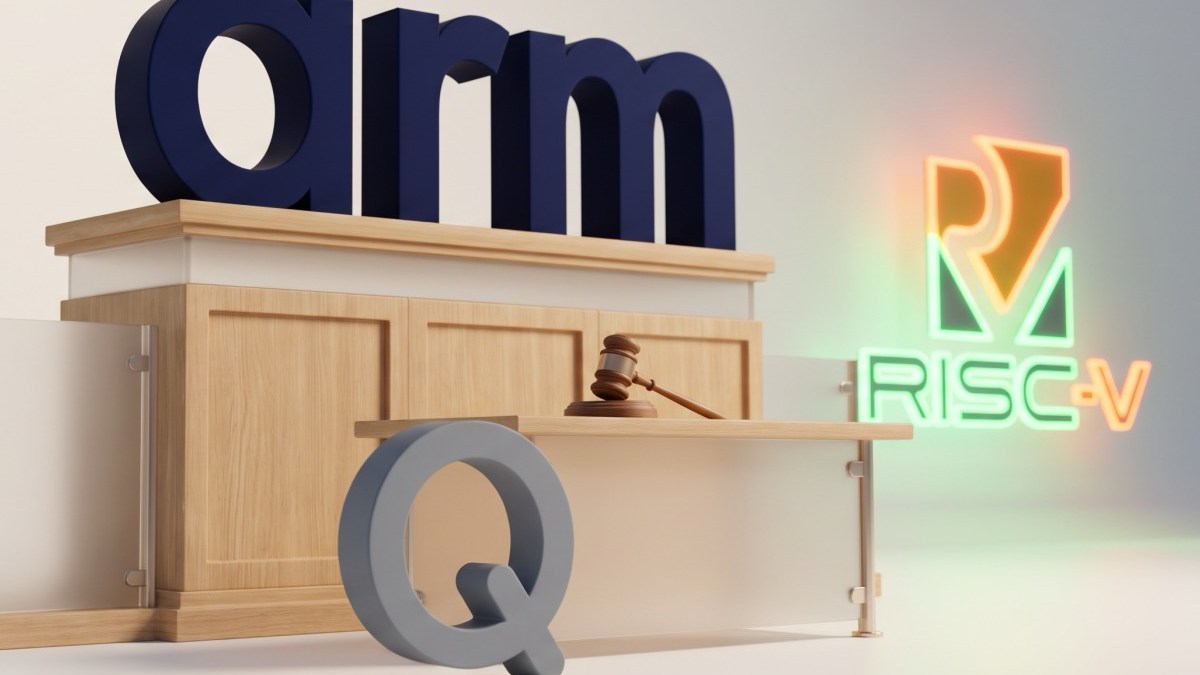
Arm comments on jury decision in Qualcomm trial
Following our initial coverage of the Delaware federal jury verdict in the Qualcomm and Arm dispute, Arm contacted EE Times to clarify the IP vendor’s position. In a phone interview with EE Times, Arm CMO Ami Badani dis…
以下正文同步自 Hacker News 最新,版权归原站所有,已转换为易读排版。
Following our initial coverage of the Delaware federal jury verdict in the Qualcomm and Arm dispute, Arm contacted EE Times to clarify the IP vendor’s position. In a phone interview with EE Times, Arm CMO Ami Badani discussed the company’s stance on the jury’s decision and the stakes surrounding licensing negotiations for Arm’s next-generation v10 architecture.
Badani contended that Arm emerged as a “victor” in court due to the nominal $2 damages award and the presiding judge’s reluctance to oversee future licensing terms, while emphasizing the ongoing technical and commercial collaboration with Qualcomm.
She also commented on the rise of other architectures such as RISC-V, as experts caution that restrictive proprietary frameworks may compel semiconductor designers toward open standards to meet the demands of evolving AI workloads.
Badani, who attended several proceedings in Wilmington, argued that the jury’s decision to award Qualcomm just $2 in nominal damages supports Arm’s position. The jury awarded $1 for a licensing breach and $1 for interference with Qualcomm’s business relationship with Meta, while finding for Arm on other allegations.
She argued that the minimal financial penalty supported Arm’s position that it operated in good faith throughout its licensing relationship with Qualcomm and that its conduct did not warrant substantial monetary damages.
Badani cited recent Bloomberg reporting on closing arguments in the case before U.S. District Judge Maryellen Noreika. During the hearing, Judge Noreika expressed strong reservations about Qualcomm’s request for the court to compel Arm to negotiate in good faith new licensing terms for its upcoming v10 architecture.
The judge characterized Qualcomm’s bid for judicial oversight of commercial terms as “very, very drastic,” remarking that the court would not step in to regulate Arm’s business practices or act as a regulatory supervisor.
Furthermore, Badani cited the court’s reluctance to dictate contractual rates or grant additional financial remedies as further support for Arm’s position. She also indicated that a final written ruling on the remaining antitrust and licensing claims could take several weeks, as both corporate parties complete their final written submissions for judicial review.
Despite the four-year court battle, Badani emphasized that Arm and Qualcomm maintain ongoing technical and commercial collaboration. She noted that, in Arm’s view, Qualcomm is not actively seeking further monetary compensation, but rather attempting to maximize the commercial and technical value derived from its ongoing licensing relationship.
Badani also directly addressed industry analysis suggesting that open-standard instruction set architectures, specifically RISC-V, are the primary beneficiaries of the legal conflict between two of the semiconductor sector’s largest partners. She rejected claims that RISC-V is capturing significant commercial market share from proprietary architectures in mainstream global markets.
According to Badani, RISC-V is not obtaining meaningful traction as an alternative processor architecture outside of China. She attributed its growth in China’s domestic market primarily to substantial state financial backing and direct government push, rather than organic commercial displacement of established instruction sets in international markets.
Her comments contrast with views from Qualcomm and prominent computer architecture researchers evaluating long-term hardware trends. Last week, Akeana, a U.S. semiconductor startup that designs processors using RISC-V architecture, was acquired by Qualcomm. Akeana’s CEO confirmed the acquisition in a LinkedIn post.
As AI algorithms and models advance rapidly, chip designers need flexibility to modify processor cores, add specialized microarchitectural features, and improve overall energy efficiency.
“As AI is evolving, chip designers need total flexibility to adapt their cores with new functions and improve performance,” Mateo Valero, director of the Barcelona Supercomputing Center (BSC), told EE Times. “Relying on closed ISAs such as Arm limits the freedom and the possibility to implement new capabilities and improve power consumption. Even the largest companies using Arm’s IP with full architectural licenses have difficulties optimizing their designs due to Arm’s tight conditions and limited support. That’s why we believe that open standard ISAs such as RISC-V offer the best alternative.”
Ultimately, Arm views the $2 nominal damages award and the court’s reluctance to intervene in licensing negotiations as validation of its good-faith practices. However, the implications of the four-year legal battle extend far beyond the Wilmington courtroom. Although Arm and Qualcomm continue to collaborate on technical matters and product roadmaps, the legal friction highlights a pivotal juncture for chip designers.
Qualcomm Wins Key Claims Against Arm, but Damages Total Just $2
RELATED TOPICS: AMI BADANI, ARM-QUALCOMM CASE, IP (INTELLECTUAL PROPERTY), JURY DECISION, LEGISLATION, PATENTS & LICENSING, RISC-V, SEMICONDUCTORS
COMPANIES: AKEANA, ARM, BARCELONA SUPER COMPUTING CENTER, QUALCOMM
Pablo is a seasoned engineer with 30+ years of experience. For over 10 years, he's been a contributing editor for EE Times (now editor of the Supply Chain section). He also wrote for EPSNews, InformationWeek, EBN, LightReading, Network Computing, and IEEE Xplore. His coverage spans Supply Chain, Semiconductors, Networks, IoT, Security, and Smart Cities. He holds an MEng, Electrical and Electronics Engineering from The Ohio State University. Follow Pablo on LinkedIn
You must Register or Login to post a comment.
This site uses Akismet to reduce spam. Learn how your comment data is processed.
正文由 探How 从来源站点 RSS 同步,内容未经改写;遇到排版缺失或需要图片、视频时请以原文为准。