There's No Such Thing as Society in the Objective Function
Last weekend I was back in London. I landed at Heathrow with ten minutes to catch the next Piccadilly line tube, and did what living in London for several years trained me to do: I overtook everyone off the plane, strol…
以下正文同步自 Hacker News 最新,版权归原站所有,已转换为易读排版。
Lauren Leek
Oct 26, 2026
41
5
5
Share
Last weekend I was back in London. I landed at Heathrow with ten minutes to catch the next Piccadilly line tube, and did what living in London for several years trained me to do: I overtook everyone off the plane, strolled unsuspiciously through baggage reclaim and customs with no baggage, and ran down the escalators. Needless to say, I made it with 30 seconds to spare.
Sitting on the tube, out of breath and very pleased with myself, I realised I couldn’t have told you what those 30 seconds were for. There was another one a few minutes later. I’d come back for the city I missed, its people and its energy, and spent my first ten minutes treating every one of them as an obstacle. My objective function had one term: me, on that tube. Everyone else was, in optimisation terms, a constraint.
We all do this. We hit the step count by pacing the kitchen at midnight, clear the inbox without really answering anyone, and, in my world, chase rankings instead of ideas. We optimise the number in front of us and forget what it was for.
Then I spent the weekend overhearing (oops) half of London complain, rightfully, about energy bills, water companies and the government. And I realised: governments do exactly the same. So I went looking through forty years of British laws and data to find out what governments actually optimise. It starts with a few lines of legislation almost nobody reads.
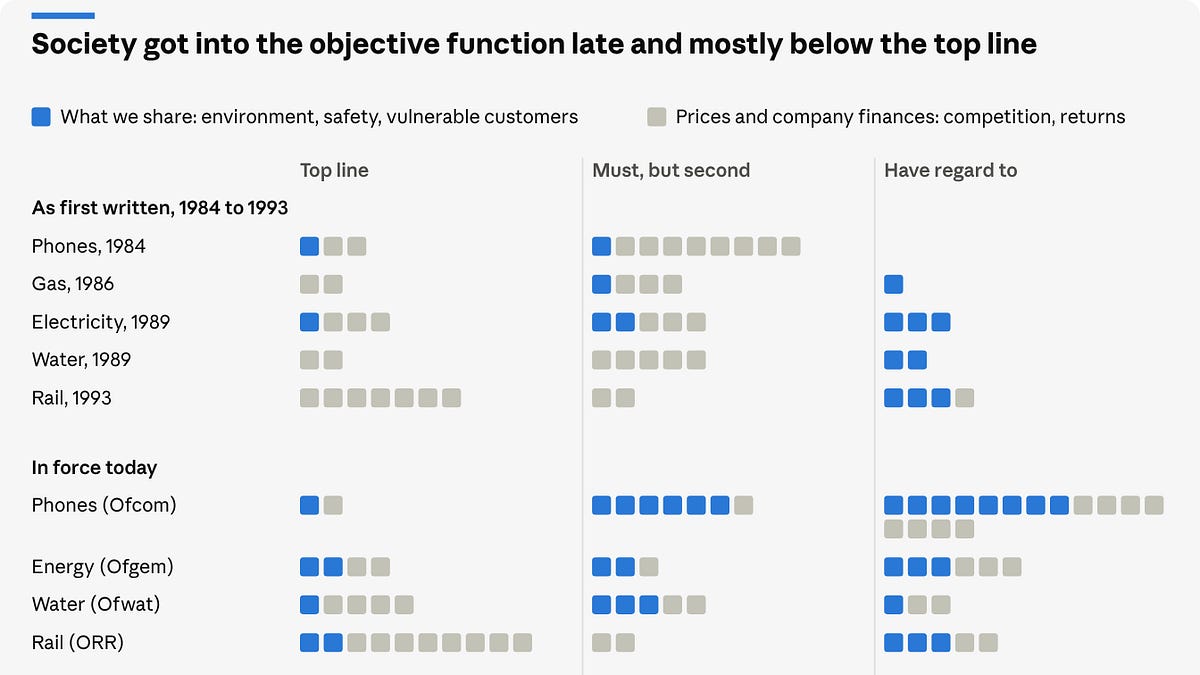
Britain’s regulators have something remarkably close to an objective function written into law, under the thrilling heading of “general duties”. I went through the original legislation from 1984–1993 and the versions in force today, coding each duty twice. First, what does it prioritise: the deal (prices, competition, efficiency, company finances) or society (the environment, safety, vulnerable customers)? Second, how important is it: a primary duty, a secondary one, or a “have regard to”, which is legal English for “bear it in mind”? The law electives I took in undergrad came in handy.
You can see a clear pattern. In the original laws, just 2 of 18 primary duties concerned society, compared with 9 of 10 “have regard to” duties. Society was, quite literally, the footnote. Forty years of amendments have brought that up to 6 of 21 primary duties, mostly by adding new obligations rather than rethinking the old ones.
Take Ofwat, the water regulator. Since 1989, its duties have included ensuring water companies can finance themselves, including earning reasonable returns on capital. Yet the words river, pollution and sewage don’t appear in its general duties.
Of course, this isn’t economy versus society. Cheap bills and financially healthy companies benefit everyone, too. The question is what happens when these objectives conflict. The law explicitly prioritises some, relegates others to secondary considerations, and leaves still others to different institutions. I think we can all agree that what gets written into the top line matters and so does what gets left out.
Every data science team I’ve worked in, whatever the sector, starts with the same question: what are we optimising? The answer is the objective function, the thing a system is told to get as good as possible at. A video app chases watch time. Google Maps, as I found when I scraped London’s restaurants, ranks places partly by “prominence”, helping decide which restaurants get seen and even survive. Private equity firms that own pubs chase returns, even when that means selling off places a neighbourhood relies on. And in Australia’s clubs with gambling machines/pokies in the basement, I found machines generating revenue to keep community spaces alive while extracting money from the very people who depend on them. Different systems, same problem: what’s good for the metric isn’t necessarily good for the people.
Britain’s public services got a new set of objectives under the woman the British collectively love to blame. In 1984, Margaret Thatcher’s government sold British Telecom; gas, water and electricity followed, and rail under her successor. But privatising a monopoly creates an awkward problem: how do you make a company behave competitively when its customers can’t easily go elsewhere? The economist Stephen Littlechild proposed RPI−X: prices could rise by inflation (RPI) minus an efficiency factor (X) set by the regulator. It was meant to “hold the fort” until competition arrived. In many services, competition never really did. The temporary fix became a lasting way of governing.
And here is where the objective matters more than who owns the company. A formula can reward lower prices, greater efficiency or financial stability. All reasonable things to want. But it doesn’t automatically account for what we value together, like a river we can swim in. Thatcher famously said there was “no such thing as society”. Her regulatory framework sometimes came surprisingly close to taking that literally (though, to be fair, the full quote goes on about looking after our neighbours).
So why not rewrite the objective? Because patching is usually easier. When something goes wrong, governments add a cap, a target or an exception. People adapt, another gap appears, and another rule follows. I also saw this in Britain’s gambling reforms: restrictions on betting machines helped empty the shops, but gambling increasingly moved online. The rules constrained one way of gambling without removing the incentives behind it.
In machine learning, exploiting the difference between a reward and its intended goal is called reward hacking. I call the regulatory response the patch loop: fix the visible problem, keep the underlying objective, repeat.
Forty years later, Britain’s original choices sit beneath layers of amendments and workarounds. And the consequences show up in some surprisingly familiar places.
Overheard by the river: “They put my bill up and they’re still dumping sewage in it.”
England’s water companies were sold in 1989. Thames Water is by now known for it’s bad financials since it despite supplying about a quarter of England with water, also carries roughly £20 billion of debt and is expected to run out of money by the end of 2026, yet in August the government shelved plans to take it into special administration.
What gets less attention is how the sewage figures are measured. In March the government celebrated a 35% fall in sewage spills in 2025. But the number it celebrated, spills per storm overflow, is the wrong objective. It counts spills rather than measuring whether rivers are clean, and it moves with something nobody controls: rain. So I set the Environment Agency’s spill figures against the Met Office’s rainfall record for England.
Rainfall alone explains 86% of the year-to-year variation, and it predicts about 9.5 of the 11.3-spill drop in 2025. The honest reading: a dry year did most of the work, and perhaps two or three spills per overflow are genuine improvement.
So the headline number mostly measures the weather. That’s what a wrong objective does: nobody has to cheat, and the system still reports progress every time the summer is dry, whether or not a single pipe has been fixed.
Overheard on a platform: “It’s cheaper if you buy two tickets. Don’t ask me why.”
Step outside London’s capped Tube and you meet the opposite: around 55 million different train fares, the leftovers of thirty years of franchise deals. That’s why Taunton to London can cost £105 on one ticket, or £42.70 on two split at Pewsey, same train, same seat. Apps now hunt these gaps for a living. To see where they are, I mapped the 20 routes with the biggest average savings from one platform’s analysis of 316,620 split-ticket bookings.
Not one of the top 20 starts or ends at a central London station. The money is on long cross-country journeys that stitch together several operators’ patches, and half of them cross into Scotland or Wales, where different bodies set the fares. The patch loop is also clear here: the 2026 fare freeze patches the price but keeps the 55 million fares, and the gaps between them.
Overheard at the school gate: “We had to take the council to tribunal just to get her the support.”
Support for children with special educational needs in England runs through a legal plan that councils must fund. Much of the specialist provision is now a private market: independent special schools cost councils an average of £63,000 a year per child, against £26,000 in a state special school, and the resulting deficits are kept off the books by an accounting fix extended to 2028.
The real numbers look exactly like a formula being beaten. I gathered fourteen years of tribunal statistics from four sources into one series:
Since plans were introduced in 2014, appeals have grown nearly eightfold, and families now win almost every case that reaches a decision. A threshold that loses 99% of challenges isn’t really a threshold; it’s a toll that only families with time, money or a good adviser can afford to pay.
Not the people beating the formula. The passenger splitting at Pewsey and the parent learning the appeals process are doing exactly what the system rewards. Mostly not the firms either, though some owners, like those who loaded water companies with debt, pushed it a long way.
The real culprit is an arrangement. Governments of both parties split each service three ways: the rule-maker owns the formula, the provider owns the service, and the citizen owns the workaround, so nobody owns the objective. And a formula is convenient since it looks neutral and lets ministers say “the regulator decided”.
That’s why changing the owner on its own doesn’t fix it. Nationalise a railway and keep its fare table, or put Thames Water into administration and keep Ofwat’s formula, and the loop carries on under new management.
Britain made me see this, but it isn’t British per se. I’m finishing this post in Jihlava, in the Czech Republic, where I somehow ended up a few times in the same conversation with complete strangers. After 1989, much of Central and Eastern Europe rebuilt its economies around a new set of objectives: privatisation, price liberalisation and competition. What was harder to score though was what happened to communities in these countries along the way.
And the same logic extends far beyond post-communist Europe. Countries chase GDP growth, central banks target inflation, hospitals count waiting times and universities climb rankings. None of these is a bad objective. The problem is what gets neglected when one number becomes the definition of success.
Some governments have noticed. The European Bank of Reconstruction and Development added inclusion and sustainability to its framework, and New Zealand introduced a wellbeing budget. But Wales went a step further. In 2015, it passed the Well-being of Future Generations Act, requiring public bodies to pursue seven goals, from a healthier population to cohesive communities and a resilient environment. It even appointed a commissioner to speak for people who haven’t been born yet. In other words, Wales tried to write society into the objective function itself. Whether that changes decisions on the ground is another question, but at least it changes what decision-makers are supposed to optimise.
So, this isn’t really about Britain, Thatcher or privatisation. Governments everywhere govern by setting objectives and delegating their pursuit to regulators, institutions and, increasingly, algorithms. The question is who gets to decide what goes into those objectives, and who notices what’s missing.
I somewhat forced an economist to read a draft of this post (I know, asking for trouble). He pushed back: most of these problems can be priced, and gaming the system is just what economists call search costs. His advice: find a better formula, not a new philosophy.
He’s half right. But economics itself has a warning about that approach. In 1991, Bengt Holmström and Paul
正文由 探How 从来源站点 RSS 同步,内容未经改写;遇到排版缺失或需要图片、视频时请以原文为准。