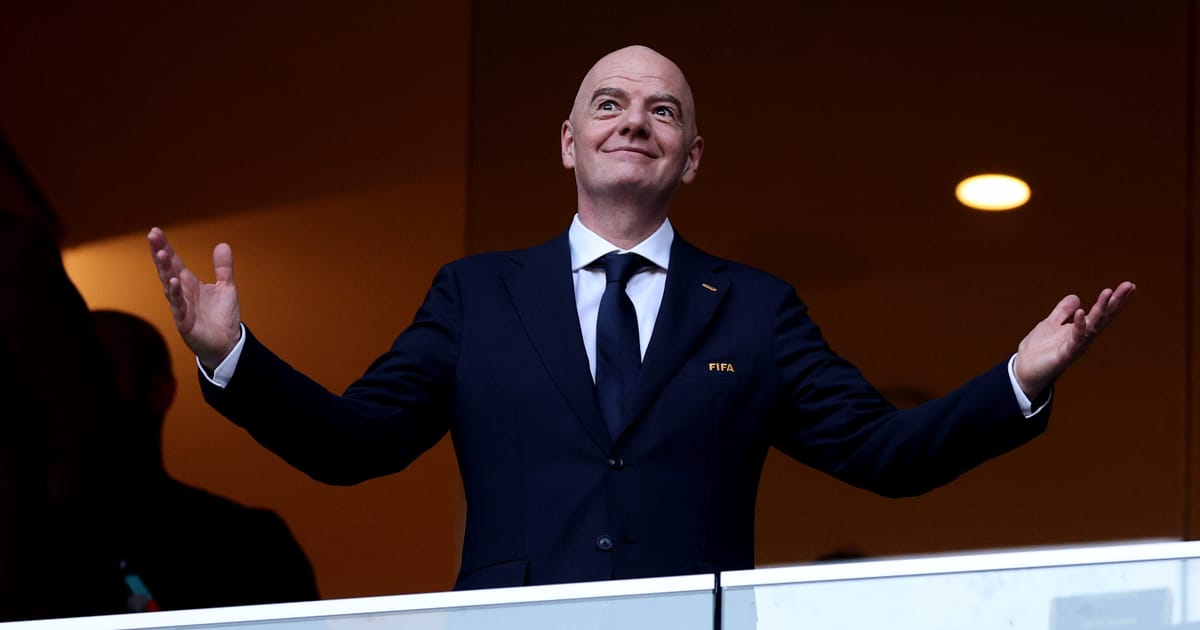
Why the EU avoids tackling Big Soccer
A languishing complaint against FIFA highlights the European Commission’s reluctance to take on sports antitrust cases.
以下正文同步自 Hacker News 最新,版权归原站所有,已转换为易读排版。
A languishing complaint against FIFA highlights the European Commission’s reluctance to take on sports antitrust cases.
A complaint lodged by the European Leagues professional soccer association in October 2024 accused FIFA of abusing its dominant position by imposing its international match calendar on other sporting stakeholders. It argued that FIFA’s dual role as a governing body and the organizer of its own competitions creates a conflict of interest, through which it enriches itself. The leagues broadened the complaint last month to cover the women’s game — but the Commission has yet to open formal proceedings.
Brussels has left the European Leagues complaint in the “freezer,” one senior EU official with knowledge of the file told POLITICO.
The episode underscores the Directorate-General for Competition’s long-running reluctance to open investigations into sports federations, which current and former European officials say is due to sport's special status in EU law — the treaties recognize its social and educational role — but also a deliberate policy choice to swerve potentially controversial cases in an emotionally charged sector.
Now, pressure is building against the competition department over the languishing European Leagues complaint, after a cross-party group of EU lawmakers urged the Commission to use its antitrust powers to rein in FIFA.
In a letter to European Commission President Ursula von der Leyen, obtained by POLITICO and copied to competition chief Teresa Ribera, MEPs called for action. Bruno Gonçalves and Hannes Heide (both from the Socialists and Democrats) and Bogdan Zdrojewski (from the conservative European People’s Party) asked the Commission to take formal action, including in relation to the complaint lodged by the European Leagues, which represents 53 men’s and women’s professional football leagues across the continent.
The MEPs say the governing body’s application of the calendar “raises concerns about FIFA’s use of regulatory powers to advance FIFA’s own commercial interests,” and that those powers “must be exercised through transparent, objective, non-discriminatory and proportionate procedures, with effective safeguards against conflicts of interest.” The EU’s top court set that test for sports bodies in its landmark 2023 Super League ruling.
“FIFA is both referee and promoter of the show,” Gonçalves told POLITICO. “We have to make sure the referee doesn’t put business before people.”
Representatives for the European Leagues pressed their case in a meeting with Competition Commissioner Teresa Ribera’s Cabinet in late April, but their overtures have so far been fruitless.
According to one soccer industry official close to the case, European Leagues also wrote to the Commission earlier this month urging it to open proceedings without further delay. The letter, described to POLITICO, accused FIFA of open defiance of EU law and the Court of Justice's case law, and argued that the Commission should not tolerate in soccer behavior it would not tolerate in any other industry.
“The thinking has always been, on the one hand, that sports has a special status, so it is not a market comparable to others that normally are scrutinized by the competition directorate,” said one former senior EU official, who was granted anonymity to discuss a sensitive file in order to protect relationships.
“But also, sports cases get very political and the Commission feels that member states tend to take the side of the federations so it’s hesitant to pick this fight up,” the former official added.
Over the last 15 years, Brussels has opened blockbuster investigations into Gazprom’s behavior in Central and Eastern European gas markets; whether Google illegitimately hindered the development and market access of rival mobile operating systems; and Apple’s rules for app developers.
But the Commission’s caution on sports is long-standing.
When then-competition chief Margrethe Vestager ordered the International Skating Union in 2017 to drop rules threatening speed skaters with lifetime bans for joining money-spinning rival events, she said the decision didn’t mean the Commission was “trying to be the referee in every dispute about sport.”
Many disputes, from doping penalties to deciding the precise scheduling of games, have “little or nothing at all to do with competition rules,” Vestager said at the time. National courts and competition authorities, she added, are “usually well placed to deal with competition disputes involving a sport federation.”
Those principles have since come to guide how the Commission’s competition department decides which sports disputes to take on. There is no shortage of candidates, with controversies in sports including tennis, padel and sailing, as well as soccer.
Any investigation would test recent case law. A pair of July rulings on FIFA’s agent rules went largely the governing body’s way. In those cases, the Court of Justice of the European Union accepted that federations can impose restrictions if they pursue legitimate aims proportionately.
Ben Van Rompuy, a competition law professor at Leiden University who helped bring the original ISU complaint, said there would likely be “little appetite” in Brussels to take up the leagues' case.
When the ISU complaint reached the Commission, courts had said little about how competition law applied to sport. Since then, “we’ve had an abundance of such guidance,” and “national enforcement in front of the courts seems to work,” Van Rompuy said. That leaves less reason for the Commission to step in. The leagues have also sued in a Brussels court, which suggests “they themselves believe that the national courts could protect their rights.”
Measured against the Commission’s own criteria for prioritizing complaints, the case looks weak, Van Rompuy said. Its impact on the EU’s internal market is “extremely limited,” he added.
Following publication of this article, a European Leagues representative clarified that the organization is not a party to the Brussels court case, which does not involve abuse-of-dominance allegations against FIFA. European Leagues said it is “determined to pursue all avenues to ensure that FIFA abides by well-established competition rules and to protect European national competitions and a key European industry from FIFA’s abusive behavior.”
FIFA declined to comment on the European Leagues complaint and the EU lawmakers' letter.
Commission spokesperson Ricardo Cardoso said international sports bodies have “a primary responsibility” for organizing global events, and that sport is mainly a matter for national governments, with the EU playing a supporting role.
When sports organizations act as undertakings, the EU legal term for entities carrying out economic activity, they are subject to the rules of competition, Cardoso said. He added that the Commission constantly monitors markets for possible breaches, and that “if any complaint is filed, the Commission will assess according to standard practice.”
Public and political criticism of FIFA has reached fever pitch over the last 12 months due to the governing body’s cozy relationship with U.S. President Donald Trump’s administration and an ultimately aborted plot this summer to sell off parts of the World Cup tournament to private investors.
According to the letter from EU lawmakers, FIFA President Gianni Infantino’s commercial sell-off scheme “exposed serious shortcomings in transparency, accountability and institutional decision-making.”
Related Tags
Antitrust
Companies
Competition
Competition rules
Competition/antitrust
Conflict of interest
Courts
Markets
Regulatory
Sport
Related People
Hannes Heide
Margrethe Vestager
Teresa Ribera
Ursula von der Leyen
Related Organizations
Court of Justice of the European Union
European Commission
Fifa
Our readers read next
Le Pen casts herself as protector of France as troubles swirl
3 HRS ago
4 mins read
Canada and Europe want to reshape the global order. But whose vision will prevail?
5 HRS ago
7 mins read
Leaked emails show AfD co-leader’s U-turn on ‘explosive’ nationalist colleague
12 HRS ago
6 mins read
Inside the cyber flaw scramble that brought the AI threat to life
Oct 24
7 mins read
More from Ali Walker
Ukraine brings war effort to football’s Champions League
“It’s a good time to invest in Ukraine, not from the point of view of big and easy money. It’s a great time to invest from the view of strategic security issues,” the club sponsor urged Europe.
Leonid Ragozin made remarks widely interpreted as making excuses for the Kremlin’s invasion of Ukraine and hybrid attacks in Europe.
“It is part of the pattern we see throughout Europe,” Danish Prime Minister Mette Frederiksen warned on Tuesday morning.
Years before Europe soured on him, Norway’s Lise Klaveness was already fighting FIFA’s president. Now she’s laying out how to rebuild FIFA without him.
正文由 探How 从来源站点 RSS 同步,内容未经改写;遇到排版缺失或需要图片、视频时请以原文为准。