Show HN: Ovok – FHIR R4 back end for remote patient monitoring apps
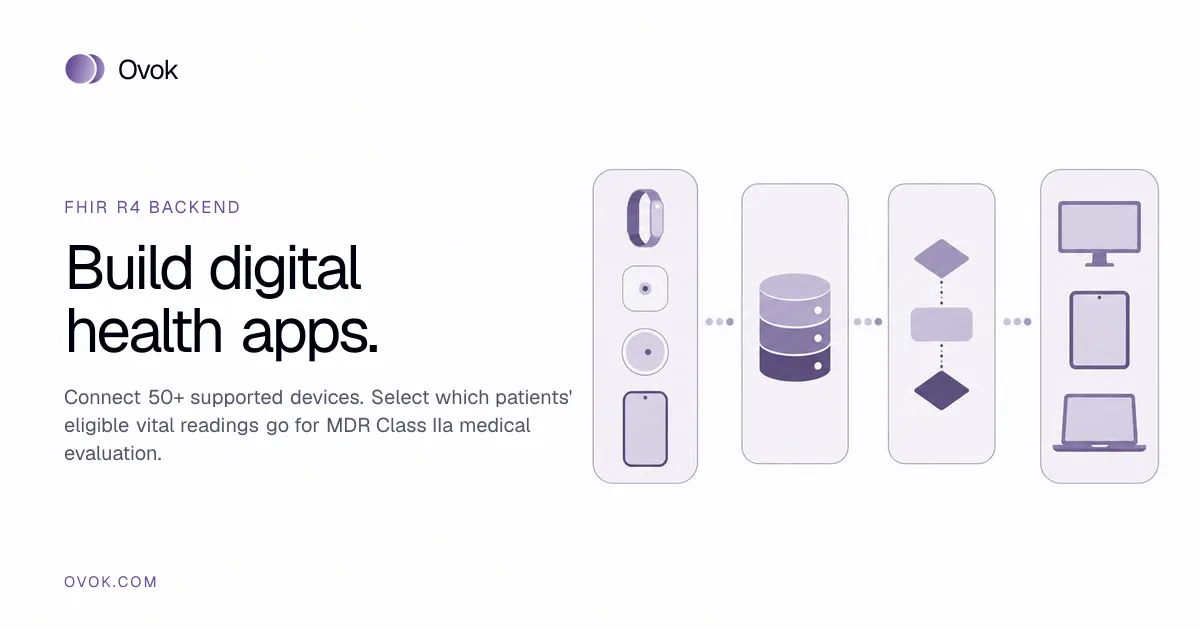
Supported-device data is stored in FHIR. Your team configures Signals enrollment per patient; only eligible vital-sign readings from enrolled patients are sent to Signals for alert evaluation.
以下正文同步自 Hacker News 最新,版权归原站所有,已转换为易读排版。
Supported-device data is stored in FHIR. Your team configures Signals enrollment per patient; only eligible vital-sign readings from enrolled patients are sent to Signals for alert evaluation.
Read the docs
Supported devicesExample destinations
Supported devices
BP monitors
Sleep radars
SpO₂ monitors
Urine analysers & wearables
FHIR backend
Signals
Example destinations
Your app
Clinician dashboard
EHR
Other systems
Signals enrollment is configurable per patient. Ovok stores device data in FHIR and forwards eligible vital-sign readings only for enrolled patients, for alert evaluation.
AWS Frankfurt hosting
Priced per monitored patient
Signals is MDR Class IIaOvok is not a certified medical-device product.UDI-DI: 42700031203-API-XG · EUDAMED search
Actimi network
Actimi works with the research, healthcare, and innovation organizations shown here.
Explore our remote patient monitoring use case, then build the web and mobile workflows your product needs with Ovok SDKs and platform services. We share new FHIR and connected- health articles on the Ovok blog as they publish.
Bring readings from 50+ supported devices, including BP monitors, sleep radars, SpO₂ monitors, urine analysers, and wearables. Explore our sleep monitoring use case and respiratory monitoring use case for related measurement workflows.
Build web apps with the React SDK and @ovok/core, or use the React Native SDK for mobile UI and integrations.
Build on FHIR, with access policies, CMS, video calls, and FHIR questionnaires.
Explore the out-of-the-box RPM app, then build from guides for CHF monitoring, type 2 diabetes, and medication reminders.
Signals evaluates eligible vital-sign readings for enrolled patients. Enrollment is configurable. Signals is MDR Class IIa.
Start with the FHIR and device infrastructure for digital-health startups, explore the platform for growing teams in our scaleup solution, or review the details for an enterprise deployment.
Evaluate the FHIR foundation and supported device data hands-on in the Developer sandbox.
Scaleups
Build on supported measurements and Signals as your remote monitoring product grows.
Enterprises
Review Frankfurt hosting, per-patient pricing, and commercial terms with Actimi.
Status labels distinguish available capabilities, documented implementation guidance, and roadmap work. Project capabilities and app-specific integrations still matter.
FHIR references cover lab orders and results; check your project’s CapabilityStatement for enabled interactions. The docs describe resource patterns, not a ready-made lab connector.
02In the docs
Medications
The medication guide covers plans, adherence, and local reminders. Ovok provides medication resources; your app schedules device notifications.
03Roadmap
Billing & RCM
Patient billing and RCM APIs are not available today. Billing support is deferred until a developer contract exists; no delivery date is published.
FHIR R4 APIs are available. The interactions enabled for your project are listed in its CapabilityStatement.
05Available
SDKs & modules
Use the web SDK or React Native SDK; optional native imports let your app include only the integrations it needs.
React Native SDK
06In the docs
Third-party tools
The LiveKit video-call API is documented. Scheduling, imaging, CRM, and other external systems need app-specific integrations.
Start building at your own pace.
Pricing is per monitored patient. Review per-patient pricing and plan details; every paid plan includes a data processing agreement.
Read the docs
Developer
For trying the sandbox
Growth
Start with GrowthScale
Start with ScaleEnterprise
Custom contract and Signals terms
正文由 探How 从来源站点 RSS 同步,内容未经改写;遇到排版缺失或需要图片、视频时请以原文为准。