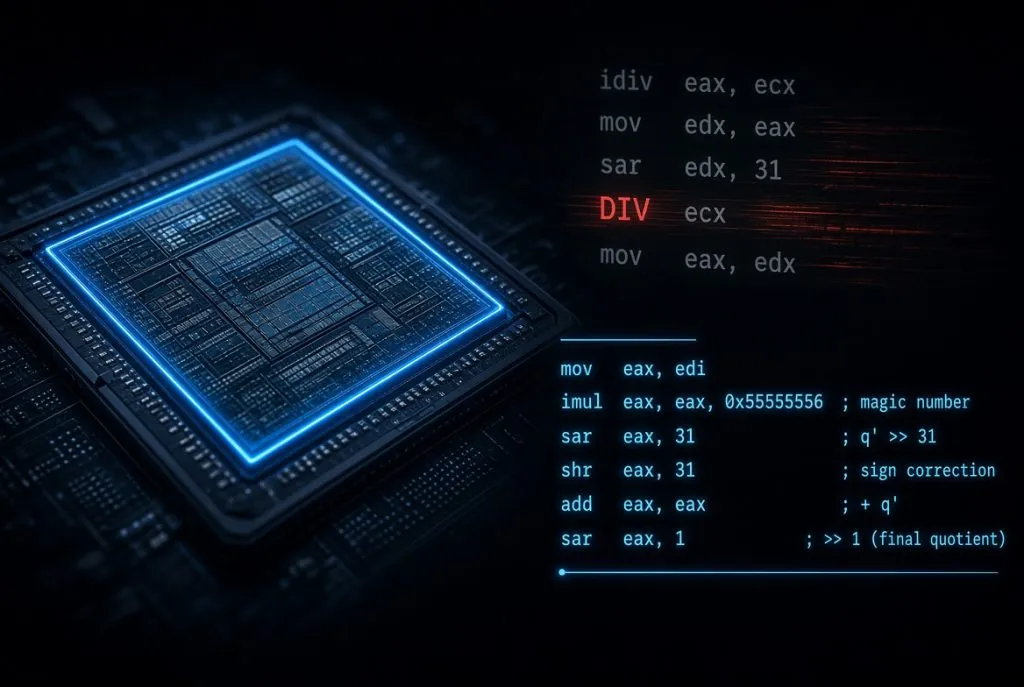
Beating the compiler at signed 32-bit division
Dividing integers is slow on our processors. A 32-bit division costs:
以下正文同步自 Hacker News 最新,版权归原站所有,已转换为易读排版。
Dividing integers is slow on our processors. A 32-bit division costs:
On Zen 4 and Zen 5, the latency depends on the inputs. The x86 rows are idiv (uops.info). The Apple row is sdiv (measurements).
A multiplication has a latency of 3 cycles. Emerald Rapids can do one every cycle. Zen 5 and Arrow Lake do three 64-bit multiplications per cycle (uops.info).
Thankfully, when the divisor is a constant, compilers replace the division by a multiplication and a shift (Granlund and Montgomery, 1994). Dividing by 7 is like multiplying by 1/7. In integer arithmetic, we multiply by an integer c close to 2s7 and we divide by 2s with a shift.
Can we do better than the compiler? With signed 32-bit integers on a 64-bit system, often yes.
Let us divide a signed 32-bit integer by 7:
int32_t div7(int32_t x) { return x / 7; }
GCC 14 produces the following code on an x64 processor:
movsx rax, edi imul rax, rax, -1840700269 shr rax, 32 add eax, edi sar edi, 31 sar eax, 2 sub eax, edi ret
It multiplies by a 32-bit constant, keeps the most significant 32 bits, and adds x back (add eax, edi). Then it shifts. The instructions sar edi, 31 and sub eax, edi add one when x is negative, so that the result is rounded toward zero, as C requires.
Why add x back? The ideal multiplier for 7 is 2454267027 which needs 33 bits. It does not fit in a signed 32-bit integer. So the compiler stores 2454267027−232=−1840700269 and it corrects the result by adding x. This is not rare: among the divisors between 3 and 1000 (excluding powers of two), 38% require this correction (376 out of 990). Over that range, GCC and LLVM pick the same multipliers, following Hacker’s Delight, Henry S. Warren, Jr.’s book of small algorithms for integers and bits.
But we are on a 64-bit processor! Multiplying a 32-bit integer by a 33-bit integer gives at most a 65-bit integer… but not with signed integers. The absolute value of a signed 32-bit integer is at most 231. Our multiplier needs 33 bits as a signed integer, but it is less than 232: it fits in 32 bits as an unsigned integer. So the absolute value of the product is less than 263, and it fits in a signed 64-bit integer.
We need to pick the multiplier. In a paper with Colin Bartlett and Owen Kaser (Integer division by constants: optimal bounds), we show (Theorem 1) that ⌊c⋅nm⌋=⌊nd⌋ for all integers n in [0,N] if and only if
We pick m=2s, the smallest power of two such that m≥d⋅231, and we round up: c=⌈md⌉. Then c⋅d−m<d and both inequalities hold for N=231. We get ⌊|x|d⌋ for all signed 32-bit integers x. For negative values of x, we compute ⌊c⋅xm⌋ and add one, as the compiler does. It works because c⋅|x|m is never an integer when x is not zero: if it were an integer k, the bounds would force |x|=k⋅d, and thus c⋅d=m, which is impossible since d is not a power of two.
template <int32_t d> int32_t div32(int32_t x) { constexpr int s = 31 + std::bit_width(uint32_t(d - 1)); // 31 + ceiling(log2(d)) constexpr int64_t c = (int64_t(1) << s) / d + 1; // ceiling(2^s / d) // floor(c * x / 2^s), plus one when x is negative return int32_t((int64_t(x) * c) >> s) - (x >> 31); }
I assume that the divisor is positive and not a power of two.
movsx rax, edi mov edx, 2454267027 shr edi, 31 imul rax, rdx sar rax, 34 add eax, edi ret
There is no correction step after the multiplication. The longest chain of dependent instructions is now movsx, imul, sar, add instead of movsx, imul, shr, add, sar, sub. The constant fits in 32 bits as an unsigned value, so loading it is cheap.
On ARM (Apple M4), the compiler gives us:
_compiler_div7: mov w8, #9363 movk w8, #37449, lsl #16 smull x8, w0, w8 lsr x8, x8, #32 add w8, w8, w0 asr w9, w8, #2 add w0, w9, w8, lsr #31 ret
and the new approach gives us:
_div32_7: sxtw x8, w0 mov w9, #9363 movk w9, #37449, lsl #16 mul x8, x8, x9 asr x8, x8, #34 add w0, w8, w0, lsr #31 ret
Why don’t compilers do it? I don’t know.
I divide 16384 random signed integers. In the throughput test, the divisions are independent. In the latency test, each division depends on the previous one. The latency includes two cycles of overhead (to make each division depend on the previous one). I disable autovectorization. I use an Intel Xeon Gold 6548N (Emerald Rapids) with GCC 14 and clang 21, and an Apple M4 Max with Apple clang 17.
Intel, cycles per division: throughput (latency)
Apple M4, nanoseconds per division: throughput (latency)
For 7, 60 and 365, the latency goes down by 2 cycles with GCC (10 to 8), and from 10.4 or 10.6 to 8 with clang. On the M4 it goes down by 12%. With clang on the Intel processor, the throughput improves by more than 20%. With GCC, the throughput does not change in my benchmark.
The divisor 1000 is a control. The compiler’s multiplier is 274877907, which fits in a signed 32-bit register, so there is nothing to add back. On the Intel processor both versions take 8 cycles. Each one starts with movsx, then a multiplication, a shift, and an add or a subtract.
On the M4, div32 is slightly slower: 1.77 ns against 1.57 ns. The compiler’s multiplier fits in a signed 32-bit register, so it uses smull, which sign-extends x as part of the multiplication. Our multiplier (2199023256) does not fit in a signed 32-bit register, so we need a separate sxtw instruction before the multiplication. Thus you should only use div32 when the compiler needs the correction step.
When the divisor is only known at runtime, the compiler cannot help and it emits the division instruction. Years ago, I wrote a small library, fastmod, that precomputes a 64-bit multiplier M, about 264|d|, once, and then divides with a multiplication. It is described in Faster Remainder by Direct Computation (Software: Practice and Experience, 2019).
Its signed division function treated M as an unsigned integer. Multiplying an unsigned 64-bit integer by a signed integer requires a correction when the signed integer is negative. The 0.1.0 code branches on the sign of x. On x64 the compiler leaves the branch in place. With random signs, it is often mispredicted: in my tests, that happens in 36% to 48% of the divisions.
The same observation applies: the absolute value of x is at most 231, and as long as |d|>2, M is less than 263. So a signed 64-bit multiplication gives the right answer directly. When |d|=2, we add x back. The new function has no branch:
int32_t fastdiv_s32(int32_t a, uint64_t M, int32_t d) { int64_t signed_M = (int64_t)M; int64_t highbits = mul128_s64_hi(a, signed_M) + (a & (signed_M >> 63)); // Round toward zero: add one when a < 0. int32_t q = (int32_t)highbits + (a < 0 ? 1 : 0); // Negate when d < 0. int32_t sign_d = d >> 31; return (q ^ sign_d) - sign_d; }
The function mul128_s64_hi returns the most significant 64 bits of the 128-bit product of two signed 64-bit integers: it compiles to a single instruction (imul on x64, smulh on ARM). The value signed_M >> 63 is zero unless |d|=2; it only depends on the divisor, so the compiler can compute it once, outside the loop. I released this change as fastmod 0.2.0.
Here are the results for a divisor (7) passed on the command line, with random signs. I report the time per division in nanoseconds: throughput (latency).
On the Intel processor, the previous version of the library was slower than the division instruction with random signs because of the mispredicted branches. The new version is four times faster than the previous one, and more than twice as fast as the division instruction. On the Apple M4, the previous version did not branch (the compiler computed both cases and selected one), so there is little difference in scalar code. However, without the branch, clang can partially vectorize a loop calling the new function: if I allow autovectorization, the new version takes 0.22 ns on the M4.
When dividing signed 32-bit integers on a 64-bit processor, there is a free bit. Compilers do not use it. For more than a third of the divisors, we can avoid two instructions on the critical path, and in a library that divides by a runtime divisor, we can avoid a branch.
This investigation was prompted by Ben Joffe’s recent post on fast floor division by constants, which you should read.
Daniel Lemire, "Beating the compiler at signed 32-bit division," in Daniel Lemire's blog, October 31, 2026, https://lemire.me/blog/2026/10/31/beating-the-compiler-at-signed-32-bit-division/.
https://lemire.me/blog/2026/10/31/beating-the-compiler-at-signed-32-bit-division/'> [BibTeX]
Copy
`;
modal.addEventListener('click', function(e) { if (e.target === modal) modal.close(); });
modal.querySelector('#bibtex-copy-btn').addEventListener('click', function() { const text = modal.querySelector('#bibtex-target').textContent; navigator.clipboard.writeText(text).then(() => { const origText = this.innerText; this.innerText = "Copied!"; setTimeout(() => this.innerText = origText, 1500); }); });
document.body.appendChild(modal);
const style = document.createElement('style');
style.innerHTML = dialog::backdrop { background: rgba(0, 0, 0, 0.5); };
document.head.appendChild(style);
}
// 1. Extract the URL
const fullLinkHtml = el.dataset.fullLink;
const tempDiv = document.createElement('div');
tempDiv.innerHTML = fullLinkHtml;
const linkElement = tempDiv.querySelector('a');
const rawUrl = linkElement ? linkElement.href : '';
// 2. Compute the current access date
const accessedDate = this.getCurrentAccessedDate();
// 3. --- NEW LOGIC: Extract ONLY the year (YYYY) --- // Gets the full date string, e.g., "November 23, 2025" const fullDateString = el.dataset.year; // Use regex to find the four-digit year at the end of the string const match = fullDateString.match(/(\d{4})$/); const publicationYear = match ? match[0] : '????'; // e.g., '2025' // 4. Generate BibTeX Data with the corrected year const safeTitle = el.dataset.title.replace(/[^a-zA-Z0-9]/g, '').substring(0, 15); // Use the clean year for the BibKey const bibKey = (publicationYear + safeTitle);
const content = @misc{${bibKey}, author = {${el.dataset.author}}, title = {{${el.dataset.title}}}, year = {${publicationYear}}, howpublished = {\\url{${rawUrl}}}, note = {Accessed: ${accessedDate}} };
// 5. Show Modal
document.getElementById('bibtex-target').textContent = content;
modal.showModal();
}
};
})();
Published by
Daniel Lemire
A computer science professor at the University of Quebec (TELUQ). View all posts by Daniel Lemire
正文由 探How 从来源站点 RSS 同步,内容未经改写;遇到排版缺失或需要图片、视频时请以原文为准。