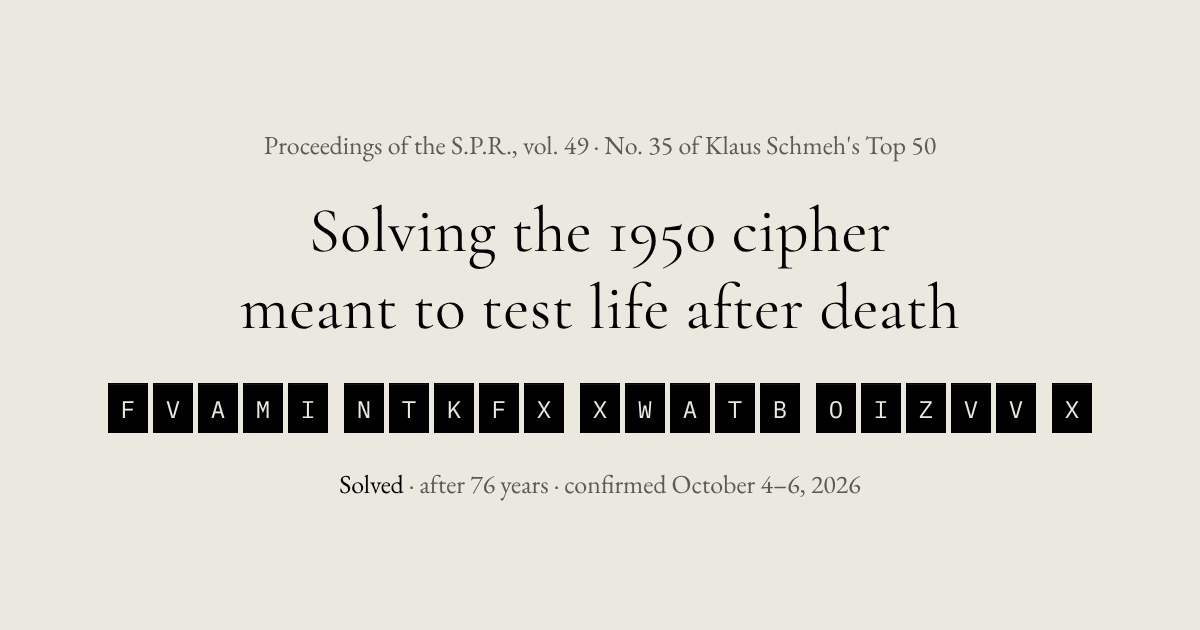
Solving the 1950 cipher meant to test life after death
The plan depended on keeping the key secret. Only Wood knew it, so if a medium produced it after his death, he hoped that would count as evidence that something of him had survived.
以下正文同步自 Hacker News 最新,版权归原站所有,已转换为易读排版。
The plan depended on keeping the key secret. Only Wood knew it, so if a medium produced it after his death, he hoped that would count as evidence that something of him had survived.
The idea came from the psychologist Robert Thouless, who had published an article titled “A Test of Survival” (Proceedings of the Society for Psychical Research 48, 1948) two years earlier. It contained enciphered messages whose keys only he knew, and one of them used a system meant to be unbreakable without the key. He showed how it works on a short example, the sentence THERE IS NO DEATH enciphered with Hamlet’s “To be or not to be” speech as the key.
The key is a passage of text taken from a book, and each word of it is used in turn.
Any word that has already appeared is skipped, so each key word is used only once. Here the second “to”, “be” and “the” drop out.
Each key word pairs with one letter of the message, so the 14 letters of THERE IS NO DEATH need 14 distinct key words.
Each letter is assigned a word from the phrase. The first pair is the message letter T and the key word “To”.
The letters of the word are added up (A=1 to Z=26), and 26 is taken off as many times as it fits whole. “To” adds up to 35, which leaves 9.
What is left names a letter by its place in the alphabet, where 1 is A, 25 is Y and 0 is Z. The 9th letter is I, so I is the key letter for T.
The key letter is then used to calculate a shift on each letter. For this method the count starts with A=0 or no shift, B=1 and so on. I is 8 places from A, so it means a shift of 8.
The message letter then moves that far along the alphabet, wrapping from Z back to A.
So T moves forward 8 places to become B, the first letter of the ciphertext.
The same happens for all 14 letters and the cipher is written in groups of five. Thouless’s printed version ends in B rather than D, a slip the article comes back to later.
Seen together, the message, the key and the cipher are the whole system. Anyone holding the key can run the steps backwards and read the message, and without it there is nothing to work from. This is the method Wood adopted for his own test.
T. E. Wood, a solicitor born in Yorkshire in 1887 who had practiced in Burma, answered Thouless with a message of his own in “A Further Test for Survival” (Proceedings 49, 1950). He published FVAMI NTKFX XWATB OIZVV X along with three clues:
If the key letters could be chosen freely, the same ciphertext could be made to say any message of the same length.
This sentence comes from Wood’s 21 letters under a freely chosen key. It reads well enough, and the key that produces it is gibberish.
A second key turns the same 21 letters into a second sentence. Nothing in the cipher itself prefers one reading over the other.
A third is just as readable. A sentence on its own would not tell you whether it was Wood’s, particularly one this short, so the key has to come from somewhere that can be checked.
Wood had given away one important thing, though. His key came from consecutive words in a published book, so a collection of books could be searched, one starting word at a time. Each spine here is one of the 129 books in that first search.
To test the search method we ran 100 ciphers with known answers through the same code and scored every decryption by how much it resembled English. The correct message came out on top in 97 of the 100 tests.
Wood’s message produced nothing readable, even after the search grew to 3,977 texts. Run on 100 random strings of 21 letters instead, the same search found a result in 12 of them that scored higher than anything it had found for Wood’s message.
The first search tested 28.6 million candidate keys from 129 publicly available books. We then added 3,848 Project Gutenberg books in 14 languages and tested about 429 million candidate keys, and the bigger library produced more tempting false leads, not a readable message.
The weakness was in the scoring. The search first compared five-letter patterns, then checked how well the strongest candidates split into English words. That gave us a way to rank possible readings, but every reading was being judged as English.
That left Wood’s clue that the message “will not be in any one language”. The next search looked for words in seven languages and let the language change from one word to the next. A quick check of letter patterns narrowed the candidates before the program tried splitting them into words, and the scoring favored common words while penalizing readings that chopped the string into tiny fragments or hopped between languages just to make the pieces fit.
Grouping with an English word list breaks it into fragments, while grouping with word lists in seven languages recovers VERSTEHT GEWISSE MINDER correctly.
We also needed a more targeted source. Wood had said the key came from “an accessible book” in a foreign language, and few books are more accessible than a Bible, so we added translations in 19 languages to the search.
The Bible run worked through the 19 Bibles word by word. For every possible starting word it built the key twice, once skipping repeated words and once keeping them, and it did all of that under two readings of the arithmetic, Thouless’s own rule and a common variant. That came to 26.7 million candidate keys for each reading, and the first pass took under three minutes.
Under Thouless’s rule, the top result came from the German Bible, starting at the sixth word of Matthew 6:9, the opening of the Lord’s Prayer. It scored well clear of the Romanian Bible in second place, and it decrypted to: HIER BIN ICH TOTSIENS TEW
The exact wording mattered. An earlier search had tried the German Lord’s Prayer in its familiar church form, beginning “Vater unser”, and found nothing. The Luther Bible’s “Unser Vater in dem Himmel” produces a different key from the very first word.
Separated into words, the letters read Hier bin ich, Totsiens and T.E.W. The first is German for “Here I am”, the second is Afrikaans for “Goodbye”, and the initials are Wood’s own.
Wood meant the message to be read after his death, once a medium had passed on the key. In it he announces himself, says goodbye, and signs his name. The key he would have sent back begins “Our Father in heaven”.
The key uses 21 distinct words, from “Unser” to “uns”. Four repeats are skipped (“Dein” twice, “Himmel” and “Unser” once each), and the ä in “täglich” is read as a.
Write a short message, give each of its letters a key word, and watch the cipher form the way it did for Thouless and Wood. The key can be a famous passage or words of your own, and no word is used twice.
The project was run by Colin Reilly. Robert Thouless designed the method, and Richard Bean’s 2019 solve of Thouless’s Message B, found by searching books by computer, showed exactly how it works and pioneered the approach used here. Klaus Schmeh kept the puzzle in view and confirmed the answer, and Richard Bean also confirmed the reading and helped improve this account of the search. The star of the show was Claude (Anthropic), which wrote the search code and found the key. GPT-6 Astra (OpenAI) checked the result independently.
To check the decryption yourself, run python3 harness/wood35t/verify_wood.py from the repository. The code is released under the MIT License.
What follows is the detail behind the solve, for readers who want to check it.
All 21 letters decrypt correctly and re-encrypt to Wood’s original ciphertext.
Before sending the result to Klaus Schmeh, we checked the decryption in several ways.
A short standalone script, using no other project code, rebuilds the key from the prayer text, decrypts all 21 letters, and re-encrypts them back to Wood’s exact ciphertext. OpenAI’s Astra, working separately, reproduced all 21 letters.
How likely was a hit like this by chance? A follow-up run tried about 854 million trial decryptions across 3,847 Gutenberg books and 19 Bibles, looking for dictionary words followed by a three-letter signature. With TEW as the signature there was exactly one match, this message, and only 7 of 500 random signatures produced a match at all.
Astra’s full review of the decryption is in the repository.
Each trial in the chance test had to split 18 letters cleanly into dictionary words of 3 to 10 letters. The run covered both versions of the arithmetic, with and without repeated words, and the matches for the random signatures (1.4%) were word salad.
There are two caveats. TOTSIENS was added to the word list after the solve, and the test itself was designed after the hit, so it shows that the match is rare, which is not the same as proof.
Scans of Wood’s 1950 article and Thouless’s 1948 article confirmed the ciphertext, the method, and Wood’s clues word for word. They also settled one detail we had been unsure of, that the rule “A means no shift” comes from Thouless’s own text and not from a later guess.
Searches of Schmeh’s blog and its comments, Reddit’s r/codes, and the other 2026 solver logs turned up no earlier solution of Wood’s cryptogram, though that is not proof that nobody got there first.
While checking the method against the 1948 paper, we found an arithmetic slip in Thouless’s own worked example. It has been in print for 78 years, and as far as we can tell nobody has pointed it out.
To show how his system works, Thouless enciphered THERE IS NO DEATH with Hamlet’s “To be or not to be” speech as the key. He printed the key letters IGGWW BG PI VNWNU and the ciphertext BNKNA JYCWY RWGB.
The first 13 key letters are right, and the 14th key word is “suffer”. Its letters add up to 19+21+6+6+5+18 = 75.
75 = 2 × 26 + 23, so the key letter should be W, the 23rd letter. Thouless printed U, the 21st.
His printed ciphertext follows the printed U, so this is not just a misprint. The 14th plain letter is the final H of DEATH, which becomes B when shifted by U, as he printed, but D when shifted by the correct W.
The last group of his example should therefore read RWGD, not RWGB.
Wood, for his part, followed Thouless’s written rule correctly. All 21 of his key letters agree with it, and that is the method that decrypts his message.
正文由 探How 从来源站点 RSS 同步,内容未经改写;遇到排版缺失或需要图片、视频时请以原文为准。