My Working Model of Consciousness
[Disclaimer: heavily edited by Claude Opus 4.6]
以下正文同步自 Hacker News 最新,版权归原站所有,已转换为易读排版。
Federico R. Cassarino
Feb 22, 2026
2
1
Share
[Disclaimer: heavily edited by Claude Opus 4.6]
Some friends have been asking me to explain how I think about consciousness, and it’s made me realize how layered and idiosyncratic my view has become. There’s a somewhat pretentious concept from LessWrong called inferential distance—the number of intermediate steps it takes to get from someone’s existing world-model to the point you’re making. The gap between how most people tend to think about consciousness and how I currently do feels wide enough that it’s hard to unpack casually in conversation. So I wanted a place to lay out the reasoning in full. That’s what this is.
The major influence on this piece is the Qualia Research Institute—especially Andrés Gómez-Emilsson. To be blunt, much of this article is a direct lift of QRI’s core framework, reframed in my own words. There’s not much structurally original here.
Other influences include secular Buddhists like Nick Cammarata, Roger Thisdell, Rob Burbea, Sam Harris, Daniel Ingram, and Shinzen Young, as well as the broad Slate Star Codex / LessWrong ecosystem, which shaped a lot of the background assumptions.
OK. Let’s get started with some building blocks.
Before going further, let me establish some terms. Phenomenology is the study of conscious experience—what it’s like to experience something, from the inside. Qualia are the individual qualities of that experience: the redness of red, the painfulness of pain, the specific felt quality of any sensation, emotion, or thought. When I talk about qualia, I mean the raw stuff of experience—the textures, colors, feelings, and sensations that make up what it’s like to be you at any given moment.
These aren’t abstract philosophical concepts. They’re the most immediate, undeniable things in your existence. Right now, you’re having qualia. The visual field in front of you, the feeling of your body, the mood you’re in—all qualia. It’s the phenomenal character of experience.
The first thing I want to (somewhat arrogantly) claim is that most people who haven’t spent a serious amount of time meditating and closely examining their own experience are usually pretty confused about how consciousness and phenomenology actually work. It’s just very hard to think clearly about this stuff without that kind of background.
Peak experiences that show you how radically different your conscious experience can be from the default are also a huge unlock. Whether that comes through direct observation via meditation, spontaneous mystical experiences, or psychedelic-induced ones—any of these can crack open the assumption that the way things normally seem is the way things are. If all you’ve had is ordinary day-to-day experience, and you’ve never questioned it through any of these means, a lot of this is going to sound very theoretical, because you don’t fully grasp just how different experience can be.
This one is a foundational building block for me. Most people have a hard time grokking this, and it causes a lot of confusion.
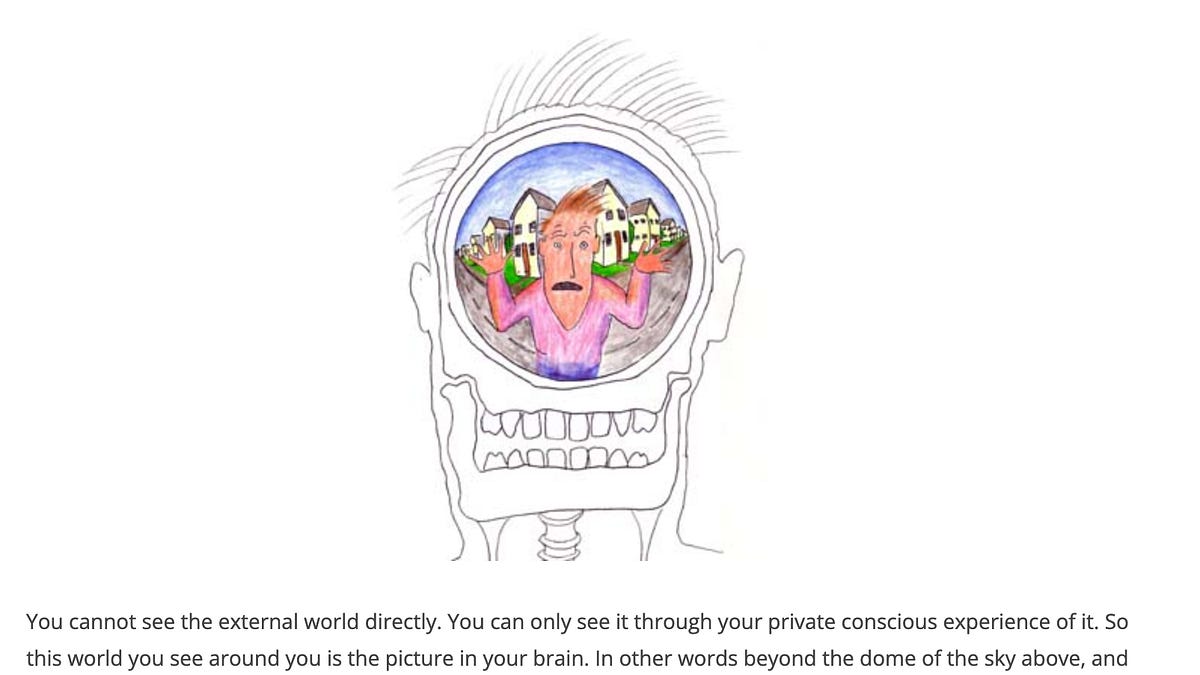
Here’s what it is. We are not seeing the physical world. We are seeing a world-simulation that our brain generates. You are never, ever, ever directly looking at something outside your brain. Everything you experience—everything you see, hear, think, and feel—is part of an internal representation your brain produces. As QRI puts it: we don’t perceive the world per se; our brains instantiate a world-simulation.
First, the causal chain. When you look at a chair, photons bounce off the chair and hit your retina. Scientifically minded people sometimes intuit that they are, in some sense, “seeing” those photons that hit their retina. But you’re not. The photons stop right there. They die at the retina. The photons trigger electrical signals in your optic nerve, which travel to the brain, where a series of processing steps happen—and at the end of all that, your brain generates an image of the chair. The image is the brain’s product. There are many steps between the chair out there and the experience of the chair in here. Your brain is sealed inside a completely dark, silent vault of bone. It has never seen any light. It has never heard any sound. It only receives electrochemical signals—like a prisoner locked in solitary confinement, getting Morse code tapped on the wall from the outside world, and from those blind taps having to guess what's happening out there. So when you see a chair, you’re seeing your brain’s representation of it—in the same way that if somebody shows you a picture of a chair, you’re not seeing the actual chair, you’re seeing the picture.
This applies to your own body too. When you look down and see your hands, those aren’t your actual hands. Your actual hands are out there, beyond the canvas of your conscious experience. What you’re seeing is a representation your brain produces—one that maps, to some extent, to what your hands are doing out there, but is not the hands themselves. “The little man at the center of our world of experience is not the observer of the internal scene. It is merely an object, made of the same substance as is the rest of the perceived scene, because that scene would be incomplete without a replica of our own body in the world”
The implication: Everything you experience is a render happening inside your brain. You have no direct access to anything out there. You are only ever looking at your brain’s output.
The person who has done the most to make this intuitive is Steven Lehar, through his illustrated dialogue “Cartoon Epistemology”. His signature idea is the “bubble world”—your entire phenomenal experience is like a volumetric bubble your brain generates, with its own spatial structure. It’s like a diorama or a theatre set: finite in volume, with a geometry where nearby things are rendered in rich detail while distant things are compressed and eventually painted onto the dome of the sky. You’re always inside this bubble. You aren’t a guy watching the bubble—you are the bubble.
The normal conscious experience we have is just a default. Consciousness can in principle render almost anything.
The most mundane example: dreams. Every night your brain generates a fully convincing phenomenal world while you’re asleep, with no external input at all. You have a conscious experience of being somewhere you’re not—flying through the air like Superman, visiting a place you’ve never been. That alone proves your brain can generate complete experiential worlds from scratch.
Another example: meditative absorption states called the jhanas. In a deep version of the first jhana, you lose all sense of your body and just feel a fully uniform field of pleasurable sensations. No memories. No thoughts. No sense of who you used to be. All you are is a uniform field of finer, pleasure-filled somatic sensations enveloping your entire canvas of consciousness. Everything you’re used to can go away, and you can just be that. You might not have experienced this, but people do it reliably and repeatedly. It is a real conscious experience that the brain can render.
Or take the example of a psychedelic like DMT. Instead of your normal day-to-day experience, you find yourself tunneling across a “hyperspace”-looking world, through impossibly complex geometrical fractal shapes, meeting impossibly complex, fractal-looking, clockwork-seeming creatures. That becomes your conscious experience.
Here’s something important to consider, especially for people whose only non-standard conscious experience has been dreams. Dreams are hazy, hard to remember, and clearly less vivid than waking life in retrospect. That makes them easy to discount: “It was just a dream—I couldn’t tell at the time, but it clearly didn’t feel that real.” People assume that because the only altered states they’ve had are dreams, or maybe alcohol or cannabis, all non-standard experiences must be similarly hazy and irreal. It makes it much easier to not be surprised by them or take their implications seriously. But in the same way that a dream or your imagination feels less vivid than regular life, there are peak experiences that feel more vivid. “Vividness” is just another qualia dial—it doesn’t inherently mean more or less real. But on psychedelics or during meditative absorption states, that dial is turned way up compared to normal day-to-day consciousness.
The point: your brain can in principle render almost anything you can conceive. The normal waking experience is also a generated world—it just happens to be constrained by sensory input. A good way to think about it is that your conscious experience canvas is like a 3D engine—it can be used to render an infinitely varied range of experiences. And this actually happens to people all the time. Mystical experiences happen all the time. Phenomenologically, this is just a fact. You can experience a wide range of qualia.
So far we’ve established that conscious experiences can vary enormously. But we all share a fairly specific default conscious experience, and we know it’s somehow generated by the brain.
How do we put this together? We know our conscious experiences are generated by the brain because we can change things about the brain and the experience changes. Turn off a part of the brain, the experience stops. Alter the chemistry, the experience shifts. There’s clearly a mapping between the brain and the contents of consciousness.
Why is the default experience the particular one we have? Because evolution harnessed the fact that organisms can produce qualia, and shaped it into something useful for survival. Whatever the substrate of conscious experience is—whether physical, whether it emerges from the physical, whatever—there’s a mechanism where conscious contents map to physical processes in the brain. Evolution took that mechanism and sculpted it over billions of years to help organisms navigate their environment, avoid threats, find food, reproduce. This does imply that there must be “some” fidelity, at some level, between what we experience and what’s actually out there. It’s not arbitrary that the experience is what it is. There’s a reason the brain makes us see what we see. Think of the earliest conscious beings—maybe the first experience of consciousness was noticing warmth or cold, because that lets you make creatures that move toward warmth.
Think of your computer desktop. You have a little trash can icon. That icon is useful—it lets you delete files. But the real file isn't a tiny piece of paper sitting inside a tiny plastic bin. The real file is a complex sequence of zeros and ones on a physical silicon chip. If the computer actually showed you the zeros and ones, you couldn't use it. You need the icon. Our visual reality works the same way—the trees, the cars, the people are all desktop icons. They are user-friendly evolutionary shortcuts designed to help us navigate a universe of quantum fields without tripping over our own feet. We aren't seeing reality—we are seeing a dashboard.
Why there has to be conscious experience at all, rather than just processes with no qualia, is a different question. But as long as there is some, evolution can harness it. For more complex beings—mammals, say—evolution created more: emotions, sensations, pleasure and pain, aversion, responses to stimuli that are most likely to preserve the organism.
And the sense of modeling oneself—”that’s me in the mirror,” “I can look down and it’s me”—is yet another evolutionary innovation for survival and reproduction.
So there must be something in our experience that corresponds to some extent to what’s out there. But you’re not actually directly in touch with it, and we have to be wary about how much fidelity there really is, or whether fidelity is even a useful concept here.
This is a good place to introduce what I think is the best model in current neuroscience for how the brain does all this: predictive processing.
The basi
正文由 探How 从来源站点 RSS 同步,内容未经改写;遇到排版缺失或需要图片、视频时请以原文为准。