A (lukewarm) defense of Minsky and Papert
In the history of AI as told in “Introduction to Neural Networks”-kind of courses, Minsky and Papert usually play the villains. The story goes that Frank Rosenblatt's first training of a Perceptron in 1957 generate…
以下正文同步自 Hacker News 最新,版权归原站所有,已转换为易读排版。
Federico Milanesio
Oct 28, 2026
Share
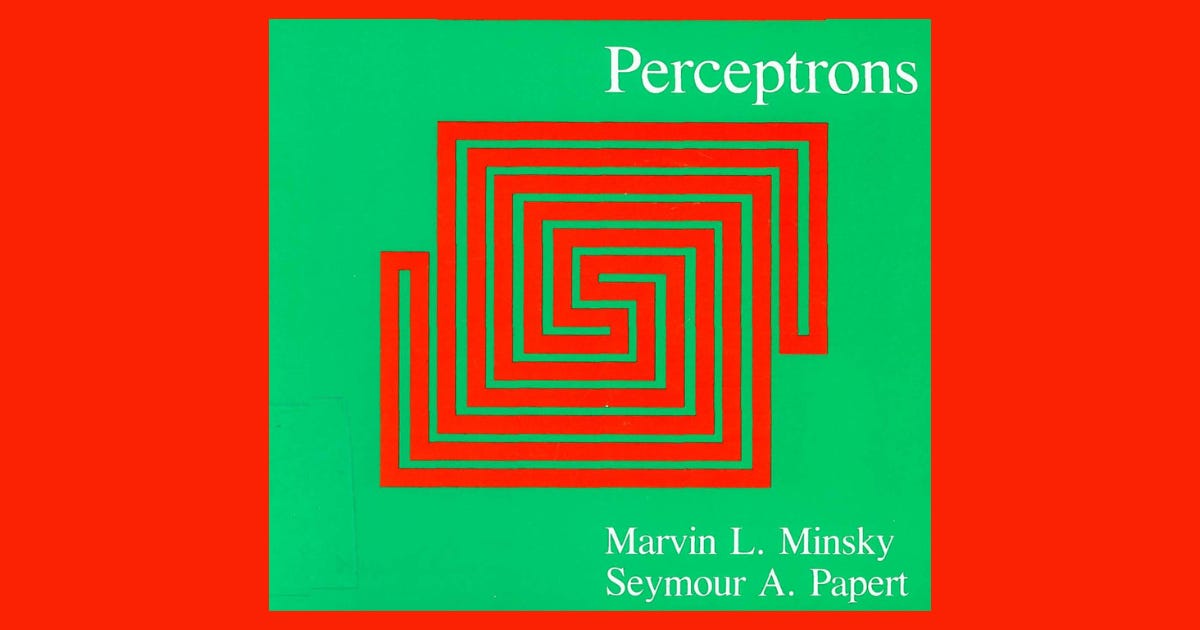
In the history of AI as told in “Introduction to Neural Networks”-kind of courses, Minsky and Papert usually play the villains. The story goes that Frank Rosenblatt's first training of a Perceptron in 1957 generated quite the enthusiasm about AI’s possibilities, with large public and private capital investments and increased research interest. But this changed after Minsky and Papert’s publication of their book Perceptrons in 1969, which supposedly caused the first AI winter, a period when neural network research stalled because of reduced interest and funding. I want to challenge this view by showing how the type of AI they opposed was already faltering because of its own theoretical limitations, and interest in neural networks had already declined by the time Perceptrons came out.
“In from three to eight years we will have a machine with the general intelligence of an average human being. I mean a machine that will be able to read Shakespeare, grease a car, play office politics, tell a joke, have a fight.”
This is what Minsky said to LIFE in November 1970, one year after publishing Perceptrons. From the same interview:
“Man’s limited mind may not be able to control such immense mentalities.”
And what of the people in the Pentagon who are footing most of the bill in Artificial Intelligence research? “I have warned them again and again,” says Minsky, ‘‘that we are getting into very dangerous country. They don’t seem to understand.”
Of course, people were not quite convinced, and he was wrong about the timeline, but no one can deny he was an AI enthusiast. Minsky started working on neural networks in the 1950s, when he built SNARC, a form of recurrent network trained with Hebbian reinforcement learning, and was a main organizer of the Dartmouth workshop in 1956. So, why would one consider this father of Artificial Intelligence the cause of the first AI winter?
The answer was the divide between symbolic and connectionist AI. Symbolic AI encodes information at the representation level starting from pre-existing human knowledge, and manipulates it sequentially using logic rules and explicit algorithms. Connectionist AI is the more data-driven approach, where rules are inferred from examples using perceptrons, neural networks, or other biologically inspired parallel architectures1. By the early 1960s, the two paradigms were locked in a struggle for dominance, with neither being clearly better than the other. Today, connectionism has won (with all its advantages and disadvantages), so the history of AI is told through its lens.
While Minsky work on SNARC was deeply connectionist, by the 1960s he became convinced of the symbolic approach's superiority, and worked with Seymour Papert on The Society of Mind (which became a book in 1988). The details of their work are irrelevant for this discussion; what is important is that their ideas put them in indirect competition with Rosenblatt, the main connectionist exponent. Around 1965, Minsky started attending conferences and circulating preprints to argue about perceptrons’ limitations, including the infamous XOR problem2.
And connectionism was actually losing ground. People already knew that perceptrons could not solve XOR-like problems. But multi-layer networks could (universal approximation theorems date back to McCulloch and Pitts, and that the addition of a hidden layer is enough to solve parity was already shown in Chapter 13 of Perceptrons). The problem was that no one could figure out how to train these additional layers. Rosenblatt tried random weights, and Widrow and Hoff proposed the MADALINE Rule I, both with scarce success. Of course, adding an ad hoc first layer could solve XOR, but that was precisely the point of the symbolic approach: the solution needed human knowledge. The trick actually needed, differentiable activations with backpropagation, was still two decades away.
Perceptrons dedicates around four of its more than 200 pages to multi-layer networks. As summarized in the 1988 epilogue:
Perceptrons could learn anything that they could represent, but they were too limited in what they could represent.
Multilayered networks were less limited in what they could represent, but they had no reliable learning procedure.
At the time, the learning procedure for perceptrons was clear and known to always converge to a solution, if such a solution existed, in finite time. Thus, the book focuses on a general theory of what perceptrons could represent, and, to a lesser extent, on convergence analysis. For the time, I think that was fair, given that no technical solution was known to train multi-layer networks. But when it came out, it was mostly a victory lap. As Bernard Widrow said:
“We had already stopped working on neural nets. As far as I knew, there wasn’t anybody working on neural nets when that book came out. I couldn’t understand what the point of it was, why the hell they did it. But I know how long it takes to write a book. I figured that they must have gotten inspired to write that book really early on to squelch the field, to do what they could to stick pins in the balloon. But by the time the book came out, the field was already gone. There was just about nobody doing it.”3
Minsky and Papert agree. In the prologue to the 1988 version, they write:
This style of analysis was the first to show that there are fundamental limitations on the kinds of patterns that perceptrons can ever learn to recognize. How did the scientists involved with such matters react to this? One popular version is that the publication of our book so discouraged research on learning in network machines that a promising line of research was interrupted. Our version is that progress had already come to a virtual halt because of the lack of adequate basic theories, and the lessons in this book provided the field with new momentum albeit, paradoxically, by redirecting its immediate concerns. To understand the situation, one must recall that by the mid 1960s there had been a great many experiments with perceptrons, but no one had been able to explain why they were able to learn to recognize certain kinds of patterns and not others. Was this in the nature of the learning procedures? Did it depend on the sequences in which the patterns were presented? Were the machines simply too small in capacity?
By 1969, symbolic AI was way on its way to becoming the dominant paradigm, and would be so for the following decade. If the 70s saw a winter, it was not for all AI. But it was surely for neural networks, which kept being studied only by smaller groups with less funding.
By 1988, the struggle between symbolic AI and neural networks had resumed, and momentum shifted. As anticipated, the connectionist paradigm would emerge as dominant. But Minsky and Papert were still very skeptical, to the point of republishing Perceptrons in 1988 with additions, namely the Prologue and Epilogue, focusing on multi-layer networks.
Roughly in order, and rephrased with modern terminology, their main objections were:
gradient-based methods can get stuck and not converge to the global minimum
high-dimensional spaces require exponential scaling of data to be properly sampled
connectionist architectures are quite opaque about what was actually learned, and knowledge might be hard to distill and transfer
an incomplete training set might not generalize well on new samples
These concerns were reasonable, and maybe even ahead of their time. In the end, connectionism won because it just works, and it is a practice-driven field, with most of the theory coming quite late. Minsky and Papert arguments were valid then, and continue to be relevant today. When we write the constructivist history, Perceptrons represents a conflicting paradigm, now surpassed4, and no one focuses on its mathematical arguments or impact on the community.
“If you like somebody’s work, just go and see them. However, don’t ask for their autograph. A lot of people came and asked me for my autograph, and it’s creepy. What I did is read everything they published first, and correct them. That’s what they really want. Every smart person wants to be corrected, not admired.”5
That is what he thought he was doing with Perceptrons. He got all his maths right, and, in the end, his paradigm still lost. But to have more critics like him…
The maybe-too-negative blog post The perceptron controversy, by Yuxi Liu
A Sociological Study of the Official History of the Perceptrons Controversy
by Mikel Olazaran, Social Studies of Science Vol. 26, No. 3 (1996)
In some sense, symbolic AI is Platonic; connectionism is Aristotelian.
To be honest, neither the book nor, apparently, Minsky public conference speaking focused much on the XOR, privileging, among other things, the problem of connectedness.
From Rosenfeld, Edward, and James A. Anderson, eds. 2000. Talking Nets: An Oral History of Neural Networks. Reprint edition. The MIT Press.
The society of mind. Lecture 6. Layers of mental activity, minute 25.
正文由 探How 从来源站点 RSS 同步,内容未经改写;遇到排版缺失或需要图片、视频时请以原文为准。