If you only read one Robert Caro book
rating the five existing books while we wait for the sixth one
以下正文同步自 Hacker News 最新,版权归原站所有,已转换为易读排版。
Translate
If you only read one Robert Caro book
rating the five existing books while we wait for the sixth one
Minh-Anh Day
Oct 15, 2026
Share
Over the last year, I’ve read all of Robert Caro’s books, starting with The Power Broker (Caro’s biography of Robert Moses, the master builder of New York City), then Working (his semi-memoir about how he writes his books), then The Years of Lyndon Johnson or, more accurately, the first four volumes of that work, since the final volume has yet to be completed.
According to every professional review of his biographies, every one of them is a masterpiece. This is accurate. If you have the time and the inclination to read all of them, I would highly recommend it. Just rereading snippets of them to write this made me want to read them all again.1 That being said, if you don’t want to read 4,711 pages of biography, you can read just one or two of the books — Caro does an excellent job of providing the necessary context within the Johnson series so each book stands on its own. If you were to read just one of them, which one should you read?
I’m rating these on three scales: how much fun they were to read, how much I learned about how the world got to be where it is, and how much they helped me understand the mechanics of political power.
Fun to read: 7
Historical education: 10
Political education: 9
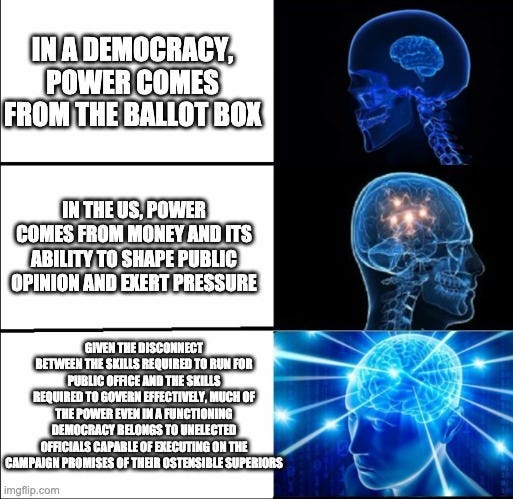
My friend recommended this to me as one of the best books to understand how political power works in the United States — I would argue that all five books fall into that category, but this is probably the best book to read if you’re under the impression (as I was) that power comes from the people’s votes, or maybe if you’re starting to glimpse that power is also about money and how that can influence elections.
I recognize this meme is supposed to be used ironically but here we are
Robert Moses was never elected to anything; the one time he ran for political office, he lost in a landslide. Despite that fact, he held power over New York City’s urban development for nearly forty years. At the height of his power, he overruled mayors, governors, and even the President, thanks to his complete control of twelve different New York commissions. On one level, The Power Broker is about how he accumulated that power, how he held it, and what he did with it — an incredibly detailed lesson in backroom political strategy.
On another, more human level, it’s a tragedy. Robert Moses starts as a young, idealistic reformer with genuine, deeply held beliefs against government waste and corruption, but he wants to build and reshape the city, and in the process of finding the power to enable that goal, he becomes the corruption he hated. His first projects improve the city, but as he grows older and more powerful, his ideas are more and more out of step with what the city needs, and no one can say no to him any more. By the end of his career, his public works projects had displaced a quarter of a million people from their homes, with essentially no plans to rehouse them, creating some of the biggest slums in New York City as fast as his other projects were claiming to eliminate them.
The book captures both his rise and fall in vivid detail. We can feel the excitement of the early days, as Moses gathers some of the brightest minds in construction and city planning to execute projects that everyone had deemed impossible, and we can feel the dread of the later years as he crushes the new wave of reformers with his accumulated power. It’s a brilliant merging of the personal and political.
On the other hand, this book is dense. It took me six weeks to read, and I was only working part-time at that point. I can’t exactly say what makes it so much more dense than the Lyndon Johnson books — after all, they too are crammed with arcane details on political maneuvers and legislative sleight-of-hand — but it does make sense, given that he wanted to make it into two volumes, and his editor wouldn’t let him. So it feels overstuffed, with too much crammed onto each page, even with its insane page count.
With that caveat, this is an incredible book, especially if you’re interested in engineering and/or urban planning and/or NYC. If any of those topics appeal to you, this is a good choice for your one Caro book. Otherwise, you’d probably have a better time with one of the Johnson books below.
There are a couple of ways I could pitch this series to you. For example, the pitch that worked on me, having read The Power Broker, was “did you know Robert Caro has written more books?”
Another angle: I’ve often imagined what it would be like to see a genuine turncoat politician in the right direction. What would it be like if a politician who seemed like an absolute pragmatist, completely comfortable with cutting deals, selling out, and destroying anyone who got in their way, turned out to be an idealist? With Lyndon Johnson, that’s basically what happened.
“Power corrupts — that has been said and written so often that it has become a cliché. But what is never said, but is just as true, is that power reveals.” — Robert Caro
Or, lastly: freed by the expansive possibilities of five volumes (it was originally supposed to be three, but I guess once you have your first Pulitzer, you can do whatever you want), Caro becomes the greatest storyteller I’ve ever read.
This is not hyperbole. Within the constraints of actual history (notorious for flouting Aristotelian conventions), he’s crafted four completely compelling narratives, each with their own arc, building into something greater, with the most fascinating protagonist I’ve ever met. If these were novels, they’d be my favorite novels. And the man wasn’t allowed to just make stuff up! Proust could never.
So again, if you can, read all of them. With all that said, I’m going to go through each of the volumes, in case you want to read just one.
Fun to read: 9
Historical education: 7
Political education: 9
The Power Broker has what I think of as a normal level of interest, for a biography, in the subject’s childhood. Caro spends quite a bit of time on Robert Moses’s parents, his home life, and his school years, then leaves it behind. In the Years of Lyndon Johnson, Caro makes it clear that Johnson never left his childhood behind, referencing constantly the way that Johnson’s early life shaped both his ideals and his ruthless pragmatism.
As such, this is a wonderful book to read if you want to read the entire series; it fills in Johnson’s character and explains a lot of what made him who he was. I wouldn’t recommend it if you only want to read one, because this book is far more Lyndon Johnson than The Years of.
In later books, Johnson shapes American politics in ways that still affect us today: the Civil Rights Act(s), Medicare, the Vietnam War. In this book, he doesn’t have that kind of power, so his actions have fewer consequences. For example, it doesn’t really matter to me that Johnson stole elections for student offices in college. Similarly, Johnson’s dedication to educating the poor Mexican children of Cotulla has never affected my life. These episodes are enormously important in revealing Johnson’s character (both the amoral politician and the genuine humanitarian with deep concern for the poor of all races), but they didn’t change the world I live in.
Caro has said he was never interested in simply telling the stories of famous men, but this book is the closest he comes to doing just that. Once Johnson reaches Congress, the scope broadens, but he’s still too insignificant for this to feel as much like a work of history as it is a work of biography. The one exception is his fight to bring electricity to his home town as part of Roosevelt’s Rural Electrification Administration, which connects Johnson’s arc with the changes happening in the country as a whole.
Fun to read: 10
Historical education: 10
Political education: 10
This is it. This is the one book you should read if you can only read one of these books. Well, this or Master of the Senate. But I’ll make a case for this one, because no one likes this book as much as I do.
This book is laser-focused on one election: the 1948 senatorial election in Texas. Johnson takes the massive gamble of forfeiting his seat in the House to run for the Senate — dangerous, but a perfectly reasonable strategic move, and likely to pay off. Enter Coke Robert Stevenson, the immensely popular two-term Governor of Texas, whose candidacy immediately causes Johnson to plummet to the bottom of the polls and certain political death.
Or rather, he sort of won — by 87 votes out of nearly a million ballots cast. And those votes were from a county known for fraudulent voting. And early on the day of the election, that county reported a vote total 200 votes lower for Johnson. And on the ballot record sheet, the 200 new votes were in a different color pen than the others. And the names were in alphabetical order.
Based on the legal doctrine of “are you kidding me”, Stevenson sued to have the election results overturned. What follows is a fascinating legal battle in which Johnson’s team of incredibly smart lawyers (including one who would go on to be a Supreme Court Justice under Johnson’s presidency) manage to keep the ballot boxes from being opened. I really can’t do this sequence justice here. It’s so, so exciting and fast-paced, and you definitely don’t have to be a legal nerd to understand what’s going on.
Fun to read: 9
Historical education: 10
Political education: 10
This one would also work well as a single book, especially if you’re interested specifically in the Senate. It starts with what is either a very long piece of historical context or a very short “greatest hits of the Senate, 1787–1948”.
If Means of Ascent is a perfect book to describe how elections really work, this is a perfect book to explain how legislation actually happens. Moreover, Master of the Senate describes how Johnson made the Senate into a creative rather than an obstructive body. The Senate in 1949 was where legislation went to die, just as much as the Senate of the 21st century, and Johnson almost single-handedly made it work.
Along the way, Johnson did some nasty things. For example, in order to gain favor with the natural gas suppliers who controlled vast sums of money, he branded Leland Olds as a Communist and got him removed from his government post — despite the fact that Olds had helped Johnson to bring electricity to his hometown during the Roosevelt administration. He delivered numerous speeches against civil rights legislation to win the approval of Richard Russell, the leader of the Southern Caucus. He lied and compromised and stabbed people in the back.
He also passed a 33% increase in the minimum wage and the first civil rights bill since Reconstruction. Johnson’s position could aptly be summed up by the words of his chief political strategist, George Reedy:
People who sneer at a half a loaf of bread have never been hungry.
Of course, Johnson was aiming at a higher target than the Senate. Despite how happy he was there — his wife, Lady Bird, described the years in the Senate as the happiest of their lives — he had always aimed, and would always aim, at the presidency. But, at least in Caro’s opinion, his greatest accomplishments happened in the Senate, and in just about everyone’s opinion, this book is by far the best account of them.
Fun to read: 7
Historical education: 6
Political education: 8
Towards the end of his reign as the most powerful Senate Majority Leader in history, Johnson finally reached for the prize he had worked for all his life. Or, more accurately, he dithered around for too long pretending he didn’t want that prize until JFK went and took it from him.
This book is hard to read if you’re prone to secondhand embarrassment. Johnson could have had the Democratic nomination for president in 1960, but he refused to admit that he wanted it — afraid of the hu
正文由 探How 从来源站点 RSS 同步,内容未经改写;遇到排版缺失或需要图片、视频时请以原文为准。