The AI and Steve Strogatz
My best high school math classes began with a letter from Steve Strogatz. Our teacher, Joff (as we called Mr. Donald Joffray), was a Loomis Chaffee School legend. Joff taught Multivariable Calculus, to this day the best…
以下正文同步自 Hacker News 最新,版权归原站所有,已转换为易读排版。
Jonathan Marek
Oct 23, 2026
12
1
2
Share
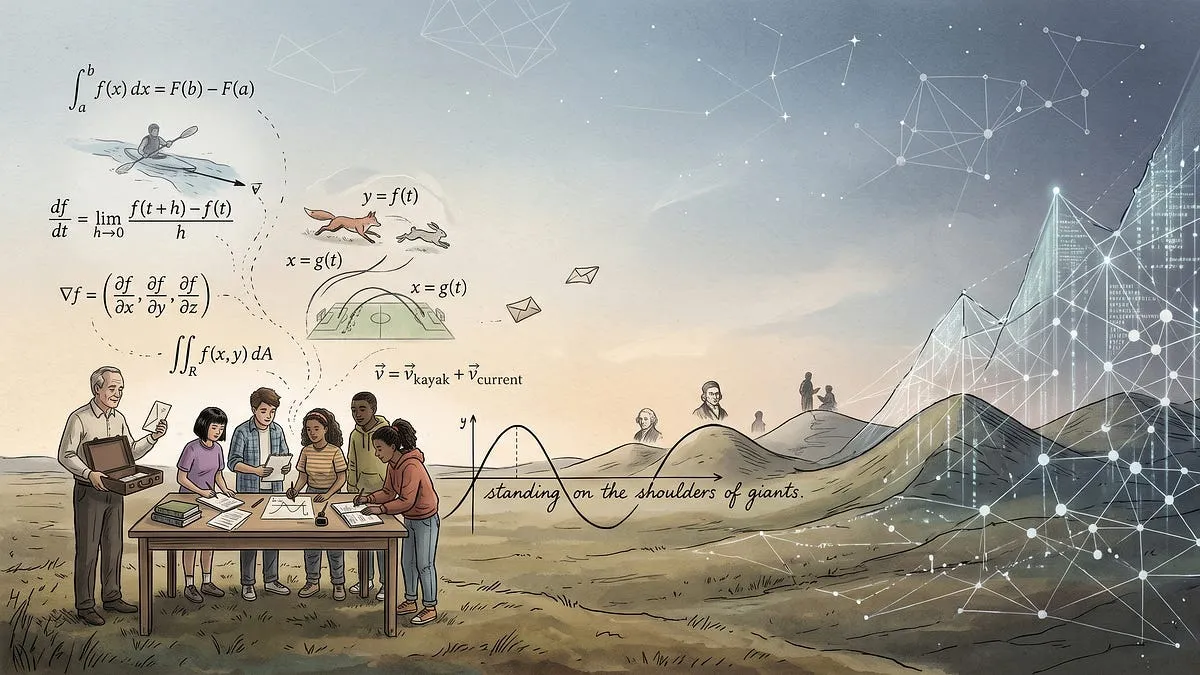
My best high school math classes began with a letter from Steve Strogatz. Our teacher, Joff (as we called Mr. Donald Joffray), was a Loomis Chaffee School legend. Joff taught Multivariable Calculus, to this day the best class I’ve ever taken. Often the problems we tackled emerged from the real world: the path of a kayaker crossing a river, the time needed for a fox to catch a hare, the ideal yard line to maximize success in kicking a field goal from the hash marks. Joff loved nature -- and football.
Joff often cited a pantheon of former LC student mathematicians. I don’t think he intended it as a motivational technique; I think he just respected his students and loved to talk about them. But for the six of us in the class, it was motivation to live up to (and perhaps make it into) the pantheon. Joff loved the Isaac Newton quote “If I have seen further it is by standing on the shoulders of giants.” Of course Joff meant Newton himself, plus Leibniz, Euler, Gauss, and many more. But he also meant his former students.
At the pinnacle of LC math Olympus stood Steve Strogatz, then a young math professor at Cornell. Years before Professor Strogatz’s dozens of math columns in the New York Times (start with the first in his 2010 series, From Fish to Infinity), before his many books including The Calculus of Friendship about his relationship with Joff, Steve Strogatz was a legend in that Founders Hall classroom, a hero to me. Joff and Strogatz were part of the reason I majored in Mathematics and considered becoming a professor.
From the cover of Steve Strogatz’s lovely book about Joff
They mailed physical letters back-and-forth. That’s what one did in 1990, before email. Besides, 90% of the content was equations that wouldn’t work in text-based email format anyway.
On the best days, Joff pulled a new Strogatz letter from his briefcase with a flourish and a mischievous smile. Memories cloud, but I foggily recall the words “here’s a problem your students will enjoy…” And we’d try to solve it together.
AI will never have that joy. It isn’t sentient. It has no mischievous smile.
But it has come for mathematics, and Steve Strogatz has been in the news the last few weeks sharing his feelings. He’s become a bit of a poster child, which brings back my 17-year-old math nerd hero worship.
Derek Thompson titled his interview with Strogatz “I Know Why the Mathematicians Weep.” I heard his wonder at the speed of technological advance, as well as his tears contemplating questions of identity, on The Daily podcast titled “When A.I. Comes for Your Purpose in Life”. Sit with those titles for a second.
At the JUMP Offsite 15 months ago, I heard former OpenAI exec Zack Kass speak about threats to identity in a different context. He described visiting longshoremen on strike at a port. He’d heard the strike wasn’t about pay, safety, or working conditions, but about stopping automation. He sat down and talked with them. They weren’t worried about being put out of a job because of the paycheck. They could transition to construction and make the same money. But they identify as longshoremen, and often as sons and grandsons of longshoremen. It’s who they are.
I certainly don’t understand the glee -- or maybe the right word is schadenfreude -- represented by the grotesque “Put the fries in the bag, Terry” meme, referencing UCLA Professor Terence Tao, one of the greatest living mathematicians. The idea: “f--- you, egghead math nerds who think they are smarter than the rest of us. You can get put in their place too, just like regular people.” It’s the wrong sentiment. We should value the pride of being a great longshoreman or a great mathematician, especially in a time of change.
But we should also realize that any and all jobs might change. Mathematicians are at one end of a spectrum, where “pure intelligence” is perhaps the only limiting factor. Even the aesthetic features of math that Strogatz describes beautifully on The Daily seem driven by intelligence. And I’d be willing to bet that the daily activities of mathematicians haven’t changed over decades (or centuries or millennia) nearly as much as other professions. The consistency breeds stronger identity.
For many other professions, intelligence isn’t actually the primary limiting factor to greater high-quality output. Or the profession has already been changing and the sense of identity is looser. It’s a frame I’m using right now: Is the limiting factor intelligence? Or, how much is this thing (coding, managing people, playing a flute, etc.) actually like advanced mathematics?
I don’t believe AI should stop solving math problems. Or any problems. The accumulation of knowledge creates tremendous value for humans. The well-trod canonical example is curing cancer, which admittedly sounds pretty great. But what about designing energy systems that reduce cost (and environmental damage) by 10x or more? (Think of the downstream impacts of that: would there be riots in France or a tanking Indonesian economy?) Or sorting through data on healthcare treatments to stop wasted spend that doesn’t improve outcomes, reducing cost in the system? Or real-time monitoring systems that reduce fraud and increase safety in countries where good people reasonably want to flee today?
These aren’t questions of pure intelligence, like frontier mathematics. But they have a lot of intelligence in them. Plus AI will increasingly push humans to do the human stuff, if we’ll listen and engage.
The advances in math themselves may help. As I understand it, the models are solving problems by tapping into the breadth of knowledge and techniques across mathematical sub-disciplines and tying disparate ideas together, leveraging the AI’s advantage in holding a massive amount of contextual information. That doesn’t stop at the boundaries of math! In his writing, Professor Strogatz ties even esoteric math to the real world. (I have no idea, but I like to think this is an influence of Joff. Most of my Stanford math professors, Robert Finn aside, shied away from it.). The AI will find real world applications humans would not have considered.
That’s the point. All of this tech exists to serve us, the humans. It’s for us. We should remember that, insist on it, and stop talking like it’s divorced from our goals.
So what’s left of being a mathematician if it isn’t solving Millennium Problems? I don’t know, but I have a few hypotheses. Others may have better ideas!
Perhaps the mathematician is an interpreter and guide. She’s trying to keep up with what the LLM is proving, both to make sure the proof is right (probably using other LLMs) but also to interpret what’s happening for the human professional math community and adjacent academic communities. The problem to be solved morphs, but maybe the advancement of the top human math brains happens even faster.
Another idea: AI has dominated every human chess player for many years, yet chess is more popular with humans than ever. For many players, AI directly helps them improve, which engages people more than only learning from other people or self reflection. Chess brings personal intellectual challenge, for fun. This could happen in math, in a way that honors all the work Professor Strogatz has done to bring math to a broader audience.
But my favorite hypothesis comes from the Strogatz letters to Joff’s class over 35 years ago. The problems in the letters were solved problems. But not for us. A professional mathematician gave us the joy of working on a problem together, the frustration and resilience of trying the wrong approach and moving on, the eureka moment of the breakthrough, the grind of writing the whole solution once you had the breakthrough, the communication skills of explaining what you did, and the pride of getting one baby step closer to being in the pantheon ourselves. These skills served us well.
AI agent mathematicians have more work to do, but so do human mathematicians. I’m rooting for the AI and for Steve Strogatz, both.
I love writing Culture & Compass. Get it sent to your inbox by subscribing (for free!) below. And please forward to a friend.
正文由 探How 从来源站点 RSS 同步,内容未经改写;遇到排版缺失或需要图片、视频时请以原文为准。