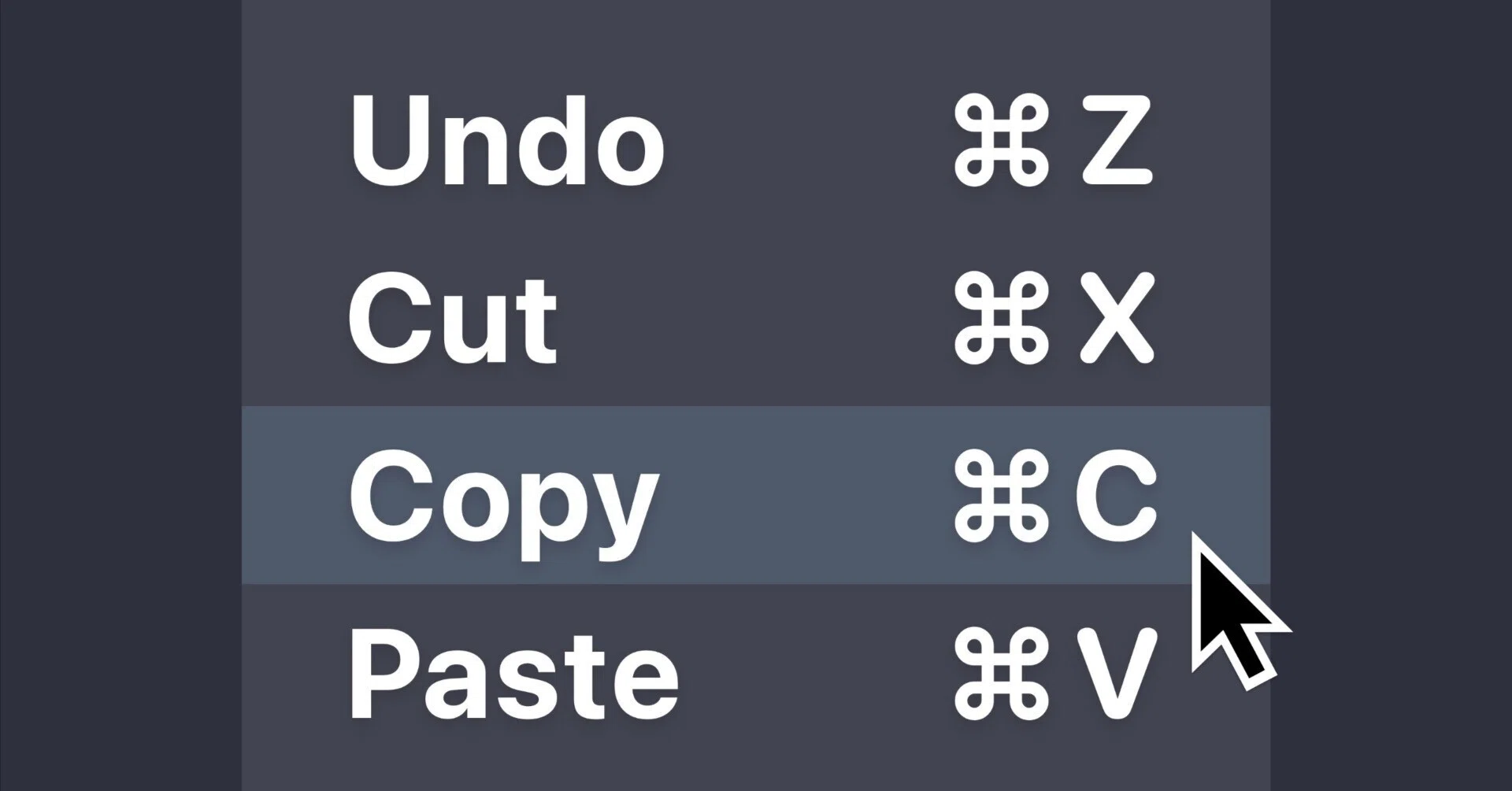
Who assigned Cut, Copy, Paste, and Undo to X, C, V, and Z?
To start with the conclusion, it seems this was Larry Tesler, but while C=Copy makes sense, I had always wondered why X and V were linked to Cut and Paste. I also didn't really understand Z. Regarding this, there a…
以下正文同步自 Hacker News 最新,版权归原站所有,已转换为易读排版。
usagimaru
2024年2月1日 12:24
To start with the conclusion, it seems this was Larry Tesler, but while C=Copy makes sense, I had always wondered why X and V were linked to Cut and Paste. I also didn't really understand Z. Regarding this, there are urban legends that go something like this:
C is the first letter of Copy. On a QWERTY keyboard, V is next to C, so it was chosen for convenience. X is also adjacent to C, and because it resembles the shape of scissors, it was assigned to the Cut command. Z represents a toggle switch.
This is incorrect, but it sounds plausible.
According to Professor Brad Myers of Carnegie Mellon University, the four commands and key assignments for XCVZ were done by Larry Tesler himself. He introduces this by quoting an email message from Tesler as follows:
Email from Larry Tesler
The NYT article is wrong (and there is no citation of a Xerox publication). Lisa was the first system to assign XCVZ to Cut, Copy, Paste, and Undo respectively. (used in conjunction with the Apple key) I chose these myself. X was a standard symbol for deletion. C is the first letter of Copy, and V is an upside-down caret, which was a symbol that meant insertion in at least some earlier editors.
Z was because it was next to XCV on the US QWERTY keyboard. Also, the shape of “Z” seemed to symbolize the three elements of Do-Undo-Redo.
Top line to the right ... one step forward Middle line sloping down to the left ... one step back Bottom line to the right ... one step forward again
In other words, there was nothing novel about the meanings of XCV, but I know of no examples of Z=Undo before Lisa.
(partially excerpted and freely translated into Japanese)
I was so surprised I almost shouted, but since it can be read that X had a meaning like the Japanese 'batsu' (X mark), it can be inferred that the custom of representing deletion with an X mark already existed in the US during the Apple Lisa era. It is also interesting that the idea for V was that since it looks like the insertion symbol of text editors before Gypsy (likely Bravo), and since paste is essentially an insertion, they should use that (and it was convenient being next to C). Z was relatively close to the switch theory mentioned in the urban legend at the beginning.
So the XCVZ text editing quartet were symbols decided by Larry Tesler in the same context...
“Origins of the Apple Human Interface” Lecture video materials of Larry Tesler talking about the interface design of Lisa and Mac. (Thank you for sharing, sumim ☺️)
By the way, in that same email, it is also written about Z=Undo as follows:
Z undoes only the most recent command, and executing it again performs a redo. In Bravo and Microsoft Office, Y was assigned to the most recent command's Redo. When Undo became multi-level, Mac and Microsoft (including Office Mac) became different.
(partially excerpted and freely translated into Japanese)
Bravo is the first WYSIWYG text editor installed on the Xerox Alto. A person named Charles Simonyi who was involved in its development later moved to Microsoft and developed Microsoft Word and Excel. By the way, it is said that he is the person who became the origin of Hungarian notation. The Gypsy text editor that Larry Tesler was involved with is the successor to Bravo.
Come to think of it, is the fact that Y (Mac: ⌘Y / Win: ^Y) is assigned to the Redo command in some Adobe applications related to this history?
Also, in that email, there is a point made that “The NY Times article (also cited on Wikipedia) stating that ‘^Z was assigned by programmers at Xerox PARC’ is incorrect.”
The Age of Undoing
… The undo command would become a crucial feature of text editors and word processors in the PC era, assigned the now-familiar keyboard shortcut of Control-Z by programmers at the research center Xerox PARC.
(According to Larry Tesler's email, this is incorrect)
And regarding the anecdote that the V symbol is an upside-down caret, when you actually look at a demo of Bravo, you can indeed confirm the insertion mode caret '^'. It does look like a V when turned upside down.
The person on the left standing on the demo stage is Charles Simonyi.
It is truly fascinating how such spontaneous ideas from that time become established as design idioms that are widely used for decades to come (and from which various schools of thought branch off).
Finally, I will also post Douglas Engelbart's Mother of All Demos.
正文由 探How 从来源站点 RSS 同步,内容未经改写;遇到排版缺失或需要图片、视频时请以原文为准。