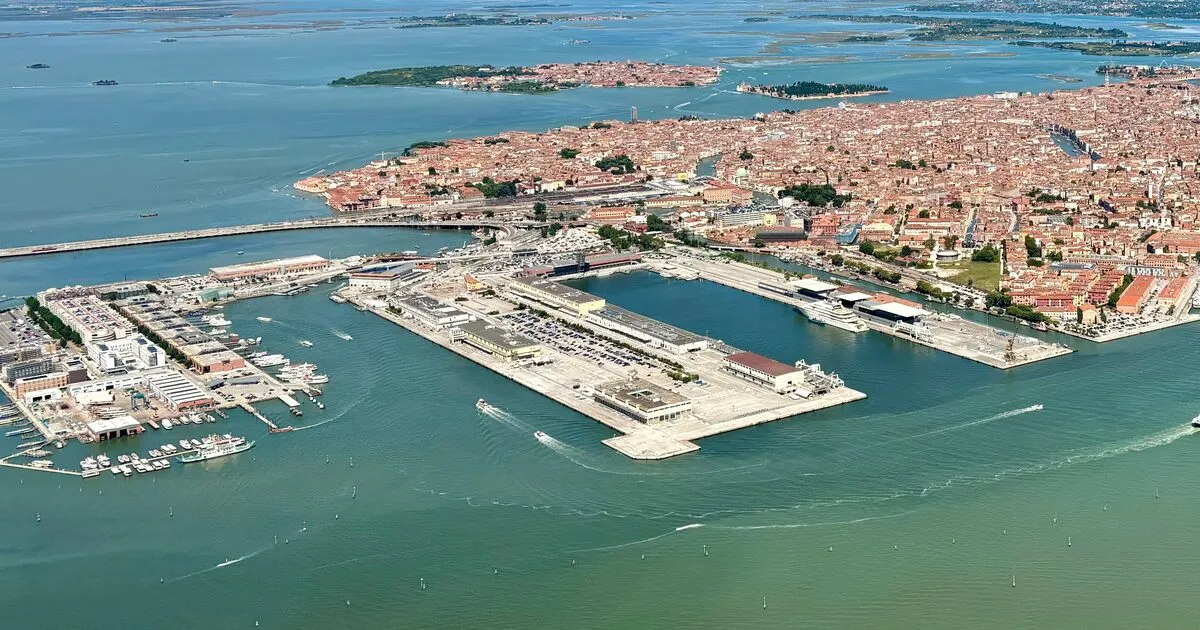
Venice's lagoon dredging approved: the combined impact was "assessed elsewhere"
It is the second of the four environmental assessments to close, after the spoil island. The expert opinion behind the decree was listed as issued in late July, but it is dated 14 September. It says the combined impact …
以下正文同步自 Hacker News 最新,版权归原站所有,已转换为易读排版。
It is the second of the four environmental assessments to close, after the spoil island. The expert opinion behind the decree was listed as issued in late July, but it is dated 14 September. It says the combined impact of the four projects was assessed «within the respective procedures», including the island's, which a year ago put that assessment off. And it rules out not dredging at all by citing a law that in fact requires a full environmental impact assessment: the very procedure in which that option has to be examined.
On 4 November 2026 Italy's Ministry of the Environment published the decree, issued jointly with the Ministry of Culture, that approves the dredging of the Vittorio Emanuele III Canal, the access channel to the Maritime Station that would bring cruise ships back into Venice1. Of the four environmental impact assessments (EIA) opened on the strength of the 2021 decree that banned large ships from St Mark's Basin2, it is the second to close, after the one on the spoil island, approved a year ago3. In August I described these four procedures in a long article: this is the sequel, and it begins with the Technical Commission's opinion, on which the decree rests.
There are four files: the spoil island (procedure 13500), a repository for dredged mud to be built in the middle of the lagoon, larger than the whole of the Vatican City State; two berths and a passenger terminal at Porto Marghera (13980); the dredging and widening of the Malamocco-Marghera Canal (13981); the dredging of the Vittorio Emanuele (13664)4. Taken together, the four files describe a single system: the terminal cannot be reached without the dredging, the dredging cannot be done without the site for the mud, and the repository is sized to the volumes to be excavated. Each of the four procedures, however, assesses one piece.
That was the central point of my August article: every file refers you to another, and the cumulative impact of the four projects was nowhere on paper. Not by oversight: in its opinion on the spoil island the Technical Commission wrote that the cumulative effects «shall be duly examined in each of the subsequent projects»5. The overall assessment had been deferred to the later procedures. Yet, according to the Court of Justice of the European Union, the analysis of cumulative effects is not optional, and it must precede the authorisation: it cannot be put right afterwards6.
There was also an oddity in the status of the two dredging projects. From 27 July at the latest, and still on 4 August, their records on the Ministry's portal read «Parere CTVIA-VAS emesso», Commission opinion issued, yet not a line of that opinion had been published; on 7 August the same records showed a supplementary examination instead7.
My article closed with four questions, and of the first three I wrote that a document could settle them: whether any act names the Vittorio Emanuele as part of the Commissioner's mandate; whether any document contains an assessment of the cumulative impact of the four projects considered as a single system; what traffic scenario, taking account of sea level rise and of the closures of MOSE (the mobile barriers that shut the lagoon off from the sea during high tides), justifies these excavations. The fourth, whether Venice needs more cruise passengers, no document can settle. The decree of 4 November and the opinion attached to it are the first documents to arrive since then, and they are best read with those questions in hand.
The decree that closes EIA 13664 issues a favourable environmental compatibility ruling and a favourable appropriate assessment under the European Habitats Directive, with environmental conditions. It is signed by the director general for environmental assessments jointly with the Ministry of Culture, includes the landscape authorisation and is valid for five years1. Attached to it are the Technical Commission's opinion no. 211 of 14 September 2026, 323 pages long8, and the opinion of the Ministry of Culture, which is dated 13 October 2025, more than a year before the decree9, and therefore predates the additional documents the proponent filed between November 2025 and April 20268. The other two open procedures, the Malamocco-Marghera dredging and the terminal, are marked «In attesa concerto», that is, awaiting the joint signature of the Ministry of Culture, and for neither has an opinion been published7. The decree can be challenged before the regional administrative court (TAR) within sixty days, which for anyone not formally notified run from its publication on the portal1.
The dates, however, do not add up. The Commission's opinion is dated 14 September 2026 and was logged on the 17th. Yet the procedure's record had shown it as issued since at least 27 July, and that is what the Ministry's environmental assessment portal still showed publicly on 4 August: between six and seven weeks before the date the document bears. On 7 August the record showed a supplementary examination instead7.
The published text mentions no earlier version, nor that supplementary examination, and the documents do not say what happened between July and September. On 27 July I wrote to the official in charge of the procedure to ask where the document the record showed as issued could be consulted, or at least what its number, its date and the expected publication time were; on 4 August I repeated the request, extending it to the Malamocco-Marghera procedure. I never received a reply.
There is a second clue, and it lies in the decree. Summing up the opinion, the decree quotes its conclusion on the appropriate assessment: according to the Commission, «on the basis of the information obtained from the Proponent, it is possible to conclude that the project, provided that the environmental conditions set out below are complied with, will not cause significant effects on the Natura 2000 sites concerned»1. That sentence is not in the published opinion. There is a similar one, but it is more categorical: «it is concluded that the project, by virtue of the mitigation measures and of the environmental conditions set out below, does not cause significant effects», followed by the statement that the cumulative effects «have been analysed and assessed within the present procedure»8. A possibility («it is possible to conclude») has become a finding («it is concluded»); a forecast tied to compliance with the conditions («provided that», «will not cause») has become a present fact («by virtue of the measures», «does not cause»); and the sentence on cumulative effects is not in the decree's quotation. It may be a transcription error, or a quotation reworded by whoever drafted the decree. Or the decree was drafted from a version of the opinion other than the published one. Finding out what happened would take a request for access to the records: an application to the Ministry, for instance under Italy's law on access to environmental information (legislative decree 195/2005) or under its freedom of information rules, for the versions of the document and the steps of the examination between July and September.
Nobody could read it, which is not the same as saying it did not exist: I do not know whether in July a text existed and was later rewritten, or whether the record was wrong. Nor is it the only case. As we will see, among the places where the cumulative impact «has been assessed» the Commission also lists the procedures on the terminal and on the Malamocco-Marghera, for neither of which, as at 4 November, is there anything to read.
On the combined impact of the four projects (the cumulative impact, in the jargon of environmental assessment), the heart of my August article, the opinion says two things, in two different places. In its examination of cumulative effects the Commission finds that the two dredging projects together produce changes in flows and salinity «significantly greater» than those estimated for each project alone: the volumes passing through the Vittorio Emanuele would grow by about 20 to 30 per cent, compared with 15 to 20 per cent estimated for dredging that canal alone, with effects that «could aggravate the known phenomenon of marinisation of the lagoon». It concludes that «a dedicated monitoring plan» is needed8. Then, just before its ruling, it writes that the cumulative impacts, «including the Commissioner's projects ID_13500, 13664, 13980 and 13981, have been analysed and assessed jointly within the respective EIA procedures», that «the assessment is therefore complete and is not left to later stages», and that the required monitoring has «no assessment function, but one of control and verification»8.
«Assessed jointly»? Assessed where? Even in its last few lines the opinion cannot make up its mind: in the passage just quoted the assessment took place «within the respective EIA procedures», that is, in each of them; a few lines later, in the final ruling, the same cumulative effects «have been analysed and assessed within the present procedure»8, that is, in this one. And one of the procedures it lists closed a year ago, and says the opposite. In its opinion on the spoil island, procedure 13500, the same Commission wrote that the cumulative effects «shall be duly examined in each of the subsequent projects»5, and on the basis of that opinion the island was approved by decree on 18 November 20253: authorised, that is, with the examination of cumulative effects deferred to the later procedures. So it is not true that the cumulative impact was assessed jointly «within the respective EIA procedures»: the island's own procedure states in black and white that it had not been assessed there. These are two statements by the same Commission, a year apart, and they cannot both be true.
In its assessment of the project, for that matter, all the Commission writes about the Commissioner's projects is that «the possible cumulative effects have been analysed by the Proponent»8. And this very opinion, which declares the assessment complete and not left to later stages, defers part of it to procedure 13981: the morphological instability of the Malamocco-Marghera, with erosion rates «of the order of tens of centimetres along the banks»8. That procedure, as at 4 November, is far from concluded, and its opinion is not published. The same goes for 13980, the terminal, which the opinion lists among the procedures in which the cumulative impact was supposedly assessed: it is not concluded either, and its opinion is not published.
In my August article, among the four questions with which it closed, I asked whether any document contained an assessment of the cumulative impacts of the four projects considered as a single system. Now the Commission answers yes: the cumulative assessment has been carried out, and it is complete, and the wording used is the one the Court of Justice requires, assessment before authorisation and not after. For the island, however, the answer does not hold: if an assessment of the cumulative impact that includes it did take place, it was carried out in another procedure and after the authorisation, which is the opposite of that criterion6.
On the Zero Option, the alternative of not building the project at all, the Commission adopts the proponent's position: the zero alternative «is not viable, since it would entail disapplying, and therefore breaching, what the legislature has laid down», and in support it cites decree-law 103/2021, interministerial decree 545/2021 and the special laws for Venice8. This has not always been its position. In May 2025, in its request for additional information, it was the Commission itself that asked the proponent to «examine the zero option further in the comparative analysis of alternatives, so as to be able to assess the environmental impact of the chosen design alternative against the current state». The proponent replied that the zero option had «already been ruled out by the Legislature», and in its
正文由 探How 从来源站点 RSS 同步,内容未经改写;遇到排版缺失或需要图片、视频时请以原文为准。