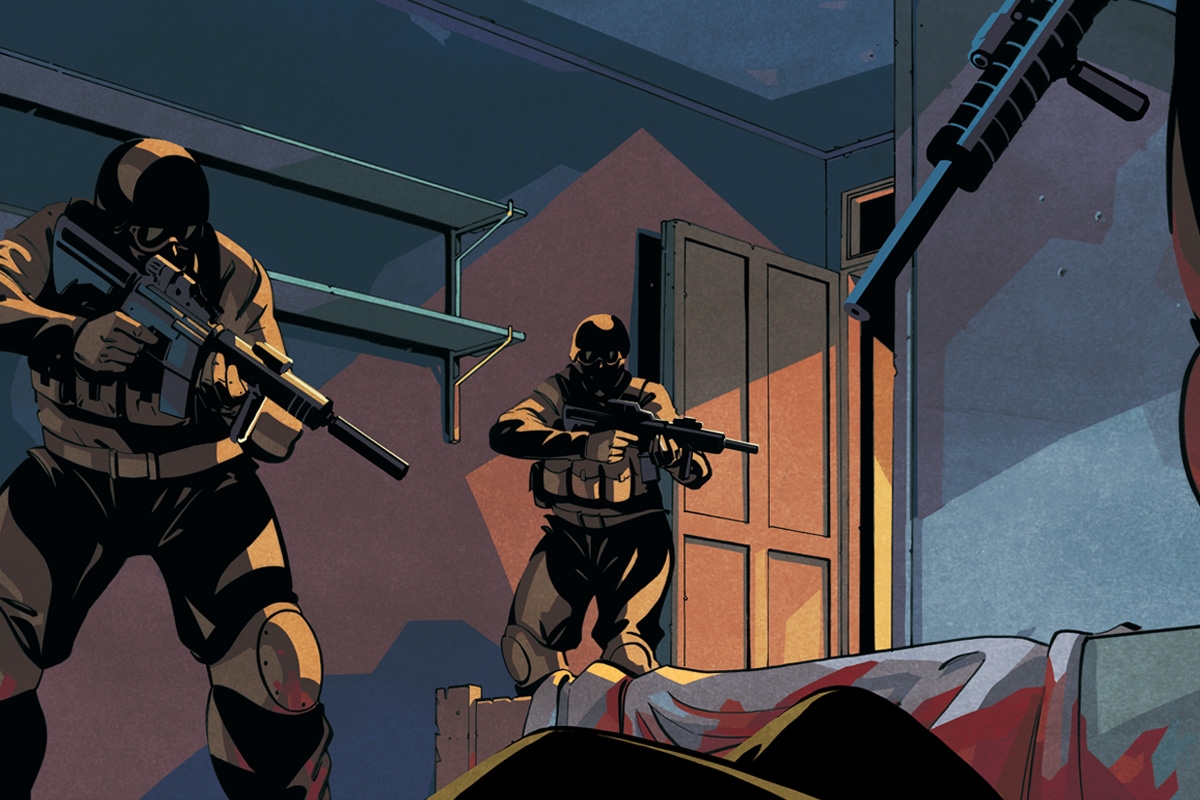
The Crimes of SEAL Team 6 (2017)
No single military unit has come to represent American military success or heroism more than SEAL Team 6, officially designated as the Naval Special Warfare Development Group and known in military vernacular as DevGru, …
以下正文同步自 Hacker News 最新,版权归原站所有,已转换为易读排版。
No single military unit has come to represent American military success or heroism more than SEAL Team 6, officially designated as the Naval Special Warfare Development Group and known in military vernacular as DevGru, Team 6, the Command, and Task Force Blue. Its operators are part of an elite, clandestine cadre. The men who make it through the grueling training represent roughly the top 10 percent of all SEALs. They are taught to live and if necessary die for one another. The extreme risks they take forge extreme bonds.
Made up of no more than 200 SEAL operators when the Afghan war began, SEAL Team 6 was the lesser known of the U.S. military’s elite “special mission” units. Created in 1980 and based at the Dam Neck Annex of Naval Air Station Oceana near Virginia Beach, the command prided itself on its culture of nonconformity with the larger military. The unit’s name itself is part of an attempt to obscure U.S. capabilities. When it was commissioned, the Navy had only two SEAL (Sea, Air, and Land) assault teams, but founding officer Cmdr. Richard Marcinko hoped that the number six would lead the Soviet military to inflate its assessment of the Navy’s SEALs.
When SEAL Team 6 first deployed to Afghanistan in January 2002, the command had three assault teams, Red, Blue, and Gold, each with a mascot. Red Team, known as the Redmen, employed a Native American warrior as a mascot; Blue Team, known as the Pirates, wore the Jolly Roger; and Gold Team, known as the Crusaders or Knights, wore a lion or a crusader’s cross.
The prevailing narrative about SEAL Team 6 in news coverage, bestselling books, and Hollywood movies is unambiguously heroic; it centers on the killing of Osama bin Laden and high-profile rescue missions. With few exceptions, a darker, more troubling story has been suppressed and ignored — a story replete with tactical brilliance on battlefields around the world coupled with a pattern of silence and deceit when “downrange” actions lead to episodes of criminal brutality. The unit’s elite stature has insulated its members from the scrutiny and military justice that lesser units would have faced for the same actions.
This account of the crimes of SEAL Team 6 results from a two-year investigation drawing on interviews with 18 current and former members of the unit, including four former senior leaders of the command. Other military and intelligence officials who have served with or investigated the unit were also interviewed. Most would speak about the unit only on background or without attribution, because nearly every facet of SEAL Team 6 is classified. Some sources asked for anonymity citing the probability of professional retaliation for speaking out against their peers and teammates. According to these sources, whether judged by its own private code or the international laws of war, the command has proven to be incapable and unwilling to hold itself accountable for war crimes.
Most SEALs did not commit atrocities, the sources said, but the problem was persistent and recurrent, like a stubborn virus. Senior leaders at the command knew about the misconduct and did little to eradicate it. The official SEAL creed reads, in part: “Uncompromising integrity is my standard. My character and honor are steadfast. My word is my bond.” But after 9/11, another code emerged that made lying — especially to protect a teammate or the command from accountability — the more honorable course of action.
“You can’t win an investigation on us,” one former SEAL Team 6 leader told me. “You don’t whistleblow on the teams … and when you win on the battlefield, you don’t lose investigations.”
By the time the two dozen Red Team operators departed for Objective Bull, tension had built up between Hyder, a commissioned officer, and the enlisted operators technically under his command. The situation was not particularly unusual. Historically, SEAL Team 6 is known as a unit where officers “rent their lockers,” because they typically serve about three years before rotating out, whereas the enlisted operators remain for much of their careers, often for a decade or more. Simply put, the unit is an enlisted mafia, where tactics are driven by the expertise developed by the unit’s enlisted assaulters, whose abilities and experience at making rapid threat decisions make up the command’s core resource. Officers like Hyder, who did not pass through the brutal SEAL Team 6 internal training program, known as Green Team, are often viewed with suspicion and occasionally contempt by the enlisted SEAL operators.
Even before the attack on the convoy and the alleged mutilation of the dead Afghan, Hyder had committed at least one killing with questionable justification. Several weeks earlier, in January 2002, Hyder killed an unarmed Afghan man north of Kandahar during the unit’s first ground assault of the war. In that operation, Hyder led a team of Red operators on a nighttime mission to capture suspected al Qaeda militants in a compound. After securing several detainees and cordoning the area, Hyder and his men waited for their helicopters to arrive and extract them. During the mission, the SEALs reported receiving small arms fire from exterior positions, though no one was hit. After 90 minutes, as the helicopters were nearing the rendezvous point, one of the SEALs alerted Hyder that an old man who had been lying in a ditch nearby was walking toward the SEALs’ position.
In an interview, Hyder said the man had approached his position with his arms tucked into his armpits and did not heed warnings from other SEALs to stop. Hyder acknowledged that the man likely did not understand English and probably couldn’t see very well. Unlike the SEALs, the man was not wearing night-vision goggles. “He continued to move towards us,” Hyder said. “I assessed he was nearing a distance where he was within an area where he could do damage with a grenade.” Hyder said that a week earlier, a militant had detonated a concealed grenade after approaching some American CIA officers, seriously injuring them. “He kept moving toward us, so at 15 meters I put one round in him and he dropped. Unfortunately, it turned out he had an audiocassette in his hand. By the rules of engagement he became a legitimate target and it was supported. It’s a question, why was he a threat? After all that activity, he’d been hiding in a ditch for 90 minutes, he gets up, he’s spoken to, yelled at in the dark … it’s disturbing. I’m disappointed he didn’t take a knee.”
Hyder, who was the ground force commander for the Kandahar operation, was cleared in an after-action review of the shooting. The rules of engagement allowed the ground force commander to shoot anyone he viewed as a threat, regardless of whether they were armed at the time of the shooting. But in the eyes of the enlisted SEALs of Red Team, Hyder had killed a man who didn’t have to die. Two of the operators with Hyder reported afterward that the man was not a threat. One of those operators was Neil Roberts.
The morning after Objective Bull, Red Team gathered at Bagram Air Base. Most of the operators held a meeting to discuss what had happened on the mission. No officers were present, and the enlisted SEALs used the meeting to address Hyder’s alleged mutilation of the dead Afghan the previous day. The discussion covered battlefield ethics. Inside a heated tent, as many as 40 SEAL Team 6 operators asked themselves how they wanted to treat their fallen enemies. Should they seek revenge for Roberts? Was it acceptable, as Hyder had done with the wounded man whom he executed, to desecrate the dead?
“We talked about it … and 35 guys nodded their heads saying this is not who we are. We shoot ’em. No issues with that. And then we move on,” said a former SEAL who was present at the meeting. “There’s honor involved and Vic Hyder obviously traipsed all over that,” he said. “Mutilation isn’t part of the game.”
Nonetheless, Red Team did not report Hyder’s alleged battlefield mutilation, a war crime. In what would become part of a pattern of secrecy and silence, the SEAL operators dealt with the issue on their own and kept the incident from their chain of command.
“The SEALs believe that they can handle the discipline themselves, that’s equal to or greater than what the criminal justice system would give to the person,” said Susan Raser, a retired Naval Criminal Investigative Service agent who led the agency’s criminal division but did not investigate this mission. “They have an internal process that they think is sufficient and they are not inclined to cooperate unless they absolutely have to.” Raser, who conducted investigations into both regular SEAL units and SEAL Team 6, said that in her experience, SEALs simply didn’t report wrongdoing by their teammates.
Senior leaders at the command knew the grisly circumstances of Roberts’s death had unsettled Red Team. “Fifi was mutilated,” said a retired noncommissioned SEAL leader who was involved in internal discussions about how to prevent SEAL Team 6 from seeking revenge. “And then we had to address a very important question, how do you get the guys’ heads straight to mitigate any retaliation for Fifi? Otherwise we knew it’s going to get out of control. A third of the guys literally think they’re Apache warriors, then you had the Muslim way of removing a head. I understand the desire, I don’t condone it, but there was definite retaliation.”
Hyder told me that he did not desecrate the body. “I deny it,” he said, adding that he didn’t understand why Heath would have claimed to have witnessed it. “Even if it was true, I don’t know why he would say that.” Hyder said he was not aware of the Bagram meeting held by the enlisted operators about him or the accusations. “Why would I do that?” he asked. “Somebody else is making this up. Memories get distorted over 14 years. They’re telling you how they remember it. There was a lot of chaos. I’m telling you the absolute truth.”
After the deployment, SEAL Team 6’s leadership examined Hyder’s actions during Objective Bull. For some of them, what was most troubling was not that Hyder might have taken gratuitous revenge for Roberts’s death on an unrelated civilian, but that on more than one occasion, as ground force commander, he had fired his own weapon to neutralize perceived threats. “If you have multiple incidents where the ground force commander pulls the trigger on a deployment, you have a total breakdown of operational tactics,” said one retired SEAL leader. “It’s not their responsibility — that is why we have DevGru operators.”
Beyond the story of the alleged mutilation, the sight of the dead civilians killed during the opening airstrikes of Objective Bull, especially the women and children, left members of Red Team with deep psychological scars. “It ruined some of these guys,” said the former SEAL operator on the mission.
Six days after Objective Bull, the Pentagon announced at a press conference that an airstrike had killed 14 people, who a spokesperson said were “somehow affiliated” with al Qaeda. Sources at SEAL Team 6 who were present during the operation estimated the number of dead was between 17 and 20. Inside the command, the incident became known as the Wedding Party bombing after it was learned that the convoy was driving to a wedding.
Hyder finished his tour at SEAL Team 6 shortly after returning from the Afghanistan deployment and was later promoted to the rank of commander, the Navy equivalent of a lieutenant colonel. He was awarded the Silver Star for his efforts at Takur Ghar to save Roberts and the rest of the Red Team recon element. A few years later, after Hyder’s name was mentioned for another rotation in Red Team, some of Hyder’s former operators informed SEAL Team 6 leadership that he was not welcome back in the unit.
Neil Roberts’s bent rifle was placed on the wall of Red Team’s room at the SEALs’ base near Virginia Beach, a visible reminder of their teammate, their first deploym
正文由 探How 从来源站点 RSS 同步,内容未经改写;遇到排版缺失或需要图片、视频时请以原文为准。