Looks Like the Intelligence Explosion Will Happen in 2027 After All
Eli Lifland, Brendan Halstead, Daniel Kokotajlo, and 3 others
以下正文同步自 Hacker News 最新,版权归原站所有,已转换为易读排版。
+2
Eli Lifland, Brendan Halstead, Daniel Kokotajlo, and 3 others
Nov 10, 2026
23
7
5
Share
We want to get this post out quickly given the urgency of the topic. It’s possible that there are some errors in the modeling, but we think it’s very unlikely that they undermine the high level conclusions. We would love to be corrected on any mistakes we made.
METR recently estimated that Anthropic is now making AI progress about twice as fast as its historical rate (they would not be surprised by anything from 1.3x to 3x), and guessed that “perhaps ≈80%” of the current acceleration is due to AI. If they’re right, that implies an AI-driven acceleration that is 5 months ahead of the AI 2027 scenario.
This level of acceleration due to AI is very unexpected. Previously, Daniel, the most bullish of us, assigned a 50% chance of Superhuman AI Researcher (SAR)1 before 2029. SAR is roughly the point at which a company would rather fire all their human researchers and rely solely on automated AI researchers than have a team of the best human researchers in the world with no AIs.2
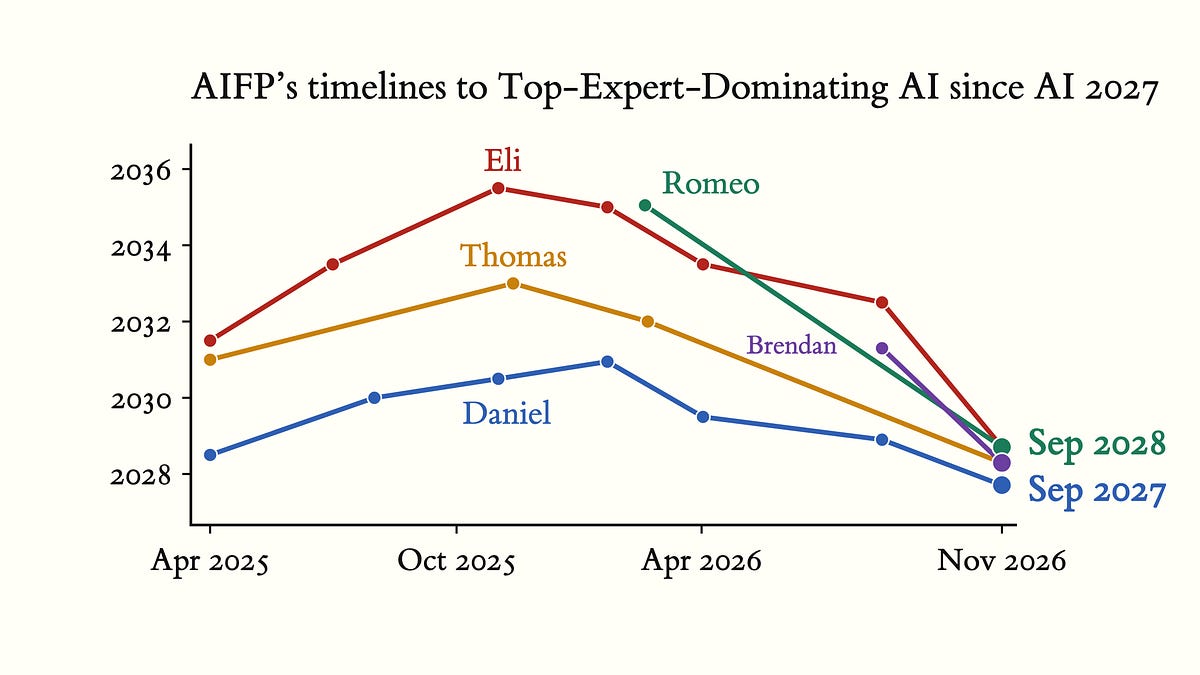
Now, all of us forecast that Superhuman AI Researcher (SAR) will likely arrive at some point in 2027 (assuming no substantial deliberate slowdown).3 We also predict a 35-65% chance that Top-Expert-Dominating AI (TED-AI), AIs that can automate all white-collar work, will arrive before 2028. While there were many factors and sources of evidence that influenced us, the single biggest source was the METR report.4.
If SAR is coming in 2027, it is incredibly urgent to pause or substantially ‘pace’ frontier AI development, with the ideal being an industry-wide pause followed by an international agreement. Companies are not on track to align a SAR, and using a misaligned SAR to do recursive self-improvement (RSI) will put us in an extremely bad position. Additionally, if we train SAR in the near future, China will probably be able to steal the training recipe and maybe even the model weights (more).5
We estimate that METR’s report implies a 1.7x AI-attributable acceleration in the pace of progress today, relative to historical levels. This surprises our model; we made our most recent timelines forecasts less than three months ago, and even the most aggressive model-based distribution (Daniel’s) assigned less than 4% to the pace of progress being sped up by at least 1.7x in November 2026.6 1.7x AI-attributable acceleration is a bigger deal than it may seem; e.g., it’s a much bigger deal than making employees 1.7x more productive.
We focus in this post primarily on forecasting when Superhuman AI Researcher (SAR) will arrive. We also discuss Top-Expert-Dominating-AI (TED-AI): AIs that are better than top human experts at virtually all tasks. (more)
In this post, we forecast SAR and TED-AI using the following approaches:
Research taste linear extrapolation: Even assuming that the recent pace of progress doesn’t accelerate further due to automation, the fact that the recent trend is above historical rates is a big update to our timelines; a linear extrapolation of the recent rate of AI progress predicts that SAR will likely be achieved by the end of 2027.
Labor uplift extrapolation: An exponential extrapolation of self-reported labor uplift predicts SAR in mid-2028. In addition to not modeling automation, there are reasons to think that an exponential is too conservative. However, self-reports may be too bullish.
Extrapolating Anthropic automation levels: Anthropic recently shared a graph showing how the percentage of R&D tasks at various automation levels has changed over time. Extrapolating this predicts SAR in late 2027; this method also doesn’t model speedup from automation.
Ajeya Cotra’s toy model: Predicts SAR in December 2027.
Tom Davidson’s toy model: Predicts superintelligence in around a year conditional on a software-only singularity, so SAR sometime in 2027.
Filtered AI Futures Model (AIFM): Keeping the existing AIFM (including parameter distributions), and filtering for trajectories that match METR’s AI-attributable pace of progress acceleration estimates. This serves 2 purposes on top of the simple extrapolations:
Modeling how automation changes the rate of progress, allowing forecasting reasonably beyond SAR.
Informing what parameter settings in the simple research taste extrapolation are plausible.
The simple research taste extrapolation, which is a simplified version of the AIFM, gives July or September 2027, depending on whether you account for parameter uncertainty. Other simple models predict late 2027 to mid-2028.
When conditioned on 1.7x Nov 2026 AI-attributed acceleration, the AIFM predicts a SAR median of Feb 2027. This is faster than the simple research taste extrapolation because it usually has a higher level of Sep 2026 research taste (in the median case, matching a median researcher),7 and it accounts for further automation.
When additionally conditioning on a 1.2x May 2026 AI-attributed acceleration, predictions get slower because it indicates a lower rate of growth than is typical when only conditioning on 1.7x in Nov.
We then explore hypotheses for why the AI Futures Model was wrong, including parameter adjustments and modeling changes. The analysis is highly preliminary, and we were unable to come to strong conclusions. Our top candidates for what explains where we went wrong are:
Near-AC coding skills result in more AI R&D uplift than we anticipated. This could explain the combination of ~1.7x AI-attributable acceleration in Nov and (very roughly) ~1.2x in May, without AIs already having high enough research taste to contribute to the acceleration. In this case, the gradual acceleration no longer implies a low research taste slope, so steeper slopes and faster taste-driven takeoffs are more likely.
Skills besides coding and research taste (the two included in the AIFM), e.g., data generation, are driving acceleration. This potentially would have similar implications to the above bullet. But it’s unclear.
Conversion of uplift to pace of progress is too conservative. I.e., we modeled diminishing returns to AI research effort too harshly. This would point toward a faster takeoff.
Here’s an example trajectory from the AIFM showing how things might go if the cause of our prediction error was underestimating AI R&D uplift from near-AC coding skills:8
After discussing some other considerations, we share our all-things-considered forecasts (conditional on AGI projects/companies not slowing down):
Note that the gap between a person’s SAR median and TED-AI median is not their median time from SAR to TED-AI. Because the distributions of the time until SAR and of the time from SAR to TED-AI both have long right tails, the difference of the medians is typically larger than the median of the difference, so subtracting the two columns tends to overstate the median time between the two milestones.
In METR’s recent assessment of AI R&D acceleration at Anthropic, they estimate that, over the past year, AI R&D progress has accelerated by ~2x relative to the trend before Oct 2025. METR estimates that ~80% of current acceleration is downstream of AI (as opposed to other factors), which implies a 1.7x acceleration due to AI (1.67–1.74x depending on how the 80% is read; see appendix).9
Both of these estimates rely significantly on evidence METR wasn’t able to share: METR says that “Anthropic redacted a majority of the evidence we found most informative for these conclusions”, which makes it difficult to know exactly what the 2x and 80% estimates are based on.
The 2x acceleration figure is partially based on evidence METR was allowed to share: the following graph, depicting benchmark scores recently growing at roughly twice the historical rate. The 80%/1.7x estimates have no comparable public support.
This estimate is produced by fitting trendlines to the performance of models as judged by AECI, Anthropic’s internal version of Epoch’s Capabilities Index (ECI). The trend fitted from data points after Oct 2025 has 1.9x the slope of the trend fitted from data points before Oct 2025. This was the best-fitting breakpoint (i.e., it was chosen to have the best fit to the data and it matched data better than fitting a one-time jump). Since the accelerated trendline is an average of the progress over the last year, and we should expect AI R&D acceleration to increase over time, it’s plausible that the instantaneous acceleration right now is even faster. Regarding the acceleration getting faster over time, METR says:
The rate of growth could be undergoing continuous acceleration, e.g. hyperbolic growth. While we do not see clear evidence of this in the AECI trends, there is other evidence that makes this seem more plausible which Anthropic redacted. If growth is hyperbolic, we are likely underestimating instantaneous acceleration and substantially understating acceleration in the near future.
Regarding AIs’ contributions over time, METR says:
We believe AI’s contribution has grown relatively more important over time.
The AECI data points that had previously been released by Anthropic seemed best explained by a one-time jump at Mythos rather than a change in slope. However, with the new AECI data points from the METR report, it looks like the post-Mythos slope is now more clearly higher than the pre-Mythos one.
Given the redactions, how much to update on METR’s report depends heavily on how much one trusts the redacted analysis by METR’s researchers (more discussion of this below). This is a very unfortunate situation. We aren’t sure what reasons Anthropic gave internally for redacting all of this important information, but we are very skeptical that Anthropic is fairly assessing the costs and benefits from an impartial perspective. We strongly urge Anthropic to release enough information such that external observers can make a complete assessment.
In the Fable 5.2 system card, Anthropic have not added much clarity, with the following quote being ambiguous as to whether they agree with the METR report’s estimate; they only specifically claim that “Claude Mythos 5.2” (which does not seem like the internal frontier Model 4) “does not double the internal rate of overall aggregate progress in AI research and development.” Full quote here:
Our estimates of both the degree of acceleration and the attribution to AI are uncertain, so our determination that Claude Mythos 5.2 does not cross the RSP threshold reflects a holistic judgment that, given its shortcomings and limitations, it does not double the internal rate of overall aggregate progress in AI research and development (relative to an unassisted counterfactual). We will discuss overall trends in acceleration in a future report.
It seems that many people aren’t tracking how big of a deal 1.7x AI-attributable pace of progress acceleration is, often conflating it with a weaker form of uplift.
METR describes a 1.7x acceleration of overall AI progress (due to AI uplift). This is saying the entire company is making 1.7x as much progress as it was before. Software R&D and research labor are only parts of the company, and inputs into overall progress. Because AI progress also depends on other factors, like compute, you should expect a 1.7x acceleration in individual inputs like software R&D or research labor to translate into less than a 1.7x acceleration in overall progress.
Labor uplift is how much faster researchers are getting work done due to AI assistance.
It’s as if the researchers read, write, talk, and think that much faster.
According to the METR report, an informal poll of Anthropic researchers yielded an estimate of 12x – though that’s just self-reports, which may be biased.
AI software R&D uplift is how much faster software progress is going with the AIs in present day than it would be without them.
It is much lower than labor uplift because compute is an important input to software R&D.
Imagine, for example, that your rese
正文由 探How 从来源站点 RSS 同步,内容未经改写;遇到排版缺失或需要图片、视频时请以原文为准。