Fixing Stack Overflow's toxicity with $500
Sadok Cervantes,Product Designer and Engineer
以下正文同步自 Hacker News 最新,版权归原站所有,已转换为易读排版。
Sadok Cervantes,Product Designer and Engineer
Stack Overflow is amazing. Stack Overflow is awful. If the saying “two things can be true at once” ever made sense, it’s here.
Back in 2020, I applied for a job at Stack Overflow. The final step of the process was a design exercise, and they offered $500 USD as retribution for the time invested in it.
I offered a potential solution to Stack Overflow’s most toxic trait. The company’s best spent $500 if you ask me!
Everybody that’s used Stack Overflow knows it’s not a forgiving place, but why?
I’m frozen by the idea that I’m going to say something wrong. Stack Overflow is not a welcoming place where I can be wrong.
That fear has a source: getting criticized and judged by “the elites”. And the feature that rewards that behavior is downvoting.
When you read mean comments or see something that everyone has downvoted, you’re dissuaded from wanting to get involved.
Funny enough, there is extensive research showing that downvoting is detrimental to online communities. One study calls it a “vicious circle of negative feedback”.1, 2
So, with all of these findings on the table, why are downvotes strongly encouraged on Stack Overflow?
The answer lies in a post by Jeff Atwood, co-founder of Stack Overflow: “The Value of Downvoting, or, How Hacker News Gets It Wrong”, from March 2009.6
…the broken windows theory applies to community sites as well. The theory is that minor forms of bad behavior encourage worse ones: that a neighborhood with lots of graffiti and broken windows becomes one where robberies occur.
Atwood then notes that the two sites (Hacker News vs Stack Overflow) have different goals, so what works for one might not work for the other. According to Atwood, Stack Overflow is a Q&A site with accidental discussion, and Hacker News is a link sharing site built around discussion.
His case for downvoting is that it doubles the dataset:
If you add back in the negatives, suddenly the range is doubled. An evil or incorrect post is now different than a mediocre or uninteresting post, because it will have downvotes and a negative score.
He does acknowledge that downvoting is a negative behavior that can evolve into toxicity, and he quotes a reader who had watched it happen before:
I stopped posting on several usenet newsgroups because the major participants were just nasty and sarcastic. Don’t let this happen to Stack Overflow.
Yet, Atwood argues that the saner level of discussion on Hacker News has nothing to do with the harder-to-reach downvote button. He puts it down to “the fact that Hacker News is relatively young, having launched in February 2007, and the small size of the community.”
Funny how, more than a decade later, Hacker News is still civil, and Stack Overflow is still toxic.
Atwood also points out that there are ten times as many upvotes cast as downvotes.
This lets him make the case that downvoting is good:
Without downvotes, how can you possibly tell the difference between a post that is harmless but uninteresting, and one that is actually wrong or harmful? Disallowing downvotes is actively harmful to community.
And his ideas have spread through the community into widely accepted opinions such as this one, with 268 upvotes: “Don’t over-protect users. Judge the quality of the post dispassionately. Poorly written question? Downvote and move on.”
Most people are willing to take the high road, though. Under a question about whether to explain a downvote, one user asks why he should “waste even a moment explaining a down vote”.
Another answers that, if you care enough to downvote, you should care enough to tell the new poster what they are doing wrong.
Users are asking for a way to give feedback instead of downvoting into oblivion, because they want the community to grow.
This is where Atwood got it wrong. Stack Overflow is a community made of people, and people need to feel safe to engage and participate in a community.
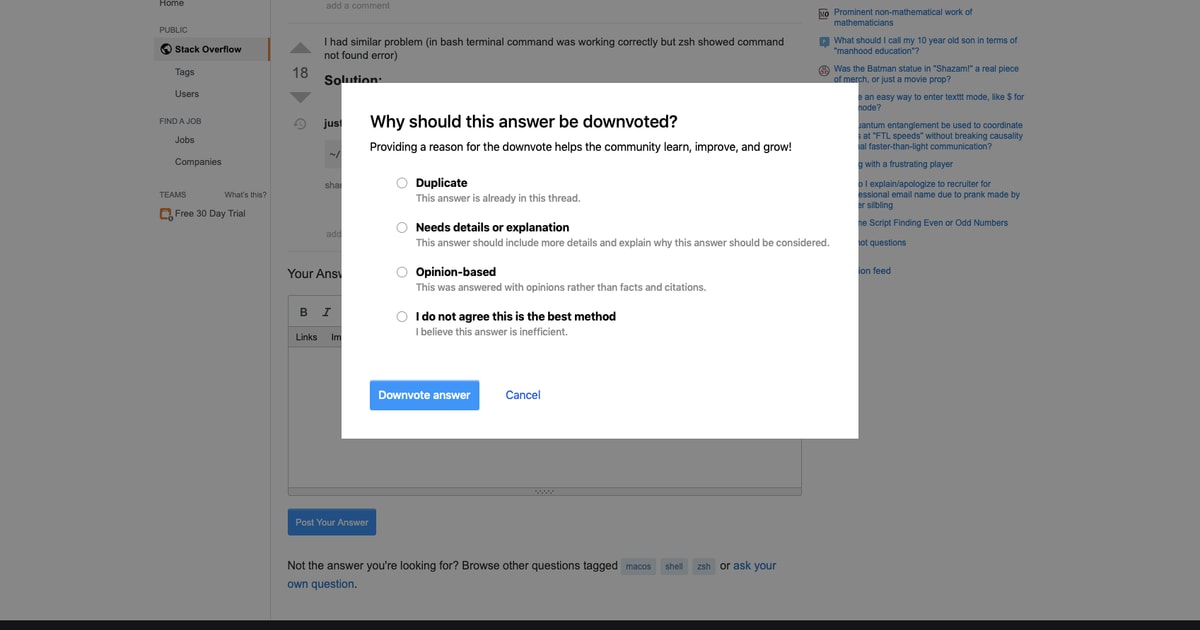
For the community to provide relevant feedback, it needs the tools to do so. Here’s what I proposed.
A downvote asks for a reason. The reason stays attached to the answer, so the author knows what to fix and the next reader knows why the score is what it is.
Incredibly ironic how such an idea is not new, yet it always fell on deaf ears with Atwood. Here’s one commenter on his own blog post:
A community is stronger when its members feel close to one another. Sharing interests and experience with each other is a great way to feel closer to someone. Reddit’s flairs and Discord’s roles are great examples of this.
On Stack Overflow it could sit right next to the name: what someone does and for how long, beside their answer.
Once the community is fixed, how do we make sure things like questions remain high quality? By moving the friction to the moment a question is written, where it helps, instead of after it is posted, where it punishes.
Asking for the language first, narrows the question to the right topic. A search of existing questions runs on the title before the question goes out so the duplicate is caught by the asker, not by a downvote.
When designing a product or system, it’s important to step out of oneself and be excited when our theories are proven wrong, much like a scientist. Easier said than done, of course, as we all have egos to protect.
That said, it’s confusing to me how the writing on the wall is so obvious, yet Atwood, in 2026, remains oblivious to it.
Stack Overflow’s future is bleak. It is essentially a ghost town at this point7, 8, the decline started way before LLMs. It won’t be long before the corporate owner decides it’s too expensive to run and it becomes another archive.
It’s the system’s fault. It’s everybody’s fault. To quote Morpheus:
“You have to understand, most of these people are not ready to be unplugged. And many of them are so inured, so hopelessly dependent on the system, that they will fight to protect it.”
In 14 years my work has reached over 100 million people, from Wikipedia to dating apps, to running the most renowned entrepreneurship program for teens worldwide.
I'm honored to be one of Fast Company's "Most Innovative People".
正文由 探How 从来源站点 RSS 同步,内容未经改写;遇到排版缺失或需要图片、视频时请以原文为准。