Terraform 2026 Update
A brief update on the state of synthetic fuel in late 2026, T+11 months since the Singularity. First, commentary on the global State of Energy. Second, what we’ve delivered so far in 2026. Third, commentary on regulator…
以下正文同步自 Hacker News 最新,版权归原站所有,已转换为易读排版。
A brief update on the state of synthetic fuel in late 2026, T+11 months since the Singularity. First, commentary on the global State of Energy. Second, what we’ve delivered so far in 2026. Third, commentary on regulatory and permitting reform.
My mapping tool shows energy infrastructure damaged in the last five years. Conflict in Iran, Yemen, Saudi Arabia, Russia, Ukraine, Iraq and Syria has resulted in the effective deletion of much of about 10% of the world’s oil production and delivery capacity.
It has been obvious enough to military planners since the 1970s that the global oil supply chain was vulnerable to interruption by unconventional forces.
I founded Terraform Industries in late 2021, and by early 2022, Russia seemed determined to put this notion to the test by invading Ukraine. In the years since, Ukraine and Russia have systematically destroyed each other’s energy and oil refining infrastructure, placing enormous stresses on Eurasian oil supply chains, especially since the “developed West” spent the last 30-40 years voluntarily (!) demolishing its own oil refining capacity.
In 2026, this kicked into high gear with Iran’s denial of the Straits of Hormuz in addition to a simmering conflict in Yemen around the Red Sea.
We hope for a speedy resumption of peaceful trade and conventional international relations, but we’re not putting that genie back in the bottle. In 1944 it took the might of the Nazi war machine to launch a few hundred inaccurate autonomous drones a few hundred miles at London and Antwerp, and the might of US airplane production to deliver tens of thousands heavy bombers to respond by destroying Nazi coal liquefaction plants and fuel delivery logistical capacity.
Today, any non-state actor, proxy, covert/clandestine operative, cartel, or sufficiently motivated middle schooler can extract losses measured in billions of dollars with commercially available hardware that costs thousands of dollars. Kinetic deterrence still exists but is ineffective if you can’t deliver it, your adversary is protected, believes they can hide, or is willing to die.
If you don’t control your own energy supply chain, you are one third party misunderstanding away from rapid regression to the pre-industrial age.
Against this cheery backdrop, Terraform has continued to accelerate its efforts to provide cheap synthetic fuel from sunlight and air.
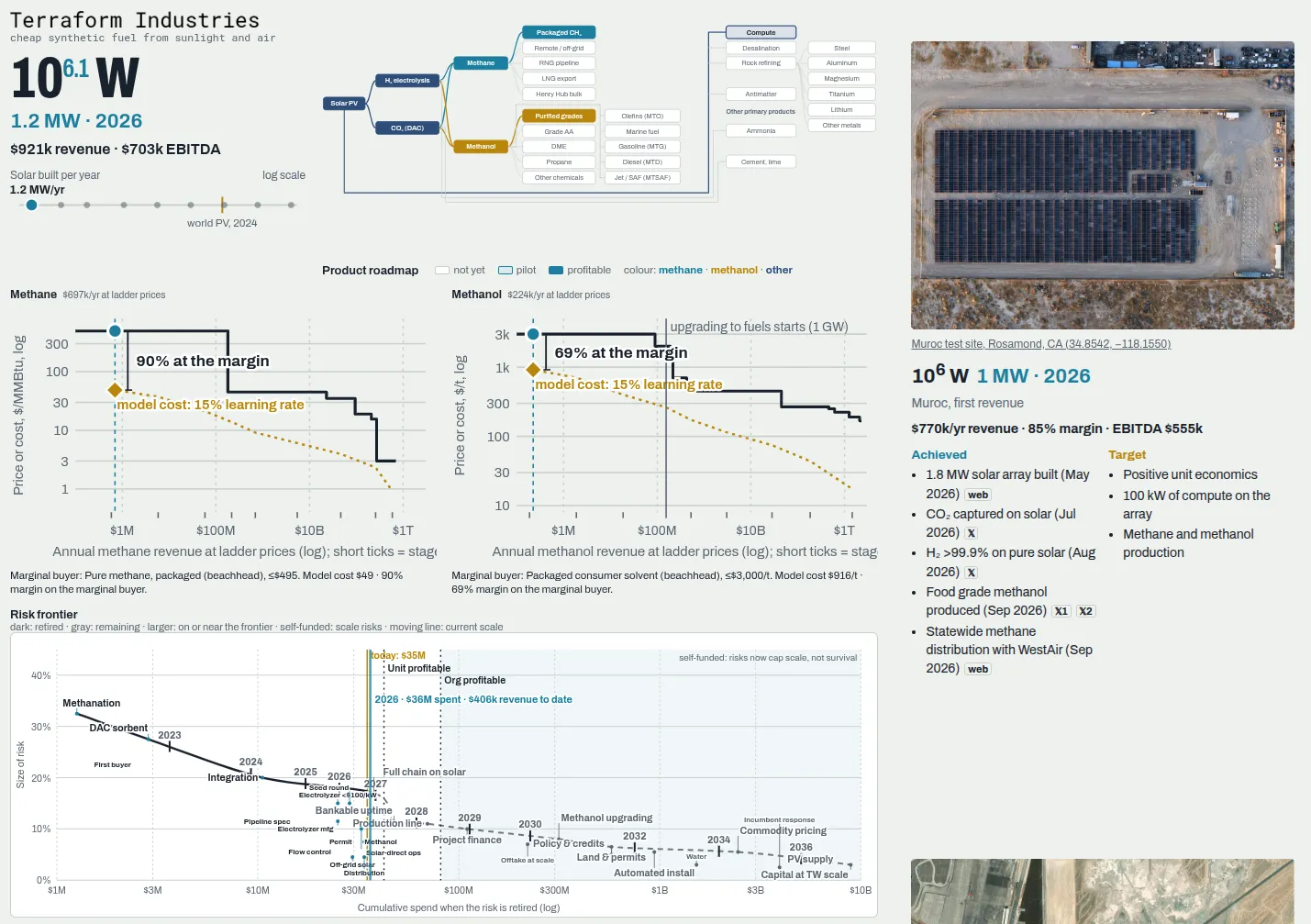
The headline of our 2026 efforts is the development of our Muroc desert test site.
I write this on the 79th anniversary of the first supersonic flight by Chuck Yeager in the Bell X-1. Back then, the nascent X planes experimental program needed a lonely, unpopulated place with good weather, and they settled on an airstrip then known as Muroc, now known as Edwards Air Force Base.
With similar needs, we found a test site in the same town of Rosamond, California, and named it Muroc in honor of those who went before, and those who favor us with a sonic boom at 9:36 every morning!
We closed on the land in January. By the end of March, all the solar panels (nearly 3000!) were in. A lot of cable work and inspections followed. By early July, the word came through from the solar team: we’re ready to go live. The site team, led by Matt Weickert and Tiana Wong, had successfully built a large solar array in California for $0.70/W in less than six months, and this includes its share of first time and small site expenses. With amortization over the coming years, we’re producing power today for 1.6c/kWh, which I’m quite confident is the cheapest power ever produced in North America. Terraform was founded on the supposition that falling prices of solar modules would ultimately trickle down to applications, enabling gigascale energy arbitrage turning cheap solar electrons into valuable energy molecules, and as of 2026, we’ve done it in the real world.
Within a week, the CO2 team successfully produced a high purity (>99%) stream of CO2 from our demo calciner, at our Muroc desert test site, in 110 F heat, using our own captive solar PV array, on the first try.
This represents several world firsts, and is an incredible testament to the team’s brilliance and grit, led by Stephanie Coronel.
I directed each of the three power consuming teams (DAC CO2, electrolyzer H2, and reactor) to fab and deploy a meaningful end-to-end “smoke test”. I knew the desert would test our faith and that our team needed to experience the dust, the heat, and the wind in order to streamline logistics for the full deployment later this year.
DAC was first off the mark. I was fortunate to find a corner of the tent where I was out of the way as we turned on the calciner for the first time, on site. Without drama the array pumped about 30 kW into the test fixture and the temperature rose smoothly to over 1000 C. Soon after that, the team proceeded to <redacted> and CO2 came out. At the end of the test, we had calcined >85% of the carbonate we started with, exceeding our requirements and validating our design, architecture, and processes.
The Terraform CO2 production system captures CO2 from the air (400 ppm) and concentrates it to >99% purity in a single step, feeding directly into a hydrocarbon synthesis reactor which produces methane or methanol.
The overarching challenge of Terraform’s approach is to produce CO2 cheaply enough that it becomes a profit center rather than a cost center. Our strategy of direct consumption of solar power from the array cuts capex and opex to the barest minimum, and our internal production cost, even at this relatively early stage, is already well below $200/T-CO2.
Other than plants and some cyanobacteria, I believe this is the first ever commercially useful direct air capture and production of CO2 at scale.
A few weeks later the hydrogen electrolyzer team at Terraform pulled off yet another first, the sustained production of >99.9% pure H2 from our proprietary, vertically integrated, California-manufactured electrolyzer stack while it was coupled directly to a solar array at our Muroc desert test site.
Most commercial electrolyzers need carefully conditioned power from expensive battery-meditated backup systems. Ours runs directly off the sun. Clouds pass, the day turns to night, and we maintain purity from a stack whose Bill of Materials cost is well below $100/kW.
Terraform’s single-minded focus on capex reduction has allowed us to convert sunlight to hydrogen in an unprecedented demo at a cost below $2/kg. If that wasn’t enough, we have a crystal clear plan of steady execution to push that cost below $1/kg in the coming years.
Rather than linger on this point in response to experts-with-spreadsheets who said this was not only beyond my team, it was forbidden by known laws of physics, let me tell you a bit about how we actually pulled this off.
We started building this test site in March. Once the panels and electrics were in place the CO2 team were the first to demonstrate production on site. Close behind them the electrolyzer team planned the logistics necessary to project substantial operational ability into a hostile test site in the middle of nowhere. It’s no good to find you’re missing a wrench half way through the day!
Much of the test prep was completed before dawn, when the panels go live. The sun came up and the stack immediately started splitting water into hydrogen and oxygen. The team carefully monitored purity and flammability as the sun climbed through the sky. As designed, the stack warmed up and conducted even more power, maintaining solid production until late afternoon when the setting sun shaded the panels.
Terraform’s synthetic fuel system is uniquely designed to follow the sun and extract the maximum possible value from cheap solar panels.
Hydrogen is a pernicious molecule. It leaks through and embrittles metals, burns almost invisibly at a wide range of mixtures in air, burns hot and fast and can easily undergo a detonation transition, and has about half a dozen other spookily dangerous properties. My advice is to never work with it unless you absolutely have to. The Terraformer produces and consumes H2 in one compact discrete area with a minimum of complexity and fuss, and as expected this demo was completed in accordance with our rigorous safety standards and no unscheduled excitement!
This successful demonstration was also a profound milestone for the team after a testing anomaly last December compelled us to finally rip off the bandaid and move decisively towards the “future design,” which has half the parts but considerable complexity in assembly. No-one else makes electrolyzers this way and we, more than anyone, know exactly why. And also how to do it anyway, translating directly into a unique cost advantage.
A huge congratulation to Ken, Sherman, Chris, Nikhil, Abdullah, and Aaron for their successful test campaign.
Terraform’s hydrogen and CO2 are the chemical precursors for synthetic methane and methanol, which we make in our own synthetic fuel reactor.
Combined, we make oil and gas out of sunlight and air. We are breaking the geological and geographical monopolies on oil production.
Terraform will deploy these electrolyzers by the millions and they will all be plug-and-play with solar PV arrays.
The Muroc smoke test campaign was far from over.
In September, the reactor team at Terraform demonstrated successful production of high purity (food grade) methanol at scale at our Muroc desert test site.
Let’s recap our progress in 2026. In January, we closed on our Muroc test site. By March, construction was underway. By May, we had 1.8 MW of solar installed. In July, we produced CO2 on site, and in August, hydrogen.
Terraform Industries has built an incredible team to revolutionize not just one or two key technical pieces, but the entire stack required to convert sunlight and air into fuel. Like plants, only 100 times higher productivity per acre and requiring no irrigation, fertilizer, or pesticide.
Two years ago, Terraform produced pipeline-grade natural gas for the first time. Since then, we’ve scaled up our methane reactor, increasing production by 250x and reducing contaminants by 10x. A chemically pure grade commands a 100x higher price, increasing revenue and margin.
But it was always clear to me that natural gas was only one piece of the puzzle. It is possible to convert natural gas into other hydrocarbon products like gasoline or jet fuel, but given our precursors are CO2 and hydrogen, we can do one better by directly synthesizing methanol as well.
Methanol is far easier to convert into longer chain hydrocarbon products, either via the MeOH->DME->ethylene pathway, MTG, or variations on Fischer-Tropsch.
Methanol also has significantly higher revenue per molecule than pipeline natural gas, which forms an essential part of our cost-reduction-through-profitable-scale-up strategy, explained in more detail here.
TL;DR: If our learning rate is above (a very conservative) 11%, our margins will strictly increase as we scale up into a market worth about $10t/year.
Amir Ahdnoparvin joined the team earlier this year and speed ran the methanol reactor development program, successfully demonstrating recirculation and heat recycling before integrating these new technologies in a production scale reactor, built from the ground up at Terraform’s facility in Burbank.
As soon as the hydrogen team was done, we shipped our latest reactor up to the desert, plugged it in, and began activating the catalyst. An extended test campaign through the heat of summer followed, punctuated by bunnies nibbling on hoses!
The hard work paid off, with Terraform’s production of significant batches of high purity methanol, independently certified as meeting food grade and shipped to a happy customer. A huge congratulation to the entire team, including Amir, Enric, Dominic, Hugo, and Lucie.
With the completion of this test, Terraform has now demonstrated TRL 9 operation of all of its subcomponents, each develop
正文由 探How 从来源站点 RSS 同步,内容未经改写;遇到排版缺失或需要图片、视频时请以原文为准。