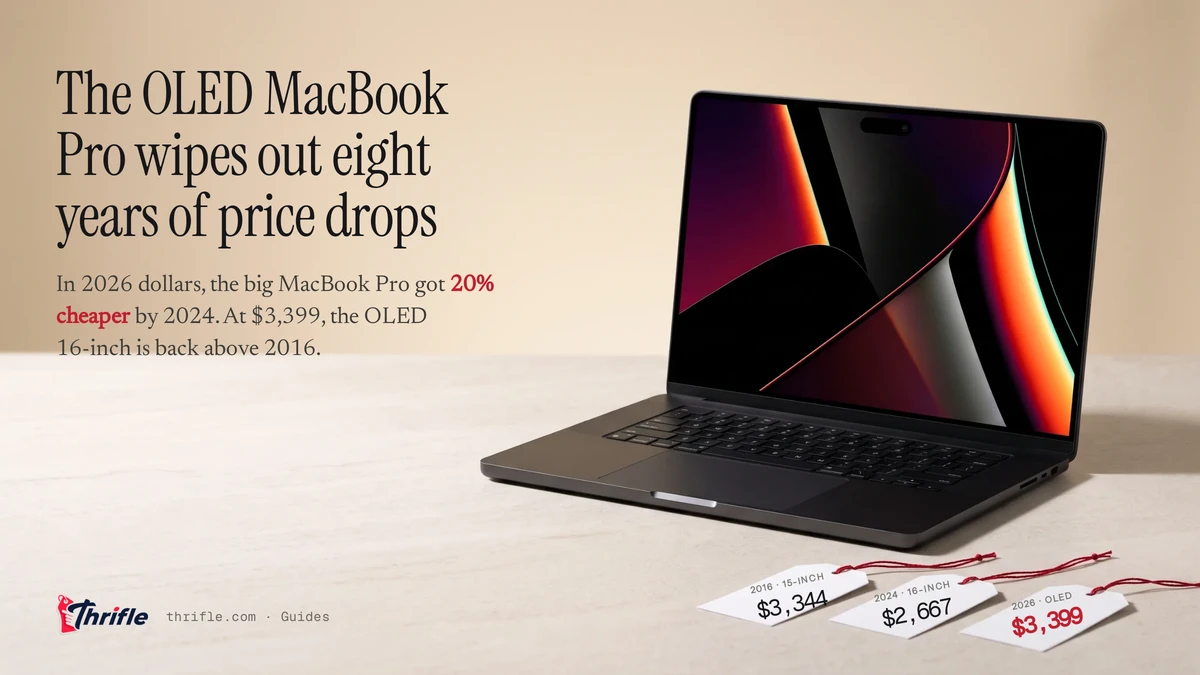
The OLED MacBook Pro Wipes Out Eight Years of Price Drops
If you are pricing the new OLED MacBook Pro, Apple wants $2,899 for the 14-inch and $3,399 for the 16-inch, and both ship November 6. Each one costs exactly $400 more than the same machine with the older mini-LED screen…
以下正文同步自 Hacker News 最新,版权归原站所有,已转换为易读排版。
If you are pricing the new OLED MacBook Pro, Apple wants $2,899 for the 14-inch and $3,399 for the 16-inch, and both ship November 6. Each one costs exactly $400 more than the same machine with the older mini-LED screen, which stays on sale right beside it.
Those prices look different once you line them up against the last ten years. From October 2016 to October 2024 the big MacBook Pro started at $2,399 or $2,499, through a keyboard recall, a switch to Apple's own chips and a full redesign. In 2026 alone it moved three times, to $2,699 in March, $2,999 after the June memory-cost increase and $3,399 when the OLED model arrived this week.
Apple calls it the MacBook Pro with PROLED XDR Display, and everything in that name except the display is shared with the model it sits above. You get the same M5 Pro or M5 Max chip, the same 24GB of memory and 1TB SSD on the M5 Pro, and the same 36GB and 2TB on the M5 Max. Memory and storage upgrades are priced to the dollar like the mini-LED models.
It is Apple's first touchscreen Mac, and it is also lighter.
The 14-inch weighs 3.0 pounds against 3.5 for the mini-LED M5 Pro, and the 16-inch drops from 4.7 to 4.0 pounds. Apple hasn't announced Apple Pencil support, so if you were hoping to sketch on it, wait for hands-on reviews before you order.
The cheapest MacBook Pro is now a $1,999 14-inch with Apple's new M6 chip, 16GB of memory and a 1TB SSD, released a day earlier with the mini-LED screen and no touch. At the other end, a 16-inch OLED with 128GB of memory and the new 16TB SSD option costs $14,549.
On the yellow line the story is messier, because Apple kept changing which model was the cheapest. It fell to $1,299 in 2017 and stayed there through the M1 and M2 13-inch models, then jumped to $1,599 in October 2023 when a 14-inch with the plain M3 chip replaced the 13-inch. Since June it has cost $1,999, which is 54% more than the M2 13-inch it descends from.
Every 2026 increase came with a reason, and only the last one is something you can choose to skip.
The March refresh made 1TB the base SSD and added $100 to $200 to each model. In June Apple raised every MacBook Pro by $300, and M5 Max models by $500, with a statement that "we have never seen a component price increase this much, this quickly." The October OLED model is the first of the three where the extra money buys you a new feature instead of covering Apple's memory bill.
In October 2016 the MacBook Pro dropped MagSafe, USB-A, HDMI and the SD slot for Thunderbolt 3 ports alone, and it added the Touch Bar and Touch ID. If you bought one, the price on the box was only the start, because every older accessory you owned needed an adapter. Its keyboard produced enough repeated, stuck and missing keys that Apple opened a Keyboard Service Program in June 2018 and widened it to every affected model in May 2019. Memory was LPDDR3 at 2133MHz, and the 15-inch came with 16GB and no option for more.
If you needed more than 16GB, the July 2018 15-inch was your first chance, because its move to DDR4 memory made a 32GB option possible for $400 more. It also brought the first six-core MacBook Pro and Apple's T2 chip, which encrypts the soldered SSD, so the storage you bought on day one is the storage you would keep. In November 2019 the 16-inch replaced the 15-inch at the same $2,399, brought back a scissor keyboard, allowed up to 64GB of DDR4-2666 and set the SSD upgrade prices Apple kept for the next six years, $200 for 1TB and $600 for 2TB.
Apple announced its move off Intel at WWDC in June 2020 and shipped the M1 13-inch MacBook Pro that November at $1,299, the same price as the Intel model it replaced. Memory moved into the chip package as unified memory, shared by the processor and graphics, and it has stayed there on every MacBook Pro since. The M1 also cut the 13-inch maximum to 16GB, down from the 32GB you could order on the Intel 13-inch that spring.
The October 2021 14-inch and 16-inch models are the design Apple still sells. You lost the Touch Bar, you got MagSafe, HDMI and an SD card slot back, and the screen became a 120Hz mini-LED panel with a notch. The M1 Pro started at 16GB of LPDDR5 with 200GB/s of bandwidth, the 14-inch launched at $1,999, $200 above the 13-inch it sat over, and the 16-inch took the $2,499 price it would hold for five years.
The M3 Pro in 2023 started at 18GB on a narrower memory bus, and its bandwidth fell from 200GB/s to 150GB/s, the only generation where that number went down. If you bought the plain-M3 14-inch at $1,599, you still got 8GB, which Apple defended by comparing it to 16GB on a Windows PC. A year later the M4 lineup made 16GB the floor on every Mac at unchanged prices, the M4 Pro moved to 24GB and Thunderbolt 5, and memory moved to LPDDR5X.
Base storage doubled to 1TB in March, which explains part of that month's increase, but nothing in the spec changed in June. Since June you pay about $25 per gigabyte for every memory step and $500 per terabyte for every storage step, so the 24GB to 48GB upgrade that cost $400 in March now costs $600, and the M5 Max jump from 48GB to 128GB went from $1,000 to $2,000. The small 8GB steps were already $25 per gigabyte, which means the June increase landed hardest on exactly the configurations people buy for local AI and video work.
At $3,399, the OLED 16-inch costs $55 more in real terms than the 2016 15-inch did, and 27% more than the M4 Pro model you could order two years ago. You do get four times the storage and half again the memory of the 2016 machine for it, so the fair reading is a reset to where Apple started the decade, with a better computer inside.
Spend upgrade money on memory before storage.
Both have been soldered since 2016, but you can add storage later with a Thunderbolt 5 drive and you can never add memory. The day a local AI model or a large project outgrows 24GB, the only fix is a new laptop, and at $600 for the next memory step that mistake now costs more than it did in March.
If you need neither the new screen nor a Pro chip, skip this year's prices and check Apple's Certified Refurbished store, which sells earlier MacBook Pro models with the same one-year warranty Apple gives new ones.
Every price in this post comes from the table below, which lists 52 verified US launch configurations from October 2016 to October 2026. You can download it as a CSV with the source for every row, and sort the table by any column.
The 14-inch MacBook Pro with PROLED XDR Display starts at $2,899 with an M5 Pro, 24GB and 1TB, and the 16-inch starts at $3,399. M5 Max versions start at $4,499 and $4,799. Education pricing starts at $2,749 for the 14-inch and $3,199 for the 16-inch, and the nano-texture glass option adds $150.
No. Both use the same M5 Pro and M5 Max chips with the same memory bandwidth, 307GB/s on the M5 Pro and up to 614GB/s on the M5 Max. Apple rates the OLED model for up to 24 hours of battery life and offers it with up to a 16TB SSD.
The first Apple silicon MacBook Pro was the 13-inch M1, announced November 10, 2020 at $1,299. Apple had announced the two-year transition away from Intel at WWDC on June 22, 2020.
Apple blamed memory and storage chip costs for the June 25, 2026 increase, which added $300 to M5 and M5 Pro models and $500 to M5 Max models. Upgrade prices rose between 25% and 100% at the same time, and Tim Cook told The Wall Street Journal that "price increases are unavoidable."
Launch prices come from Apple Newsroom announcements and Apple tech-spec pages, with launch-day coverage where Apple gave only a starting price. Inflation uses the BLS CPI-U.
Source: Apple Newsroom: MacBook Pro with PROLED XDR Display (Oct 28, 2026) · Apple Newsroom: 14-inch MacBook Pro with M6 (Oct 27, 2026) · Apple Newsroom: MacBook Pro with M5 Pro and M5 Max (Mar 3, 2026) · MacRumors: Apple raises prices (Jun 25, 2026)
Apple Newsroom: MacBook Pro with M1 Pro and M1 Max (Oct 18, 2021) · Apple Newsroom: Mac transition to Apple silicon (Jun 22, 2020) · Apple Newsroom: 16-inch MacBook Pro (Nov 13, 2019) · Apple Newsroom: MacBook Pro with Touch Bar (Oct 27, 2016) · BLS: CPI-U, all items, US city average (CUUR0000SA0) · Dataset: MacBook Pro launch prices 2016 to 2026 (CSV)
正文由 探How 从来源站点 RSS 同步,内容未经改写;遇到排版缺失或需要图片、视频时请以原文为准。