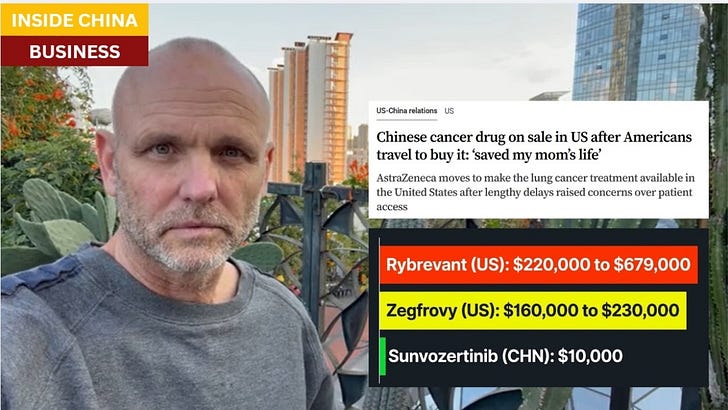
Last year Americans flew to China for a $10k cancer drug. Now it's $200k
China draws tens of thousands of patients from across the world, who access cutting-edge drugs and therapies at low cost.
以下正文同步自 Hacker News 最新,版权归原站所有,已转换为易读排版。
Kevin Walmsley
Oct 31, 2026
17
1
5
Share
Bullets:
China draws tens of thousands of patients from across the world, who access cutting-edge drugs and therapies at low cost.
The US Food and Drug Administration allows for American patients to buy medicines abroad, and bring them back to the US, in certain very limited circumstances.
Western pharma giants have discovered a massive new profit center, in buying global distribution rights from top Chinese labs, then aggressively marking up the price for patients in North America and Europe.
The first part of this report reads like a feel-good story. Max Doppelt’s mom is Debbie Doppelt, she lives in New York City, and has lung cancer. By January of last year, it had spread to her brain, and the only drug that could help her was approved in China, but not yet in the United States. His doc made an offhand comment that if the family were Chinese, they could just pick it up at the neighborhood drugstore.
Max flew to Shanghai, bought 26 boxes of sunvozeritnib, and brought it home. His mother is still alive and well.
Sunvozeritnib was approved in China three years ago. It is produced by Dizal Pharmaceuticals in Shanghai, and in China it is considered “best in class” for treatment of non-small cell lung cancer, which is unfortunately quite prevalent here.
The same drug was approved by the FDA last year, but was not yet commercially available in the United States, so the only option was getting on a plane and flying over.
That’s a feature of the American medical system. This is a pharmacy in Hong Kong that ships Chinese drugs across the world, but cannot do so in most cases for patients in the United States.
Mr. Doppelt knows of 30 other Americans who made the same trip he did, flying to China and getting the drug and flying home. He closes the tweet by saying more should be done to get more drugs developed and available in the United States, and that means big changes are needed at the FDA.
The story was picked up by the Washington Post, but it’s paywalled so we shared most of it onscreen.
This is the longer version. Used to be that New Yorkers could expect the best medical care in the world. But China has developed and approved a lot of drugs that aren’t available in the United States. Debbie Doppelt was diagnosed with her condition in 2023, and after rounds of chemotherapy and surgeries, the disease was still advancing. Her doctors considered numerous other treatments, but none of them panned out.
They were able to get their hands on a small supply of sunvozeritnib, Debbie made good progress, so Max got on a plane, brought more back. Other Americans also went over for that drug. And lots of others fly in for cutting-edge treatment and therapies in other diseases also.
It’s a happy ending for the Doppelt family. The drug worked. And AstraZeneca has bought the rights to distribute sunvozeritnib in the United States, so that means “no more trips to China”.
Here’s where things get technical, and expensive. American citizens and foreign nationals generally are prohibited from bringing medicines into the United States, which have not yet been approved by the Food and Drug Administration. However, there are some allowances, in very specific cases.
If it’s “for a serious condition for which treatment is not available in the US through commercial or clinical means”, and “no known commercialization or promotion of the product. Then the quantity can only be for three months—that means repeated flights back and forth to China, to pick up enough medicine for the next 90 days.
According to the original tweet on X, and the Washington Post report, Max Doppelt brought 26 boxes and put them in his luggage. That is a nine-month supply, not three-month. So if true, he took a large, calculated risk of Customs simply seizing all of it.
However he did it, it is that loophole in the regulation that allowed Max Doppelt to bring over the drugs that saved his mom’s life. And now that loophole is being closed, with the announcement by AZ that they would commercialize the drug for sale in the United States. Sunvozeritnib was approved for use in the United States in 2025, but not yet commercially available. Now it is, and US patients can get the drug through AstraZeneca, who is re-branding the drug as Zegfrovy.
AZ paid Dizal $600 million upfront, and will owe royalty payments to Dizal based on global sales of the drug through AstraZeneca’s sales channels outside China. AZ “will take responsibility for the treatment’s global development and commercialization”. This is a research report that assesses the impact to AZ’s stock price, and they note that the company has a target of $80 billion in annual revenues by 2030. Zegfrovy is a cancer drug, and oncology is one of the fastest-growing profit centers for drug companies.
Whether or not, and by how much, this is a good partnership for Astra Zeneca, is dependent on how much AZ can sell the drug for, and how they can expand its use. That’s to say that Astra Zeneca hopes to use Zegfrovy to displace other drugs, offered by other Big Pharma companies, including the ones that did NOT work in the Doppelt’s case.
And the other way to make the partnership pay off, is to aggressively mark up the price. In China, a nine-month supply of Zegfrovy is 26 boxes, and costs $10,000. The drug is part of China’s national insurance system, so the out-of-pocket costs to Chinese nationals are about a third that. But the forecasted price from AstraZeneca, to patients in the United States, for that same supply and dosage, is $160,000 to $230,000. That estimate is based on current US pricing models for similar targeted cancer therapies that are in the market now:
It is exactly the same drug, and it is produced in exactly the same Shanghai facility. The only difference is that it’s put into a box that says AstraZeneca on the side of it, and has a name that’s a lot easier for Americans to pronounce.
What’s more, Zegfrovy was developed here, in China—so it’s not like AZ has a lot of Research and Development costs they need to recoup. The high price is a function of what the drug can command in the American market, and how much other drug companies, like Pfizer or Merck, might offer to Dizal to have distribution rights to their drug.
We’ve made this point several times, about the impacts of this to GDP, and how we are probably measuring it the wrong way. The very same product that contributes $10,000 to Chinese GDP, has an impact on US GDP of 20 times that. If we really wanted to reform the FDA, we would change all these rules.
If we really were serious about the affordability of everything, and prescription drugs in particular, we would let Americans in the so-called “land-of-the-free” buy the drug online from Shanghai or Hong Kong send it over by FedEx.
Matt@matt503ea5sf9z5
@shuimaojin @maxdoppelt keep in mind the average annual salary in China is ~ $10k usd
9:50 PM · Oct 22, 2026 · 5.32K Views
11 Replies · 23 Likes
As Politicians Argue About China, US Patients Find Cutting-Edge Treatment There https://kffhealthnews.org/health-industry/china-cancer-drugs-foreign-travel-pharma-biotech-fda-regulation-clinical-trials/
Washington Post, US Patients fly to China for life-saving cancer drugs https://www.washingtonpost.com/health/2026/10/20/us-cancer-patients-need-lifesaving-drugs-some-have-get-them-china/
FDA, Regulations Governing Personal Importation https://www.fda.gov/industry/import-basics/personal-importation
Chinese cancer drug on sale in US after Americans travel to buy it: ‘saved my mom’s life’ https://www.scmp.com/news/us/article/3371835/china-made-cancer-drug-go-sale-us-after-americans-travel-buy-it
Sunvozertinib (Zegfrovy) Launches in US for Previously Treated EGFR Exon 20 Insertion NSCLC https://trial.medpath.com/news/sunvozertinib-zegfrovy-launches-in-us-for-previously-treated-egfr-exon-20-insertion-nsclc
Zegfrovy (Sunvozertinib) | NSCLC | HongKong DengYue Med https://dengyuemed.com/product/zegfrovy-sunvozertinib-nsclc/
AstraZeneca Secures ZEGFROVY Rights in Up to $1.5B Deal https://trial.medpath.com/news/astrazeneca-secures-zegfrovy-rights-in-up-to-1-5b-deal
AstraZeneca Made a $1.5 Billion Lung Cancer Bet, but Can Zegfrovy Strengthen its Oncology Growth? https://finance.yahoo.com/healthcare/articles/astrazeneca-made-1-5-billion-193855181.html
Sunvozertinib in EGFR Exon 20 Insertion NSCLC: Approved but Not Available – Practical Dose Selection Considerations and Real-World Access Challenges https://www.dovepress.com/sunvozertinib-in-egfr-exon-20-insertion-nsclc-approved-but-not-availab-peer-reviewed-fulltext-article-LCTT
ZEGFROVY® (sunvozertinib) now available in the US for patients with previously treated non-small cell lung cancer with EGFR exon 20 insertion mutations https://www.stocktitan.net/news/AZN/zegfrovy-sunvozertinib-now-available-in-the-us-for-patients-with-sncw2bb9ifkm.html
Dizal Pharma, company page
Dizal to Present Emerging Data on ZEGFROVY® in Non-Small Cell Lung Cancer at WCLC 2026 https://www.prnewswire.com/news-releases/dizal-to-present-emerging-data-on-zegfrovy-in-non-small-cell-lung-cancer-at-wclc-2026-302857202.html
Inside China Business, Are we measuring China's GDP wrong?
正文由 探How 从来源站点 RSS 同步,内容未经改写;遇到排版缺失或需要图片、视频时请以原文为准。