FM Broadcasting in Western Germany
Fig. 2 - (a) FM slope detector circuit. (b) Peaking the tuned
以下正文同步自 Hacker News 最新,版权归原站所有,已转换为易读排版。
Fig. 2 - (a) FM slope detector circuit. (b) Peaking the tuned circuit below the FM carrier converts carrier-frequency deviations to audio voltage variations.
In general, FM receiver circuits developed in the United States have such high sensitivities that large areas can be served by low-power transmitters. The comparatively low prices of sets, tubes, and parts in the United States make it possible to manufacture and sell the elaborate multi-tube receivers needed there. In spite of these favorable factors, FM broadcasting has not developed as a serious competitor to AM in the United States. To make sure that it does so in Western Germany - and this was not merely a matter of preference, but an absolute necessity - it was decided to blanket the entire country with field strengths of more than 1 mv/m by installing an adequate number of high-power FM transmitters. To be able to provide this high field strength over the large area required and to make a complete network of transmitters as quickly as possible the following basic requirements were established:
The FM transmitting antennas were to be mounted on top of existing 600-foot vertical transmitting antennas used for medium-wave broadcasting. Assuming that the radius of the area to be served is 30% greater than the optical distance to the horizon and that the signal level at the fringes of this area should be 1 mv/m measured at 30 feet above ground level in accordance with international definition, the effective radiated power (ERP) of each transmitter must be about 60 kw. Horizontal polarization is used, as in the United States. Antenna gains of 8 to 1 can be obtained easily. Line losses between transmitter and antenna can be figured at about 20% if the FM transmitters are installed in the existing buildings now used for the medium-wave transmitters, which are generally about 600 feet from the bases of the antenna towers. This calls for a 10-kw output from the FM transmitter, a power that can be provided at reasonable cost.
The high field strength available with this system everywhere has two important advantages from the receiving side:
Very simple and inexpensive receiving antennas - in most cases indoor types - can be used; Good quality reception is possible without the high-sensitivity FM circuits developed in the United States.
To reduce receiver selectivity requirements - helping to keep receiver costs as low as possible - the minimum frequency separation between channels was set at 0.4 mc, twice the separation used in the United States. (This does not mean that each station utilizes the full 400-kc bandwidth provided by this arrangement. Deviation is limited to ±75 kc, as in the United States, and the unused separating channels may be used eventually for additional stations.)
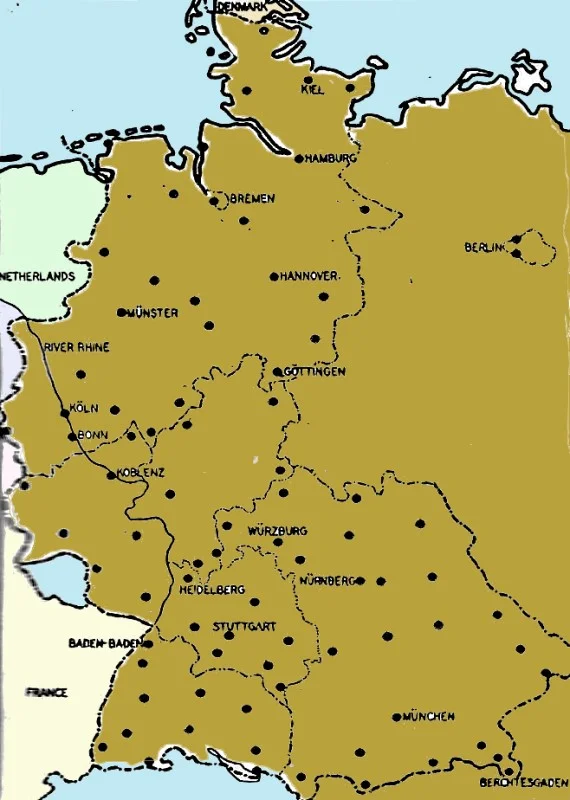
Sixty-two FM transmitters operating between 87.5 and 100 me have been installed in Western Germany in the two years since FM was introduced. The map (Fig. 1) shows how completely they cover the territory to be served. Relatively few transmitters are needed to cover the flat northern part of the country with transmitting antennas on top of existing 600-foot towers. The southern part of the country has mountains of 6,000 feet high available for the stations, but there are deep valleys as well, so that more transmitters are needed to cover a given area in the south. One of the most important facts that made this network of transmitters possible is that the "shadow" areas cast by mountains, houses, and other obstacles are only gray
- never quite black. Reception is possible not only with roof antennas, but also with indoor antennas on all floors of buildings, the ground floor included. Even indoors the electrical shadows are only gray and not black, and the high field strength assures adequate receiver-input voltages for good reception.
For the future it is intended to install many more transmitters in order to offer a bigger choice of programs in the FM range.
One of the many interesting special problems that had to be solved for the development of the FM technique in Western Germany should be mentioned.
正文由 探How 从来源站点 RSS 同步,内容未经改写;遇到排版缺失或需要图片、视频时请以原文为准。