Production-grade LLMs and agents: a field guide
A maturity model for taking agents from an impressive demo to a system people can depend on — with a self-assessment and the map to a deep-dive on each layer.
以下正文同步自 Stack Overflow Blog,版权归原站所有,已转换为易读排版。
October 8, 2026Production-grade LLMs and agents: a field guide
A maturity model for taking agents from an impressive demo to a system people can depend on — with a self-assessment and the map to a deep-dive on each layer.
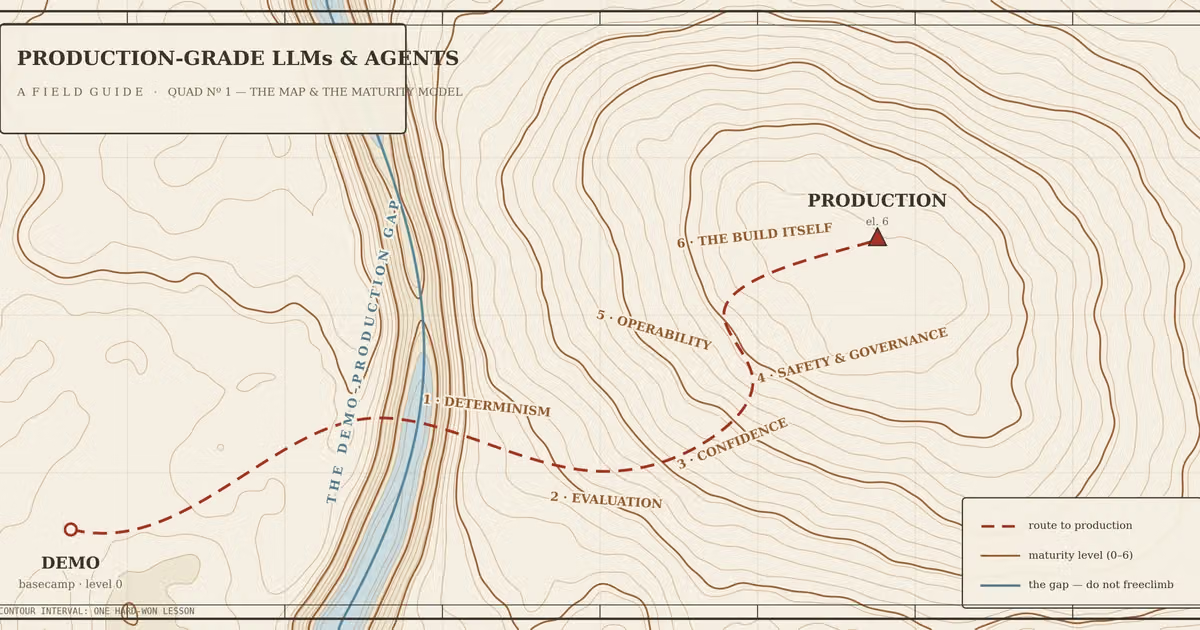
There’s a canyon between an agent that demos well and an agent you’d put in front of customers or money. Crossing it isn’t about a bigger model — it’s the boring machinery around the model: determinism, evaluation, calibrated confidence, layered guardrails, an audit trail, and observability. This post is the map and the maturity model. Each layer links to a focused deep-dive.
LLMs are probabilistic; production demands guarantees. You get guarantees not by making the model deterministic (you can’t) but by shrinking the model’s job to the smallest decision that needs judgment, then wrapping that decision in deterministic machinery you can test, gate, audit, and observe. The model is one contained component in an otherwise ordinary, well-engineered system.
Levels you climb, each assuming the one below.
The level — What you have· The tell for gaps
How to use it: find your weakest level and fix that, in order. Most teams are strong at 0 and wish for 5 — but determinism comes before evals, evals before trusting confidence, confidence before automating, safety before scaling, observability before sleeping at night.
Fewer than half ticked → you’re earlier than the demo suggests. The series below is the path.
Level 1 · Determinism 1. Make your AI agents boring · 2. Anatomy of an agent request · 3. Structured output over free-form · 4. Bounded ReAct: the one place loops belong
Level 2 · Evaluation 5. Evals as a deployment gate · 6. Drift detection in production
Level 3 · Confidence 7. Building on confidence · 8. LLM-as-judge · 9. Human-in-the-loop UX
Level 4 · Safety & governance 10. Defense-in-depth guardrails · 11. PII at the boundary · 12. The append-only audit ledger · 13. A memory model for multi-tenant agents · 14. Seed vs runtime
Level 5 · Operability 15. Hexagonal architecture for AI · 16. Observability for LLM systems · 17. Cost control · 18. Model routing & fallback · 19. Kill switches & graceful degradation · 20. Identity for agents · 21. What infrastructure an agent platform actually needs · 22. Making an agent pipeline fast
Level 6 · The build itself 23. Running a build with parallel autonomous agents · 24. The decision log 25. An operating system for coding agents
You don’t reach production by trusting the model more; you reach it by containing it more — and building the testable, measurable, auditable, observable system around it. Climb the levels in order. Each post below is one rung.
Series: Running LLM systems in production.
A maturity model for taking agents from an impressive demo to a system people can depend on — with a self-assessment and the map to a deep-dive on each layer.
These articles are licensed under a Creative Commons Attribution-ShareAlike 4.0 International license.
creativecommons.org/licenses/by-sa/4.0/deed.en
正文由 探How 从来源站点 RSS 同步,内容未经改写;遇到排版缺失或需要图片、视频时请以原文为准。