The psychology of separating church and state Essays
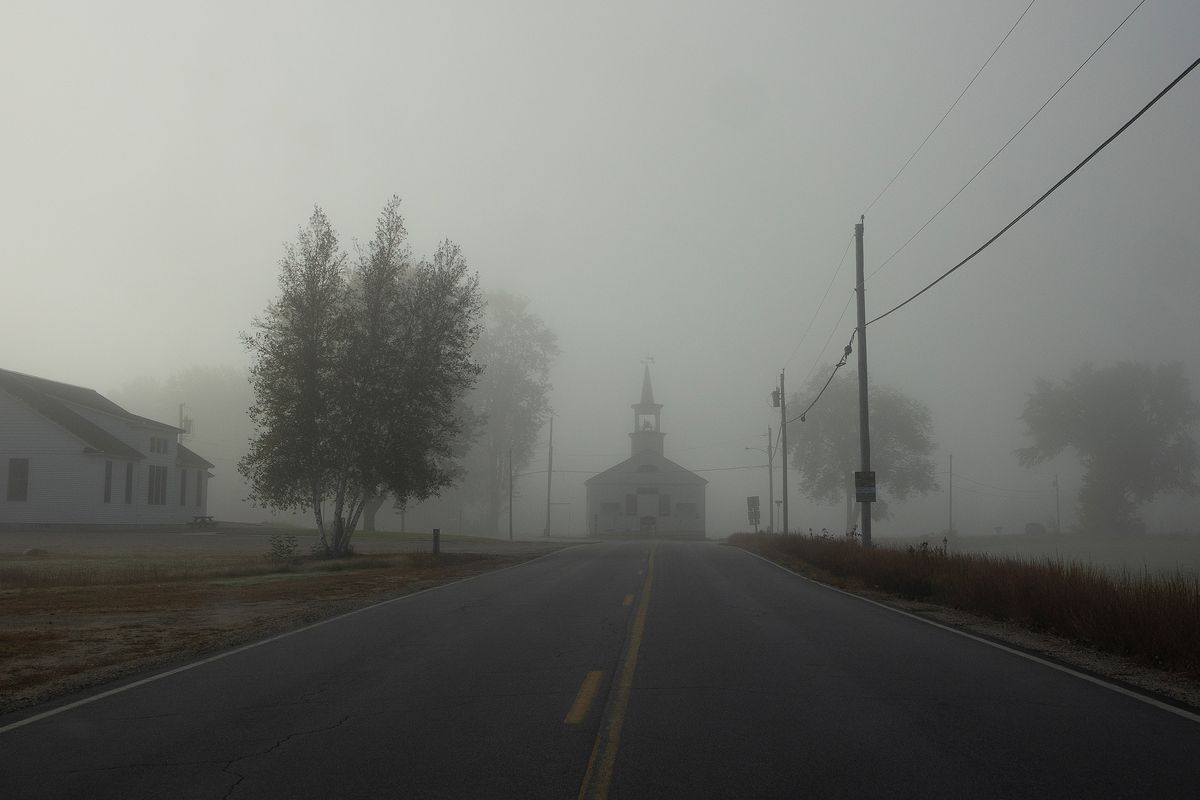
Fryeburg, Maine, US. Photo by Andrew Lichtenstein/Corbis/Getty Images
以下正文同步自 Hacker News 最新,版权归原站所有,已转换为易读排版。
Fryeburg, Maine, US. Photo by Andrew Lichtenstein/Corbis/Getty Images
is professor of philosophy at Florida State University, where he specialises in philosophy of mind and cognitive science. He is the author of Religion as Make-Believe: A Theory of Belief, Imagination, and Group Identity (2023) and a recipient of the European Commission’s Marie Curie Fellowship. His research has been covered in The Atlantic, The New Yorker and The New York Times, among others.
is the James Edmund and Margaret Elizabeth Hennessey Corry Professor at Florida State University College of Law, where he specialises in constitutional law and law of democratic process. He is the author of The Law of Freedom: The Supreme Court and Democracy (2023), which won the 2024 Distinguished Scholarship Award from the AALS Election Law Section.
Save
Political philosophyPolitics and governmentValues and beliefs
SYNDICATE THIS ESSAY
SaveShare
Listen to this essay
The idea of separating church and state – now entrenched in many modern liberal democracies – is in some ways strange. After all, governments must keep themselves informed and inform their citizens. That’s why they turn to the science of meteorology to predict weather patterns, to economics to understand patterns of growth and decline, and to the medical sciences to improve public health. So why wouldn’t governments also keep close alliances with religious institutions to know what’s going on with God?
Separating church and state appears strange from other perspectives as well. In the historical sweep of large-scale human societies, it’s a relative newcomer, often associated with the United States’ founding father Thomas Jefferson. In 1802, Jefferson asserted the principle of separation in a letter to the Danbury Baptist Association in Connecticut:
We’re fans of Jefferson’s principle, one of us (Neil Van Leeuwen) being a philosophy professor who grew up in the Christian Reformed Church, and the other (Jacob Eisler) being a law professor who regularly attends synagogue. But Jefferson’s letter makes putting the principle into practice sound simpler than it is – as though governments could be entirely hands-off when it comes to people’s beliefs, or ‘opinions’. That, however, can’t be right: engaging with and shaping political, social and other kinds of beliefs is actually a core function of government. Public education guides what people believe about everything from mathematics to history to astronomy. Governments also shape beliefs for policy reasons. If fire department officials learn that people believe a building is safe when it isn’t, they will try to change what people believe about the building’s safety. Belief is also a category of legal interest. If a psychotherapist, for example, believes a patient is a danger to himself or others, the therapist is obligated by law to report that belief.
All this means that Jefferson’s ‘wall of separation’ can’t sensibly prohibit governments from intervening on beliefs of any type whatsoever. Rather, Jefferson – along with advocates of the principle who came after him – must have presupposed that there is something distinctive about religious beliefs that makes it reasonable to give them a different legal status.
But what is this distinctive thing? Is it that religious beliefs concern God? No, because Buddhism is a religion with its own beliefs, yet Buddhism has no supreme deity. Is it that religious beliefs concern the supernatural generally? No, because many superstitions that aren’t part of a religion concern the supernatural too. Is it that religious beliefs concern morality, as the biologist Stephen Jay Gould once suggested? No, because many religious beliefs aren’t about morality, and many moral beliefs aren’t religious. In any case, any system of government must presuppose some moral beliefs – eg, that murder is wrong – to be a government at all. These considerations might make one despair of articulating the psychological distinction of interest – what’s different about religious ‘belief’? – that’s needed to make sense of separating church and state in the first place.
Such attempts at characterising religious belief fail, we think, because they focus on belief contents, or what the believing is about. But since any given idea can be believed in a religious way or not, that won’t work. Our suggestion, then, is that religiously believing is a different attitude from ordinary matter-of-fact believing – a different way of relating to ideas – and that this is what’s distinctive about religious belief. In other words, sacralising an idea is different from just taking it to describe how things are. Furthermore, empirical research in cognitive science and anthropology of religion, along with accompanying philosophical analysis, can help reveal characteristic features of the difference in attitude we’re after. To have specific terms, we call that the difference between religious credence and factual belief. Understanding this difference, we’ll see, helps make sense of Jefferson’s wall of separation, and supports the rationale for separating church and state in liberal democracies more generally.
Whatever they are, ‘beliefs’ come in different varieties. The word ‘belief’ is polysemous – meaning it can refer to a range of different-but-related things – and it subsumes a motley crew: from humdrum factual beliefs (say, about where the ice-cream store is) to superstitions (like those found in astrology), and from moral beliefs about murder to philosophical beliefs about how ‘all is one’. As mentioned earlier, beliefs can also be categorised by their contents (what is the belief about? Is it about politics? Or maybe about a probable scientific theory?) Or by the attitude they embody (how does a person relate to given ideas or contents?) Here, however, we focus on the differences between matter-of-fact believing and religious credence as distinct ways in which people process ideas. There are, of course, more varieties of belief-like attitudes. But we home in on factual belief and religious credence since the differences in those attitudes matter most to the psychology of separating church and state.
Ethnographies of religion, like the anthropologist Tanya Luhrmann’s When God Talks Back (2012), feature the devout talking of their ‘beliefs’ as a matter of choice. One of the congregants from the Vineyard Church whom Luhrmann interviewed told her: ‘There is always a choice to believe what it is.’ And a common theme in the Vineyard is choosing Jesus, which means choosing to believe in Jesus. Nor is choosing ‘belief’ unique to Christianity. People around the world switch religions for reasons of romance or for other social incentives, which means voluntarily choosing what religious credence to have.
But suppose someone offered you $1 million to believe, in a matter-of-fact way, that lions are vegetarians. Could you do it? We doubt it, even if you wanted the money. You could voluntarily imagine that lions are vegetarians, or you might pretend to believe it. But if you know that lions eat meat, you can’t just choose to believe the contrary. This is one illustration of how factual belief is not under voluntary control. Or, as one of us (Neil) has put it in Religion as Make-Believe (2023): if you factually believe it, you can’t help believing it. Try for a moment to factually believe that New York City is in Quebec, that Iceland is in the Southern Hemisphere, or that Justin Bieber speaks Swahili as his mother tongue.
This gives us our first processing difference between religious credence and matter-of-fact belief:
Difference number 1: religious credence is voluntary, while factual belief is involuntary.
But if matter-of-fact belief isn’t voluntary, or responsive to the will, what does it respond to? Numerous psychological pressures come into play, including distortions like biases and misremembering. But that shouldn’t obscure the main driver of factual belief: evidence. Examples are so simple they’re easy to overlook. If you think, in a matter-of-fact way, that you started the washing machine and then, an hour later, see that the clothes you loaded are dry and still dirty, the evidence of your eyes extinguishes your prior factual belief. If you think the supermarket is open and then arrive to find its lights are all out, that evidence changes your factual belief.
Noah was an exemplar of faith for building an enormous boat when there was no evidence of an impending flood
Empirical research reveals such evidence-responsiveness already in children and even infants. According to The Scientist in the Crib (1999) by the developmental psychologist Alison Gopnik and colleagues, young children and even babies learn about the world by forming mini-theories in different domains, and testing them – much like scientists do. According to the research of the developmentalists Paul Harris and Melissa Koenig, children are also evidentially discriminating in how they learn from other people. Among other things, children are more likely to believe sources that have been accurate in the past than sources that have been inaccurate.
Is religious credence similarly responsive to evidence?
Consider faith. In Hebrews 11:1, we read: ‘Now faith is the assurance of things hoped for, the conviction of things not seen.’ If that’s right, then religious credence doesn’t depend on evidence in the way factual belief does. In the Gospel of John, for example, we read about Doubting Thomas, who demands evidence that the man before him is Jesus resurrected; he consequently is an exemplar of what faith is not. In the Old Testament, Noah was an exemplar of faith for building an enormous boat when there was no visible evidence of an impending flood. Examples can be multiplied. If faith is to stand strong, religious credence must endure the slings and arrows of absent, or even contrary, evidence.
Contemporary cognitive science of religion bears out this point. In a series of cross-cultural studies, researchers have found that, from a young age, people, even in religious societies like Iran and the US, report lower levels of confidence in the invisible religious entities they profess, like God and angels, than in invisible scientific entities, like germs and oxygen. That difference in confidence is presumably due to the felt poverty of evidence for the invisible religious entities. Yet people in some sense nonetheless ‘believe’ (read: religious credence) in the invisible religious entities. The psychologists Emily Liquin, S Emlen Metz and Tania Lombrozo conducted studies finding that participants indicated a lower need for explanation when it came to religious beliefs as opposed to scientific beliefs, while at the same time having a higher mystery acceptance for religious beliefs. So people are often fine treating their religious credences as inexplicable and mysterious.
That gives us our second difference between religious credence and matter-of-fact belief:
Difference number 2: factual belief is highly vulnerable to evidence, while religious credence is not vulnerable to evidence.
There are, of course, complications here. Religious apologists, for example, claim evidence for the stories and doctrines they profess. But claiming evidence is not the same as having one’s credences be vulnerable to it, and apologists are outliers anyway against the broad background of faithful who don’t usually pretend to treat their religious credence in an evidence-based way.
Those differences, voluntary choice versus evidence-responsiveness, are differences in how religious credence versus factual belief arise in the first place. But what about downstream differences, like how they bring about action and behaviour?
This brings us to the third difference. Have you ever heard the expression ‘once-a-week Christian’? The phrase describes people who act as though their Christian ‘beliefs’ are true one day a week – and then largely leave them dormant otherwis
正文由 探How 从来源站点 RSS 同步,内容未经改写;遇到排版缺失或需要图片、视频时请以原文为准。