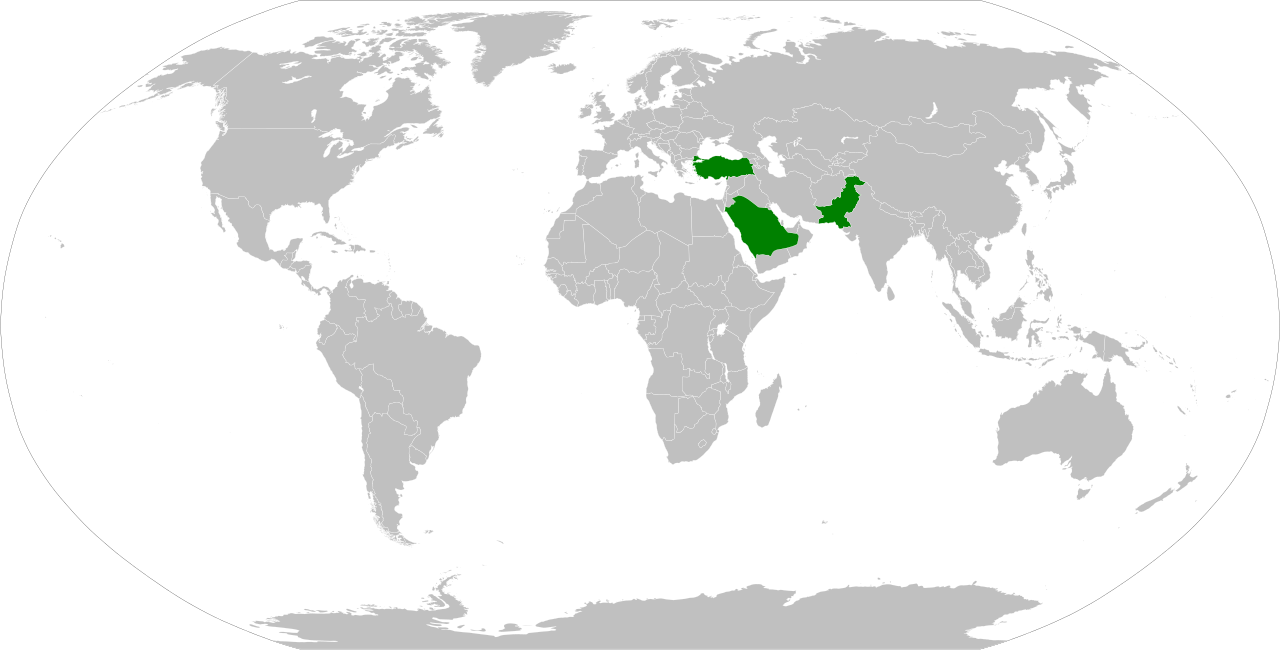
Mecca Defence Alliance
The Mecca Defence Alliance, [[Turkish language|Turkish]]) Mekke Savunma İttifakı<br> ([[Urdu]]) مکہ دفاعی اتحاد"}},"i":0}}]}'>[a] formerly the Mecca Joint Defence Agreement, also known as the Mecca Pact or Makkah Allian…
以下正文同步自 Hacker News 最新,版权归原站所有,已转换为易读排版。
The Mecca Defence Alliance, [[Turkish language|Turkish]]) Mekke Savunma İttifakı<br> ([[Urdu]]) مکہ دفاعی اتحاد"}},"i":0}}]}'>[a] formerly the Mecca Joint Defence Agreement, also known as the Mecca Pact or Makkah Alliance,[1][2] is an intergovernmental military alliance in the Muslim world that was signed into force by Pakistan, Saudi Arabia, and Turkey on 7 August 2026.[3][4] It builds upon the earlier Strategic Mutual Defence Agreement signed between Pakistan and Saudi Arabia on 17 September 2025 to include Turkey.[5][6][7] The pact's ratification was officially announced amidst the 2026 Iran war.[4] The text has not been released.[8]
The Mecca Defence Alliance enshrines a collective security arrangement modelled on Article 5 of NATO,[9] with its official announcement stating that "any armed attack against any one of the three states shall be regarded as an attack against them all." The trilateral pact has been described by Steven A. Cook as a "major change" in Middle East geopolitics[10] and the first institutional arrangement of its kind in the region.[9]
Saudi Arabia and Pakistan first established a bilateral collective-defence commitment through the Strategic Mutual Defence Agreement (SMDA), signed on 17 September 2025 at Al-Yamamah Palace in Riyadh by Crown Prince Mohammed bin Salman and Prime Minister Shehbaz Sharif.[11] That agreement formalised decades of military co-operation between the two countries, during which Pakistan had long provided training and technical assistance to Saudi forces.[4] Turkey and Pakistan had separately deepened their own defence ties, exchanging warships and training aircraft and in 2023, Saudi Arabia agreed to purchase Turkish drones.[4][12] By mid-2026, Pakistan deployed several thousand troops, fighter aircraft, drones and an air-defence system, to Saudi Arabia, and opened talks with Kuwait in July 2026 on an expanded security arrangement.[4]
The trilateral pact was signed amid rising regional tensions in the Middle East. Saudi Arabia, alongside other Arab nations, was struck by Iran, after the opening of the 2026 Iran war, which threatened oil exports and stability.[4] Turkey and Pakistan, while less directly exposed to the fighting, were reportedly concerned about growing instability.[4]
Pakistani Prime Minister Shehbaz Sharif arrived in Jeddah on 6 August 2026 and performed the Umrah pilgrimage in Mecca the following day[3] while Turkish president Recep Tayyip Erdoğan met Crown Prince Mohammed bin Salman.[3] The collective security agreement was formally concluded in Mecca.[4][13]
At the gracious invitation of the Custodian of the Two Holy Mosques King Salman bin Abdulaziz Al Saud, the President of the Republic of Türkiye, H.E. Mr. Recep Tayyip Erdoğan, and the Prime Minister of the Islamic Republic of Pakistan, H.E. Mr. Muhammad Shehbaz Sharif, paid a visit to the Kingdom of Saudi Arabia, on 24 Safar 1448H, corresponding to August 7, 2026.
His Royal Highness Prince Mohammed bin Salman bin Abdulaziz Al Saud, Crown Prince and Prime Minister received H.E. the President of Türkiye, and H.E. the Prime Minister of the Islamic Republic of Pakistan, at Al-Safa Palace in Makkah, where the Makkah Al-Mukarramah Summit for Joint Defence was held, during which the distinguished relations between the Kingdom of Saudi Arabia, the Republic of Türkiye and the Islamic Republic of Pakistan were reviewed, along with a number of issues of mutual interest.
Guided by the longstanding historical ties among the three States, based on the enduring bonds of brotherhood and Islamic solidarity that unite them, and building upon their shared strategic interests and longstanding defence co-operation, His Royal Highness Prince Mohammed bin Salman bin Abdulaziz Al Saud, Crown Prince and Prime Minister of Saudi Arabia, H.E. Mr. Recep Tayyip Erdoğan, President of the Republic of Türkiye, and H.E. Mr. Muhammed Shehbaz Sharif, Prime Minister of the Islamic Republic of Pakistan, signed the Makkah Joint Defence Agreement, reflecting the three States’ shared commitment to further strengthening their collective security and to promoting peace, security, and stability in the region and beyond, in pursuit of a secure and prosperous future.
The Agreement is intended to strengthen collective deterrence against any act of aggression, and stipulates that any armed attack against any one of the three States shall be regarded as an attack against them all. It further provides for the enhancement of all aspects of defence co-operation among the three States.
— Saudi Arabia, Türkiye, and Pakistan Issue Joint Statement of the Makkah Al-Mukarramah Summit for Joint Defence[14][15][16]
The agreement consists of 16 articles covering collective defence, military and security co-operation, defence-industrial development, intelligence sharing, logistical support, institutional coordination, confidentiality and the agreement's entry into force and termination.[17]
The parties undertake to co-operate in safeguarding one another's independence, sovereignty, territorial integrity and internationally recognised borders. If any party's territorial integrity, sovereignty or internationally recognised borders are threatened or endangered, the parties are to use all necessary means to eliminate the threat or danger.[17]
An armed attack originating externally against any party is to be considered an attack against all parties. If a party suffers an armed attack or military aggression by another country or group of countries, the other parties are to provide immediate assistance using the means of mutual assistance available to them.
The scope and nature of the assistance are to be determined following an objective assessment of the assistance required, in accordance with the right of individual and collective self-defence recognised by Article 51 of the United Nations Charter. The parties are to co-operate within the limits of their available resources, including military means and capabilities.[17]
The parties undertake to co-operate in defence, the defence industry and security, develop relations among their armed forces, and carry out agreed activities intended to strengthen defence co-operation.[17]
The parties are to hold regular consultations on international security matters. They also undertake to assist one another and develop individual and joint measures based on common assessments, with the stated objectives of protecting vital interests and national security and eliminating threats and dangers to their security.[17]
The parties undertake to strengthen existing co-operation and joint efforts, including at the operational level, against terrorism in all its forms and manifestations that adversely affect regional and international stability and security.[17]
In peacetime and wartime, the parties are to encourage reciprocal exchanges of personnel among defence institutions, joint training programmes and exercises, and deployments and other activities intended to increase interoperability among their armed forces and develop their defence capabilities.[17]
The parties are to support technology sharing, joint technology development, joint production and co-operation among defence-industry organisations on the basis of mutual agreement. The areas of co-operation specified in the agreement include:
The agreement establishes a Strategic Political and Defence Committee composed of the foreign ministers, defence ministers and chiefs of general staff of the core parties. The committee is responsible for providing strategic direction for joint defence, developing defence and security co-operation, and addressing obstacles to implementation.
The committee is to meet twice a year, with the host rotating among the parties. Leaders may meet annually if considered necessary. The committee may establish subcommittees, while additional agreements or protocols may be negotiated to implement the co-operation envisaged by the agreement.
Accession procedures and principles for additional parties are to be determined and approved by consensus of the core parties.
A secretariat is to be established in Saudi Arabia to serve the committee. Its organisation, establishment and operating procedures are to be determined by consensus of the core parties. The secretariat is to be headed by a secretary-general appointed for a three-year term on a rotational basis among the core parties, with the first secretary-general being a Pakistani citizen. The article also specifies that the agreement does not prejudice the work of existing military co-operation committees among the parties.[17]
The parties undertake to deepen intelligence co-operation and coordinate their activities by sharing intelligence through mutually agreed secure channels. Such sharing is subject to information-security, data-protection and confidentiality requirements.[17]
Subject to the availability and compatibility of logistical support services, the parties are to provide one another with logistical assistance in peacetime, wartime and other emergencies. The specified forms of assistance include weapons, ammunition, fuel, spare parts and other equipment.[17]
Without prejudice to international law and the relevant domestic laws of the parties, the agreement is to serve as the legal basis for implementing its provisions. The parties are also to propose additional legal measures where necessary.[17]
The agreement does not prejudice the rights and obligations of the parties arising from international agreements they have previously concluded.[17]
The parties undertake to protect classified information and documents obtained under the agreement in accordance with their national legislation. Such information and documents are not to be shared with states, companies or individuals outside the parties. Access is restricted to individuals with the appropriate security clearance and a demonstrable need to know.[17]
Disputes concerning the interpretation or implementation of the agreement are to be resolved amicably through consultations and discussions among the parties.[17]
The agreement may be amended through consultations and unanimous agreement among the core parties.[17]
The agreement is subject to ratification under the procedures applicable in each party's jurisdiction. It enters into force on the date the final instrument of ratification is deposited with the secretariat of the Strategic Political and Defence Committee.
The agreement remains in force indefinitely. A party may withdraw only after ten years have elapsed from the agreement's entry into force, by notifying the other parties in writing through diplomatic channels at least three months in advance.
Termination or withdrawal does not affect ongoing activities or projects agreed upon before the relevant date. Obligations concerning the protection of classified information and the prevention of its disclosure continue after termination or withdrawal.[17]
The agreement was signed in Mecca on 7 August 2026. It was executed in three original copies in Turkish, Arabic and English, with all three texts declared equally authentic. In the event of differences in interpretation, the English text is to prevail.[17]
Analysts described the Jeddah–Mecca summit as symbolically significant, bringing together three influential Muslim-majority states at a moment of heightened regional uncertainty, and as a sign of growing security co-ordination among regional middle powers.[4] Reactions to the pact's predecessor, the September 2025 Saudi–Pakistan agreement, had been mixed: Iranian state media described that earlier pact as non-threatening and potentially a step toward a broader regional security framework, while India maintained a neutral public position.[6]
Nawaf Obaid, a senior fellow at the Department of War Studies at King's College London, commented that the agreement is the beginning of a new defence structure for the region. He called it "the beginning of the post-A
正文由 探How 从来源站点 RSS 同步,内容未经改写;遇到排版缺失或需要图片、视频时请以原文为准。