I inspected all 30,516 remote MCP servers in the official registry
We connected to every remote MCP endpoint in the official MCP Registry, listed its tools, and called none of them. Here is how many actually work, how they break, and what that means for agents and the people who run se…
以下正文同步自 Hacker News 最新,版权归原站所有,已转换为易读排版。
We connected to every remote MCP endpoint in the official MCP Registry, listed its tools, and called none of them. Here is how many actually work, how they break, and what that means for agents and the people who run servers.
By Pavel Osadchuk · October 20, 2026 · 12 min read · Read as Markdown
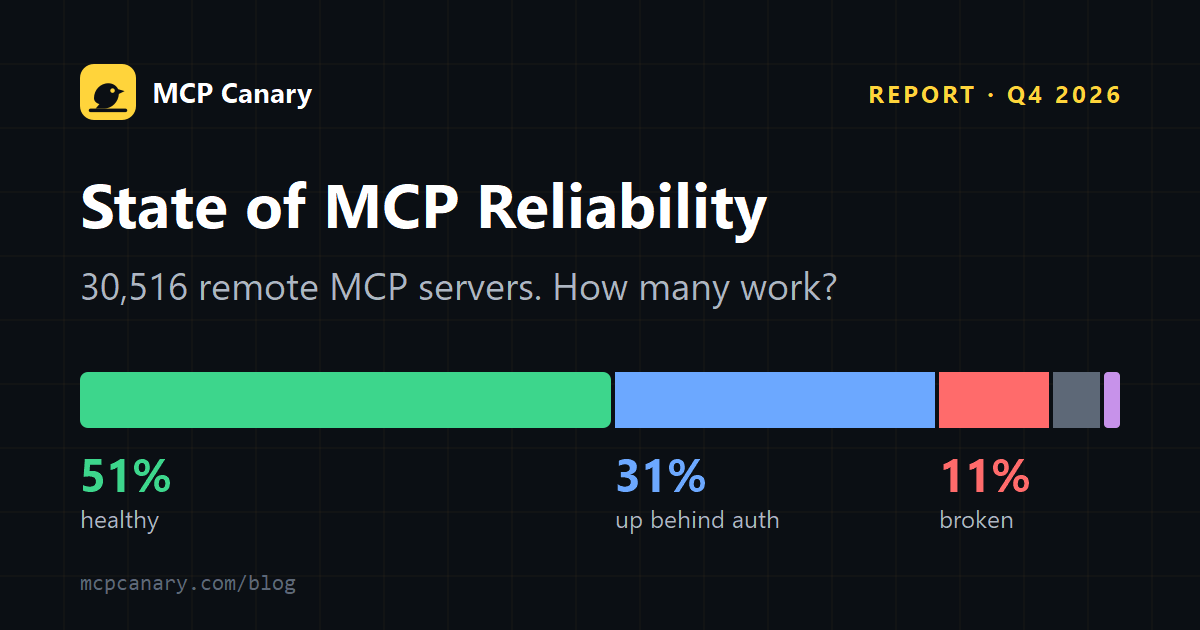
On 20 October 2026 we connected to every remote MCP endpoint in the official MCP Registry: 30,516 URLs. We completed the MCP handshake, asked each server for its tool list, and called no tools. 15,697 servers (51.4%) answered correctly without credentials. 9,517 (31.2%) were up but asked for a key. 3,337 (10.9%) were broken.
The handshake is the easy part, though. For 41% of the servers that passed, no tool says whether calling it is safe, so an agent or a monitor has to treat every tool on them as one that can change data.
We will run the same scan every quarter and track the same servers over time.
The official MCP Registry grew fast. 64% of its remote listings got their latest version in September or October 2026. A listing says that a server exists. It does not say that the server answers, which tools it has today, or whether those tools still work.
Directories and agent platforms show these listings to users as if they all work. Server authors rarely hear about a failure, because an agent that cannot connect does not open an issue. It tries the next server.
So we measured it. This is the baseline for a quarterly series that probes the same population again.
flowchart TD R[Official MCP Registry: 46,227 active servers] --> U[30,832 unique remote URLs] U -->|316 URL templates skipped| P[30,516 endpoints probed] P --> I[Connect: Streamable HTTP, then legacy SSE] I --> L[tools/list, no tool calls]
Three decisions shape these numbers:
What this method misses: it is one snapshot from one place. A server that was down for ten minutes that day counts as broken. And "healthy" means only that the server finished the handshake and listed its tools. It does not mean that the tools work.
An April 2026 scan by AliveMCP of 2,181 endpoints from six sources found 9% healthy. It counted servers that ask for credentials as dead, and it required three passes over three days. Both choices answer a fair question: "can an anonymous agent use this server today?"
We answer a different one: "is this server running and speaking MCP?" A server that answers HTTP 401 is running. It wants a token we did not send. Counting it as dead would hide the 9,517 servers that are probably working products behind a login.
The registry has bulk publishers. The ten largest namespaces hold 22% of all endpoints. The largest has 2,365 endpoints, all healthy. Others have hundreds of endpoints that fail in the same way.
When we count each of the 18,892 publishers once, the healthy share moves from 51.4% to 49.7%, and the auth share rises from 31.2% to 39.4%. The headline holds. Small publishers put their server behind auth more often.
The registry stores when each listing's latest version was published. Grouped by that date:
Listings that nobody has touched since April are broken 40% of the time. The registry keeps them, marked active, next to servers that work. Two notes: this is the date of the latest version, not of the first release, and active publishers both republish often and keep servers alive. The table shows that untouched listings rot. It does not show how fast a single server dies. The next quarterly scan will measure that directly.
Workers looks very healthy partly because the largest bulk publisher (2,365 endpoints) runs there and is fully healthy.
The 3,337 broken endpoints fail in a few repeating ways. Ranked by count:
flowchart LR A[Loud<br/>DNS, TLS, refused] --> B[Visible to a ping<br/>5xx, timeouts] B --> C[Quiet<br/>HTTP 200/404/405, but not MCP] C --> D[Silent<br/>handshake passes,<br/>tool fails or changes]
Some failures are loud. DNS, TLS, and connection errors show up in any uptime tool. Some are quiet. 1,664 endpoints (5.5%) answered HTTP normally (a 404, a 405, or a 200 with the wrong body) and still were not working MCP servers. A plain HTTP check on these hosts is green.
The quietest failure does not appear in this report at all, because no handshake can see it. A server builds its tool list in code, so tools/list still succeeds when the database, the upstream API, or the API key behind the tools is broken. 15,697 servers passed our inspect. That is all we, or any handshake-only monitor, can say about them. To know that a tool works, something has to call it and check the answer.
MCP tools can declare annotations. readOnlyHint: true says that a call changes nothing, and destructiveHint: true warns that it can delete data. An agent uses them to decide whether to call a tool without asking a person. A monitor needs them to choose a tool it may call every five minutes.
Counting each distinct tool definition once (143,074 distinct out of 249,332 served):
Per server, the picture is sharper. Of the 15,686 healthy servers that list at least one tool:
That splits the registry into two populations. The passive population is all 30,516 endpoints: anyone can check the handshake and the tool list. The active-safe population is 7,716 servers where a test call is safe by the server's own declaration. For everything else, only the author can choose which tool to call and with which arguments.
Other schema gaps: 27% of tool arguments (127,694 of 469,186) have no description. 29% of tools declare an output schema. Descriptions are the one part that almost everyone fills in: only 73 distinct tools have none.
An agent loads the full tool list into its context on every session. We estimate the cost as the JSON size divided by 4.
The full inspect (TCP, TLS, MCP handshake, and tools/list) took a median of 1.2 seconds on healthy servers. 90% finished under 3.0 seconds and 99% under 6.0 seconds. The slowest took 20 seconds. All times are from one vantage point.
Clients must support all five. The newest version, 2026-07-28, replaces the initialize handshake with server/discover, and it is already the source of the largest group of protocol errors (222 servers). The deprecated HTTP+SSE transport is almost gone: only 108 healthy endpoints still use it, though 999 of the probed endpoints declare it in the registry.
The probe behind this report is a free command:
curl -fsSL https://mcpcanary.com/install.sh | sh
Windows PowerShell: irm https://mcpcanary.com/install.ps1 | iex
canary inspect https://your-server.example.com/mcp
inspect connects, reports the transport and protocol version, and lists every tool with its safety class. It never calls a tool. If your server needs a token: MCP_TOKEN=... canary inspect URL --bearer-env MCP_TOKEN.
To catch the silent failure, MCP Canary calls one read-only tool on a schedule and checks the result with assertions:
canary monitor set prod --url https://your-server.example.com/mcp
--tool search --args '{"query":"canary"}'
--assert '$.results[0] exists' --interval 5m
By default it calls a tool only when the server declares it read-only, alerts when the tool list changes, and is built to be set up by your coding agent. See the docs for every command.
This is the Q4 2026 baseline. The Q1 2027 report (January) will probe the same population again, so it can show per server:
Run the same probe against your own endpoint. It lists your tools with their safety class and never calls one.
curl -fsSL https://mcpcanary.com/install.sh | sh canary inspect https://your-server.example.com/mcp
Install · Docs · Atom feed · This post as Markdown
正文由 探How 从来源站点 RSS 同步,内容未经改写;遇到排版缺失或需要图片、视频时请以原文为准。