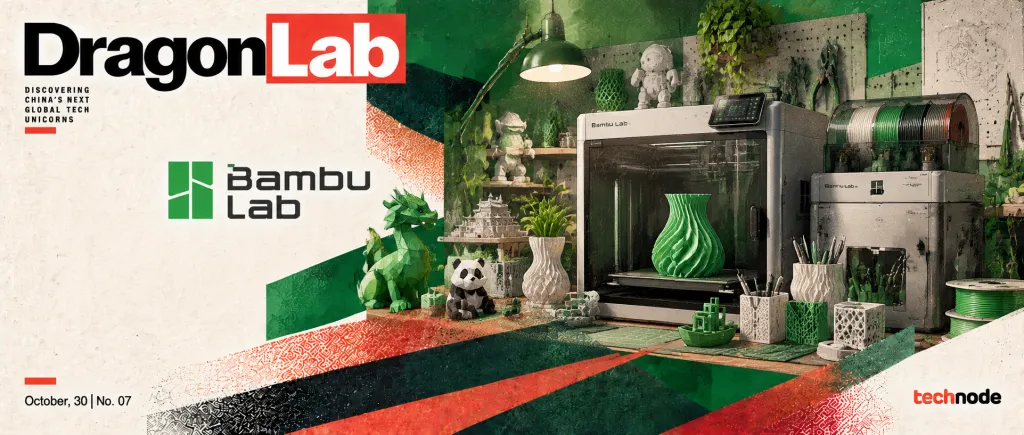
How Bambu Lab Turned 3D Printing Into a Consumer Hit
Editor’s Note: In 2025, Shenzhen-based Bambu Lab ranked No. 1 globally in shipments of sub-US$2,500 3D printers, with a 37% share, and reportedly surpassed RMB 10 billion in annual revenue. Its MakerWorld platform reach…
以下正文同步自 动点科技 TechNode,版权归原站所有,已转换为易读排版。
Editor’s Note: In 2025, Shenzhen-based Bambu Lab ranked No. 1 globally in shipments of sub-US$2,500 3D printers, with a 37% share, and reportedly surpassed RMB 10 billion in annual revenue. Its MakerWorld platform reached roughly 10 million monthly active users. Backed by IDG Capital, Temasek, True Light, 5Y Capital, and Mingshi Investment, it combines printers, materials, software, and MakerWorld. And its R1 laser cutter extends that ecosystem into personal manufacturing.
A Shenzhen Company With a Global First Act
In 2022, Bambu Lab took an unusual route to market. Instead of debuting at a domestic trade fair, the young Chinese company launched its first major product, the X1 series, on Kickstarter. The campaign drew 5,575 backers and raised RMB 47.28 million, introducing its former DJI team to a global community of early users. Company ID Card Afterward, Bambu Lab raised angel backing from Mingshi Investment in 2021, a RMB 30 million Series A from IDG Capital in 2022, a 2023 Series B involving Mingshi, 5Y Capital, Temasek, and True Light Capital, and a RMB 150 million Series C from IDG in April 2024. Built from the start for global customers, Bambu Lab was founded in Shenzhen in 2020. It operates R&D centers in Shenzhen and Shanghai, with an office in Austin, Texas. Bambu Lab is a Chinese company built from the start for global customers. For years, desktop 3D printing carried a frustrating contradiction: it promised creative freedom but often required users to become repair technicians. Machines needed leveling, tuning, maintenance, and patience. The X1’s real proposition was not that it made 3D printing new; it made it less exhausting. With automated calibration, cameras, lidar-assisted monitoring, and its Automatic Material System for multicolor printing, Bambu Lab packaged considerable engineering into something closer to an appliance. Its breakthrough was technical, but also psychological: it reduced the anxiety of pressing print and wondering what would fail.
Overseas First, Ecosystem Next
That approach resonated overseas. Makers, educators, small studios, Etsy sellers, and print-farm operators already knew 3D printing’s potential—and its everyday frustrations: calibration, failed prints, material changes, and maintenance. Bambu Lab’s answer has been to build an ecosystem around the machine. It sells printers alongside software, branded filaments, accessories, the Bambu Handy app, and MakerWorld, its model-sharing platform. Together, these tools reduce the friction between finding a design and producing a successful print. Photo by Jakub Żerdzicki on Unsplash For buyers, that ecosystem matters. Without dependable profiles, usable models, compatible materials, or a community, a printer can quickly become an underused machine. By the end of 2025, MakerWorld had reached about 10 million monthly active users, with an 83% one-year retention rate. The strategy extends Bambu Lab’s role beyond hardware into the broader 3D-printing workflow. China, meanwhile, is becoming a stronger second engine. By June 2026, Bambu Lab’s cumulative domestic consumer-printer sales had surpassed one million units, while the company reported 2025 revenue above RMB 10 billion.
From Cult Machine to Category Leader
By late 2025, Bambu Lab had moved to the front of the entry-level market. CONTEXT’s Q4 data put it first globally in shipments of 3D printers priced below US$2,500, with a 37% share. That does not make it the leader in industrial 3D printing, but it is a notable result in a field that includes Creality, Elegoo, and Anycubic. The company has expanded its X1 halo into a layered portfolio. The newer P2S represents the practical middle: a productive machine for serious hobbyists and small businesses, with AI error detection, upgraded airflow, and a quick-swap nozzle system. Bambu Lab P2S At the ambitious end is the H2C. Its Vortek system uses up to six interchangeable hotends and supports as many as 24 filaments, reducing the material waste normally associated with frequent color changes. The H2D Pro reaches toward enterprise users with high-temperature materials, a 350°C nozzle, and an actively heated chamber. Together, these machines show a company trying to stretch upward without abandoning the users who made it famous: people who want industrial capability without an industrial learning curve. Scale has also brought legal scrutiny. In September 2026, a Texas jury awarded Stratasys US$27.6 million after finding Bambu Lab liable for infringing four patents; the company plans to seek review and appeal. A European court had earlier declined an injunction in a related case, and the wider dispute remains unresolved.
Beyond the Printer
Having broadened its range within 3D printing, Bambu Lab is now moving into adjacent forms of desktop fabrication. In September 2026, it introduced the R1, a 55W CO₂ laser cutter and engraver—its first dedicated product line beyond 3D printing. Designed for materials including wood, acrylic, leather, paper, and fabric, the R1 extends the company’s reach from additive manufacturing into cutting and engraving. The move is logical: a maker who prints a plastic enclosure may also want to cut an acrylic panel or engrave a logo using the same ecosystem. Bambu Lab is thus broadening from 3D printers into a wider range of desktop manufacturing tools.
正文由 探How 从来源站点 RSS 同步,内容未经改写;遇到排版缺失或需要图片、视频时请以原文为准。