Physicists Knock at the Door of the Zeptoverse
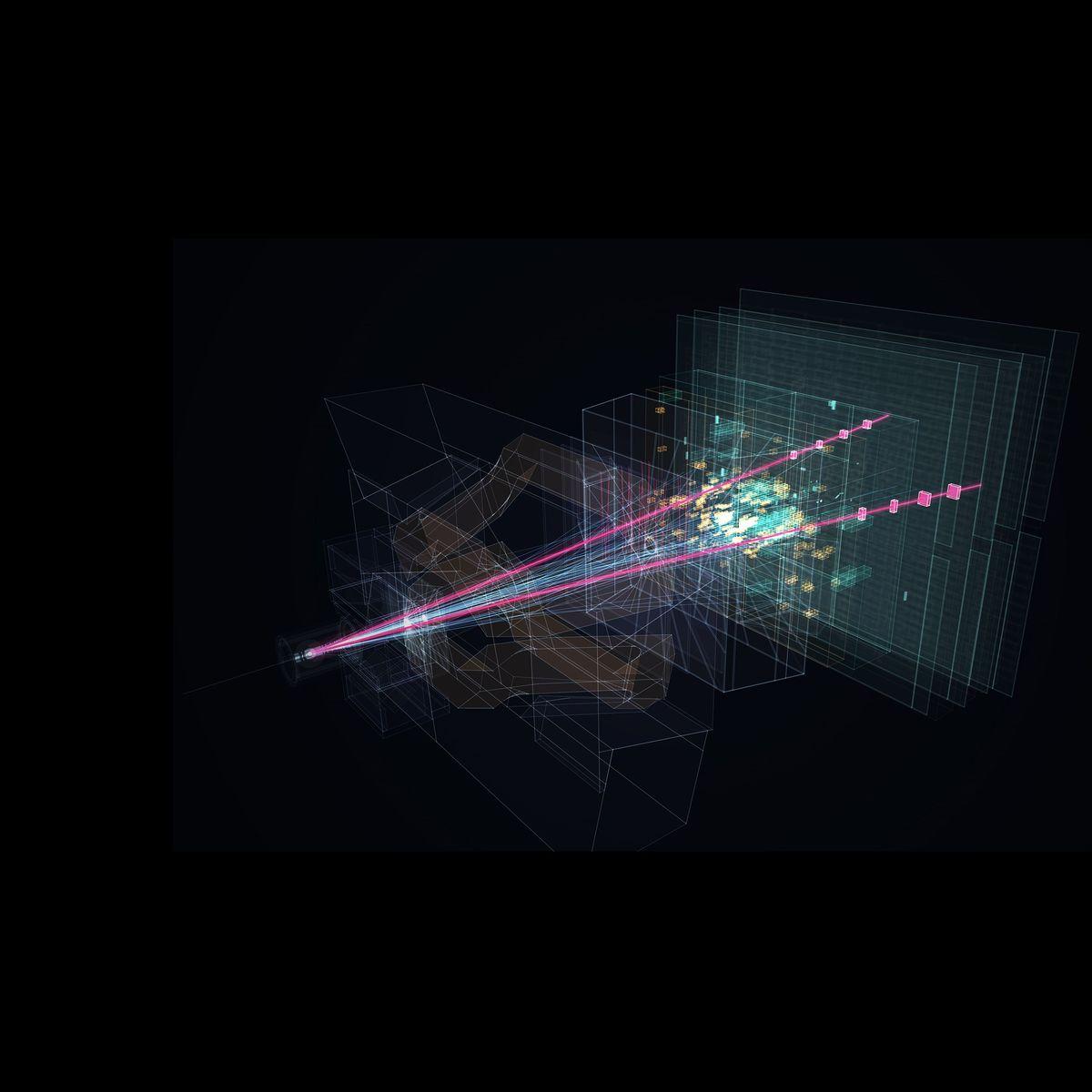
Visualisation of the decay of a beauty partcile into two muons. Credit: LHCb Collaboration / Federico Leo Rede
以下正文同步自 Hacker News 最新,版权归原站所有,已转换为易读排版。
By Sarah Collins Published 3 November 2026
Visualisation of the decay of a beauty partcile into two muons. Credit: LHCb Collaboration / Federico Leo Rede
Visualisation of the decay of a beauty partcile into two muons. Credit: LHCb Collaboration / Federico Leo Rede
The team, working at the upgraded LHCb experiment at CERN’s Large Hadron Collider (LHC) near Geneva, were studying beauty quarks, exotic cousins of the up and down quarks that make up all atomic matter in the universe.
When these beauty particles are created, they live for just one and a half trillionths of a second before they decay. The way they decay can tell us about physics that happens at very short distance scales: trillionths of billionths of a metre.
“What we found in these latest results is an incredibly rare decay of one of these beauty particles, where it turns into two even smaller particles called muons,” said Dr Harry Cliff from the University of Cambridge’s Cavendish Laboratory, who led the analysis team. “This process only happens for one in every ten billion beauty particles, so it’s incredibly difficult to find.”
This is the first time that evidence for this rare type of decay, known as ‘Bd to mu mu’, has been achieved by a single experiment. The results, which have not yet been peer-reviewed, will be presented today (3 November) at CERN.
Cambridge’s Cavendish Laboratory is where the first subatomic particle – the electron – was discovered in 1897, and where the neutron was discovered in 1932. But at the LHC, physicists are now probing distances 10 billion times smaller than an atom.
The LHC is powerful enough to study the structure of reality down to a hundred zeptometres – thousands of trillions of times smaller than the width of a human hair – in search of new particles that may reside in the zeptoverse. The fact that LHC has not yet seen new particles suggest they may be hiding at even shorter distances, as short as a zeptometre: a trillionth of a billionth of a metre.
The research team, which included around 20 physicists from the UK, Germany, Italy, Spain and the Netherlands, used the LHCb experiment to zoom in even further than the LHC can resolve directly. The LHCb experiment was set up to study beauty quarks, which don’t normally exist in nature but are made in huge quantities in high energy collisions at the LHC.
By making precise measurements of the different ways beauty quarks decay, physicists can detect the quantum mechanical influence of new particles that may be far too small to see at the LHC.
In general, the rarer a decay, the more sensitive it is to the influence of new particles. Among the rarest is when a beauty quark annihilates with an oppositely charged antiquark to produce a muon and an antimuon. In the Standard Model of particle physics, this process occurs through a complicated set of interactions, making the decay extraordinarily unlikely: less than a few times per billion beauty particles.
However, in the zeptoverse, new particles could provide an additional route for the decay to follow, altering how often it occurs. For decades, these decays have been seen as ‘golden channels’ in the search for new physics. “Physicists have been looking for this rare type of decay since 1984, which was before I was born,” said Cliff.
In 2024, a major upgrade to the LHCb experiment made it possible that this rarest of decays – the Bd to mu mu decay – might be found at last. An enormous new sample of beauty decays from 2024 and 2025 harnessed the ability of the upgraded LHCb experiment to tell different types of particles apart. By using machine learning techniques, the researchers were able to suppress the huge amounts of background noise that would otherwise bury these very rare signals, allowing them to obtain the first evidence for the Bd to mu mu decay.
By combining the 2024 and 2025 data with earlier data collected between 2011 and 2018, the strength of the signal rose to 3.2 sigma, above the ‘three sigma’ level of statistical significance, the accepted evidence threshold for a new phenomenon.
“Seeing clear evidence for this rarest decay for the first time was thrilling,” said Cliff. “We’re knocking on the door of the zeptoverse now. I can’t wait to see what we find as we explore deeper.”
The new results agree with the predictions of the Standard Model, giving physicists information about which particles could be found when the LHC’s successor comes online in the second half of this century. Another major upgrade, planned for the middle of the 2030s, could increase the rate of data collection by another order of magnitude, turning these discoveries into precision probes to search for undiscovered particles, giving physicists new opportunities to find cracks in the Standard Model and reveal what may lie beyond.
Professor Tim Gershon from the University of Warwick, who leads the LHCb experiment, said : “This fantastic result showcases the extraordinary capabilities of LHCb to probe nature at the fundamental level. This project, driven and led by UK physicists, is producing beautiful science. My focus is now on delivering the upgrade of LHCb planned for the 2030s, which will be essential if we are to continue on this journey of discovery.”
The UK’s contribution to CERN is supported by the Science and Technology Facilities Council (STFC), part of UK Research and Innovation (UKRI).
Reference: LHCb collaboration. ‘Evidence for the decay B0 → μ+μ− and improved measurements of B0s → μ+μ−.’
The text in this work is licensed under a Creative Commons Attribution 4.0 International License
正文由 探How 从来源站点 RSS 同步,内容未经改写;遇到排版缺失或需要图片、视频时请以原文为准。