Valve Responds to Developers Fearing AI Slop and Clones
"The genuine version must be the best version — counter with community and consistent updates"
以下正文同步自 Hacker News 最新,版权归原站所有,已转换为易读排版。
"The genuine version must be the best version — counter with community and consistent updates"
Korean (한국어) KO
Add us on
Valve has advised developers concerned about AI clone games to focus on community building and consistent updates. The trust built with players serves as the strongest barrier against clone games, and the features and distinct identity continually added through updates cannot be easily copied like a single mechanic. Valve's Steam Business Team shared these insights at the 'Steam Indie Connect' developer event held on October 27, stating that making the genuine version the best version has long been Valve's core principle.
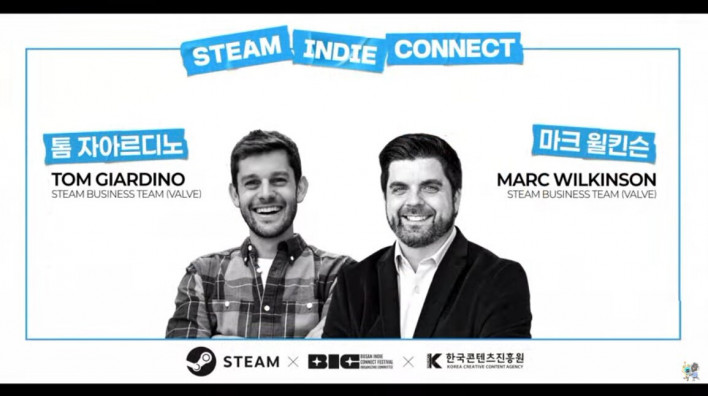
The event was co-hosted by Valve, the Busan Indie Connect Festival Organizing Committee, and the Korea Creative Content Agency (KOCCA). Taking the stage were Tom Giardino and Marc Wilkinson from Valve's Steam Business Team, joined for the Q&A session by Matt from the localization team, which oversees translations into 30 languages for Steam and Valve games. Amid a flood of AI-generated games, Valve representatives directly explained to Korean developers how Steam handles visibility and curation.
"Launch Is Not the Finish Line, It's the Starting Line"
Tom Giardino opened the presentation with an update on Steam's current status. According to the presentation materials, Steam, which launched on September 12, 2003, recently reached a peak of 43.5 million concurrent users worldwide. Total Steam revenue in South Korea grew 126% over the past five years, with premium game and DLC revenue increasing by 70% and in-game purchase revenue surging by 388% over the same period.
He then outlined the launch preparation process — spanning Coming Soon pages, demos, Next Fest, playtests, setting an official release date, and build reviews — remarking, "Launch feels like the finish line, but it's actually the starting line." He also urged developers not to rely solely on Steam, but to utilize consoles, other PC stores, Discord, and social media alongside it.
Marc Wilkinson introduced new tools. Key among them are the Wishlist Data API, which allows developers to retrieve wishlist data by period, country, and language by specifying an App ID and date range, and the 'Personal Calendar,' which transitioned from a Steam Labs experiment into an official store feature. The Personal Calendar recommends upcoming releases wishlisted by players with similar play styles, and games must have a set official release date to appear on it.
Threatening Emails Saying "We'll Copy Your Game with AI and Launch First" — Valve's Answer
The question regarding AI cloning stemmed from a specific threat. One developer shared that indie developers have recently been receiving extortion emails threatening, "If you don't pay, we'll clone your game with AI and release it first." While understanding the advice to showcase games prior to release, the developer noted that such threats could make creators hesitate and asked if Steam had protective measures in place.
Tom Giardino expressed regret, noting that this was the first time he had heard of such extortion cases. He started with Valve's underlying principle regarding new technologies. "We don't want to be gatekeepers telling developers which tools they should or shouldn't use," he said, stating that whether to use AI in development is a decision for the developers themselves.
However, he pointed out that clone games existed long before AI. Spotting an interesting concept during Next Fest and quickly making a similar game or chasing trends has always happened; AI has simply accelerated that pace.
He framed this as creating two challenges for developers. The first is community. Building a developer website, engaging with players, and establishing identity and trust serves as the first line of defense against clone games, whether AI was involved or not. However, he added that because it takes time and does not happen automatically, community alone is not enough.
The second is continuous improvement. He emphasized that this task is equally important for small indie studios worried about AI clones and for Valve, which operates Dota.
As evidence, he pointed to Valve's philosophy on anti-piracy. Valve has historically not been aggressive with DRM or anti-piracy measures. Instead, it placed weight on making the legitimate version the best version available, and he explained that Valve views AI cloning through the same lens. Giardino said, "Rather than relying on a single mechanic that someone can easily copy, you need to keep growing your game by adding features, personality, and creativity that stem from your own perspective."
While drawing a line on the extortion itself, he kept communication channels open. He noted that such extortion is closer to an issue for law enforcement agencies rather than a game platform to solve. Even so, he added, "If you report such cases to us, we want to look into them further and help in whatever way we can."
'AI Slop' Hits Next Fest — "First Two Days Use Random Exposure"
The issue of AI slop (low-quality games made with AI) was also brought up. A developer who recently participated in Next Fest noted that complaints had surfaced on community channels and social media about an influx of low-quality games, and mentioned having experienced disappointing results personally. They asked whether Valve was aware of the issue and if solutions were planned for the next Next Fest.
Marc Wilkinson explained the visibility structure of Next Fest. For the first two days of the event, games are shown to players on a virtually random basis. After that, personalized recommendations kick in, surfacing more games that a player is likely to enjoy and purchase. He pointed out that many articles complaining about a flood of low-quality games were written based solely on those first two days.
He also shared the reason behind starting randomly. It is to prevent system abuse by those trying to enter early just to gain immediate visibility, and to give every game a fair share of exposure during Next Fest. "We recognize that the trade-off is some low-quality games get exposed," he said. "We are fully aware of the situation, and a significant number of people are thinking about how to solve this problem."
Tom Giardino highlighted the shift in scale. Just three years ago, he was going around trying to convince developers to participate, saying, "There are only 50 or 100 games, so you should definitely join," but now the number of participating titles reaches into the thousands. He described it as "the pendulum swinging to the opposite side."
He also pointed out that the benchmark for success varies for each game. There are titles overjoyed to gain 10,000 wishlists during Next Fest — tripling their previous total — while others are disappointed even after gaining 50,000 because it fell short of expectations. "As platform operators, we can't define what success means for an individual game," he said, explaining that Valve chose to keep the doors open for both Next Fest and seasonal sales while continuously refining page layouts and placements.
He noted that this concern was not new. When Steam Greenlight launched around 14 years ago, developers asked if Greenlight games could be filtered out. When Steam Direct, the current self-publishing system, was introduced, requests came in for a checkbox to hide Steam Direct games. Every time, rather than turning developers away or trying to pre-filter good games from bad ones, Valve chose to improve the shopping experience.
Giardino said, "We don't think we're perfect and there's plenty of room for improvement," but added, "Rather than limiting developer access, making Steam a smarter and more dynamic platform is the starting point of our philosophy."
"Wishlists Have No Impact on Visibility — They're a Thermometer for Marketing"
Questions around visibility transitioned to wishlists and the Personal Calendar. One developer observed that because Steam's main front page has focused primarily on top sellers among new releases, studios have obsessively chased 'wishlist farming,' increasing the importance of publishers who assist with it. Expecting that personalized recommendations via the Personal Calendar will become crucial for indie game exposure, the developer asked about Valve's intentions for expanding the feature and how developers should prepare.
Marc Wilkinson first corrected a misconception regarding wishlists. He clarified that while wishlists are a good indicator of marketing performance, they do not affect visibility on Steam. "What drives visibility is the number of people buying and playing the game," he emphasized. He shared examples of games that launched with 3 million wishlists but suffered falling sales and dropped off top charts due to poor user experience, as well as games with virtually no wishlists that achieved massive success. He advised against wishlist farming, urging developers to focus instead on making a great game.
Tom Giardino redefined the role of wishlists, pointing out that many developers do not utilize wishlists enough to measure marketing effectiveness. For example, checking if wishlists increase after running an ad, posting TikTok videos for a week to gauge reaction, and then testing different methods on other platforms. He noted that tactics that worked for a first game might not work for a second game years later. "Don't treat wishlists as a magic number you have to hit; use them as a thermometer or speedometer to measure the effectiveness of your efforts," he said.
He also detailed the design intent behind the Personal Calendar. While only a subset of users tested the Personal Calendar during its Steam Labs phase, becoming an official feature means far more player response data will be gathered. He explained that this feature differs from other Steam features because it revolves around recency. While top store recommendations and top seller lists include games from years ago like 'GTA 5' or 'Tactical Breach Wizards,' the Personal Calendar is virtually the only space dedicated exclusively to brand-new releases.
He did not hide its limitations either. Once 1-2 weeks pass after release, exposure on the Personal Calendar does not happen again. After that, the hard work of discounts, DLC, and game improvements remains. Nevertheless, he noted that the Personal Calendar was designed to reach deep into the catalog. "It doesn't matter if this game is a global top seller. What matters is whether there are enough signals indicating it will be popular with you personally," he said, stating that Valve will continue to refine the feature so games can connect with their audience even if they aren't top sellers.
Dilemma Over Tags and Single-Player Options — "A Design Choice, Not a Business One"
Questions about tags were also raised. A developer creating a game centered on co-op for two or more players asked whether single-player tags or solo options heavily influence wishlist conversion rates and refund rates, and how to communicate it on the store page if the game remains co-op only.
Marc Wilkinson responded that specific genres or features do not guarantee success. Steam has players who enjoy VR, single-player, and multiplayer games alike, and co-op-only games like 'It Takes Two' have achieved massive success. Ultimately, he said, it comes down to game quality.
Tom Giardino pointed out that major titles like 'Marathon' and 'ARC Raiders' grapple with the same dilemma between players who want to play solo and those who play with friends. He explained that Valve has never analyzed wishlist conversion rates by genre or game type, so he couldn't confidently say that adding a single-player tag increases conversion. Instead, he cited Valve's 'Left 4 Dead' as an example. While best enjoyed with three friends, not everyone has friends available, so delivering an experience close to multiplayer even
正文由 探How 从来源站点 RSS 同步,内容未经改写;遇到排版缺失或需要图片、视频时请以原文为准。