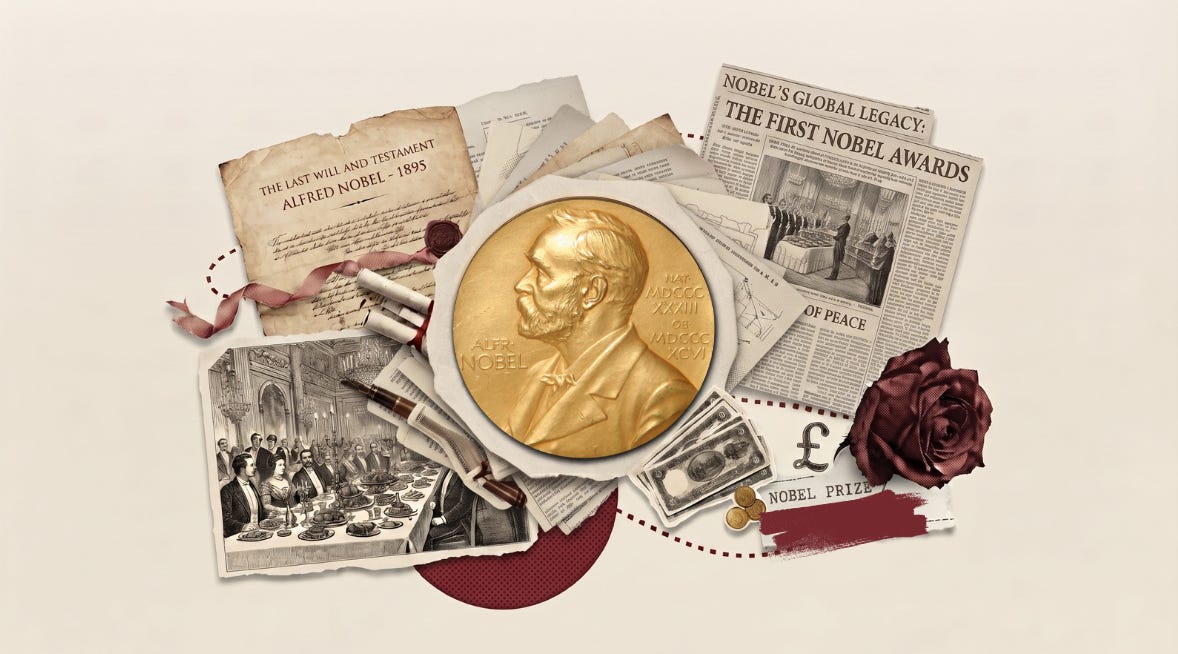
How the Nobel Became the Nobel
Ragnar Sohlman exhales, shakily, with a briefcase in one hand and a pistol in the other.
以下正文同步自 Hacker News 最新,版权归原站所有,已转换为易读排版。
Jolie Gan
Oct 22, 2026
27
6
6
Share
Logbook | Dossier | Institutions
Ragnar Sohlman exhales, shakily, with a briefcase in one hand and a pistol in the other.
It is January 1897, and the cab he is riding in has just left a bank on the Boulevard Haussmann containing the fortune of the richest man he has ever known. The carriage behind him is packed full of parcels sized to the insurer’s per-parcel limit.
Bank, cab, consulate, then the Gare du Nord, he thinks to himself. When he arrives at his destination, his parcels will be checked as registered luggage to Stockholm; others will go to London to be sold. He has been told that thieves in Paris stage carriage collisions and that a young man – at the ripe old age of twenty-six – carrying securities should expect one.
Luckily, he does not need it that day. The only attacks he had encountered were earlier, from his former employer’s nephew, who had come with a brother-in-law and a lawyer to contest the will of Sohlman’s former employer. The man was barely dead. What a disgrace.
The will is four pages long. Alfred Nobel himself had written it, at the Swedish-Norwegian Club in Paris, in November 1895. He had no lawyer – he had already lost a lawsuit once and had decided he could do without them. The witnesses were four men who happened to be at the club. The document leaves the residue of his estate, more than 90% of it, to a fund that does not yet exist, to be administered by just four institutions: the Royal Swedish Academy of Sciences, the Karolinska Institute, the Swedish Academy, and a not-yet-named committee of five to be chosen by the Norwegian Parliament. There is no legatee. In legal terms, there is nobody to inherit the sum.
Alfred Nobel’s handwritten will, shown as a facsimile at Villa Nobel in Sanremo. Photograph: Samuele / Wikimedia Commons, public domain.
In May 1897, The New York Times predicted that the Swedish and Norwegian authorities entrusted with awarding the so-called Nobel Prize faced a responsibility that would bring “more trouble than glory.”
For young Ragnar, the man entrusted by Alfred Nobel himself to execute his will, this certainly seemed to be the case.
Four years later, on December 10, 1901, the first Nobel Prizes were presented in Stockholm and Christiania.
Today the Nobel hardly needs an introduction. Universities count their laureates, governments celebrate them, and scientists who agree on nothing else agree that winning one places a peer among the most distinguished people in the field. In 1897, none of this was inevitable. Someone had to agree to administer the prizes, scientists had to agree to accept one, and the general public had to be convinced that a science award decided by Swedish academics was worthwhile.
Why is the Nobel the only science prize most people have ever heard of?
Science had already been managing quite well without Alfred Nobel.
The Royal Society had awarded the Copley Medal since 1731, to the likes of Franklin, Faraday, and Darwin, and the Académie des sciences in Paris ran multiple prizes of its own.
Nobel’s unfair advantage was the scale of his enormous fortune, but also the array of fields he hoped to award.
Nobel himself was not a university scientist. He was a chemist and an engineer who had spent his entire life developing explosives. At the time he died, he held 355 patents, ran factories in approximately 20 countries, and owned a stake in his brother’s oil company in Baku. He had never held an academic position.
Yet throughout his lifetime, Nobel had become increasingly interested in putting his fortune towards the advancement of knowledge. He had considered funding scientific prizes in an earlier will from 1893. Two years later, he decided to enlarge the idea, including literature and peace. It was more ambitious than any scientific prize the world had ever seen.
Nobel had actually specified the institutions he wanted to award each of these awards. Physics and Chemistry would go to the Royal Swedish Academy of Sciences. Medicine would be handled by the Karolinska Institute. Literature would fall to the Swedish Academy, and Peace to a committee appointed by the Norwegian Parliament. He was also unusually explicit about nationality: he hoped that prizes would go to the most deserving candidates internationally, whether they were Scandinavian or not.
In 1897, the leading scientific nation of the world was Germany. Behind Germany were England and France. America was still in the process of building its own research universities and no American would win a science prize until 1907. Sweden, as a relatively small country in Europe, was proposing to judge the scientists of these larger, dominant scientific powers.
Domestically, the existing Swedish scientific establishment had little reason to acknowledge the award. Sweden already had a network of universities and academies, and its own established methods of recognizing scientific achievement. Administering a private international prize would require time, expertise, personnel, and an institutional responsibility for decades, potentially centuries, to come. Awarding the wrong scientist could provoke criticism from the scientific community abroad. Even though the money belonged to the Nobel Foundation, the humiliation, should anything go wrong, would belong to the scientific academies.
The king also rejected the notion of the award. Oscar II, who ruled both Sweden and Norway, told Emanuel Nobel, head of the family’s Russian branch, that he should not “neglect his duty to his relatives in favor of the nonsensical ideas of your uncle,” whom he believed had been “got at by peace fanatics, particularly by women.”
The Swedish branch of the family did not want it either – so much so, in fact, that they sued. In a Stockholm gossip column in January, a correspondent reported that the relatives had discussed asking for an autopsy on the grounds that “the testator suffered from megalomania.” The body had already been cremated.
Sohlman had arrived in San Remo too late to see Nobel alive. His mentor had died on the night of December 10, 1896, alone with his servants. When he arrived back in Sweden, he and fellow executor Rudolf Lilljequist enlisted the lawyer Carl Lindhagen. Together, these three men would spend the next several years trying to turn Nobel’s will into something legally workable.
Ragnar Sohlman (1870–1948), executor of Nobel’s will. Undated portrait. Source: Svenskt Biografiskt Lexikon / Wikimedia Commons (public domain).
Their first order of business was to establish Nobel’s legal domicile in Sweden rather than France, where the will could have faced legal challenges. They also had to reach an agreement with Nobel’s relatives.
Some relatives wanted the riches to themselves. Others worried that the academies would use the fortune for their own benefit. Others still feared that Nobel’s ambitions were too vague and too impossibly aspirational to fulfill.
The institutions had also rejected their appointed responsibilities out of fear of carrying liabilities that came with failing to select the most deserving candidates, and being tasked with evaluating nominations. It was a heavy undertaking. What if a discovery celebrated in 1901 was disproved in 1905? What if a scientist who had been passed over for the prize ended up transforming their field in 20 years? It would demonstrate that the judgment of the committee was wrong.
Eventually, the three men struck arrangements that proved persuasive and decisive for the institutions. The first was an international nomination system. The Swedish committees would not have to identify the world’s most consequential researchers unaided. They could solicit recommendations from qualified scientists abroad, which gave them the opportunity to de-risk candidates through sheer strength in numbers.
The second was the creation of Nobel Institutes. These institutions would be financed from Nobel’s fortune but belong to the prize-awarding bodies. They could support investigations connected to the awards and, in the case of the scientific institutes, conduct research of their own.
The larger, longer-term vision behind them was to transform Stockholm into an international center of scientific activity, and the Nobel Prizes could help draw attention to the research taking place there. This would, in turn, encourage future talent and investment to flow inward.
The academies were convinced, having been offered something considerably more attractive than an additional administrative burden. Their time and personnel investment would now support the acquisition of research resources, international relationships, and a more prominent position within the scientific world.
And so the Royal Swedish Academy of Sciences began writing to professors abroad, pooling names for the inaugural – and at the time, unknown – Prize.
Simultaneously, it appointed two committees of five scientists, one for Physics and another for Chemistry. All ten were Swedish and chosen by the Royal Swedish Academy of Sciences, which retained the final vote. The international nominations were meant to support the Swedish judges, providing access to discoveries and expert opinions abroad.
The system was hardly free of personal conflicts of interest. Svante Arrhenius helped organize the early prizes, served on the physics committee, and won the chemistry Nobel himself in 1903.
The committees would solicit recommendations from members of scientific academies, university professors, previous laureates (in a few years, once there were some), and specially selected researchers outside Scandinavia. Foreign universities were included on a rotating basis. Importantly, candidates could not submit applications themselves.
In Chemistry, Nobel’s home domain, the Committee sent approximately 300 invitations annually. The first year produced twenty nominations. Of those twenty, eleven named the Dutch chemist Jacobus van ’t Hoff, whose work on chemical kinetics, equilibrium, and osmotic pressure had helped establish physical chemistry.
He was already well known. The Academy could demonstrate that respected researchers outside Sweden considered him deserving of the award. He was an easy choice.
The nominations in Physics included Max Planck recommending Wilhelm Röntgen, the discoverer of X-rays. X-rays had already made their rounds in the popular press, with features in comics and books and articles covering the discovery with enthusiasm. Röntgen himself nominated the British physicist Lord Kelvin. Other candidates included Henri Becquerel, Gabriel Lippmann, and the young Italian inventor Guglielmo Marconi.
One of Wilhelm Röntgen’s first X-ray images, showing his wife’s hand, 1895. Source: Wellcome Collection / Wikimedia Commons (public domain; digitally restored).
From its beginning, the Nobel involved scientists who had little connection to Sweden. A professor who received an invitation abroad could participate in judging the award, even if nobody from his university had ever won it. This allowed the Academy to access scientific expertise abroad, and its correspondents acquired a reason to pay attention to the new prize – the hope that they, or their institutions, would soon take home one of these revered prizes.
Folke Henschen is twenty years old, one of the student marshals assigned to guide guests through the first Nobel Prize ceremony. He has been instructed to stand very, very still.
It is just before seven o’clock on the evening of December 10, 1901. The young student stands, shoulders back, in the great hall of the Royal Academy of Music – a room he will, seventy years later, describe as “unpretentious, rather boring.”
Tonight, the inaugural Nobel Prize winners will be named and recognized. The identity of the laureates is a mystery, unlike the modern practice of announcing winners months beforehand. Though perhaps the surprise was rather spoiled when a few sharp spectators noticed three disti
正文由 探How 从来源站点 RSS 同步,内容未经改写;遇到排版缺失或需要图片、视频时请以原文为准。