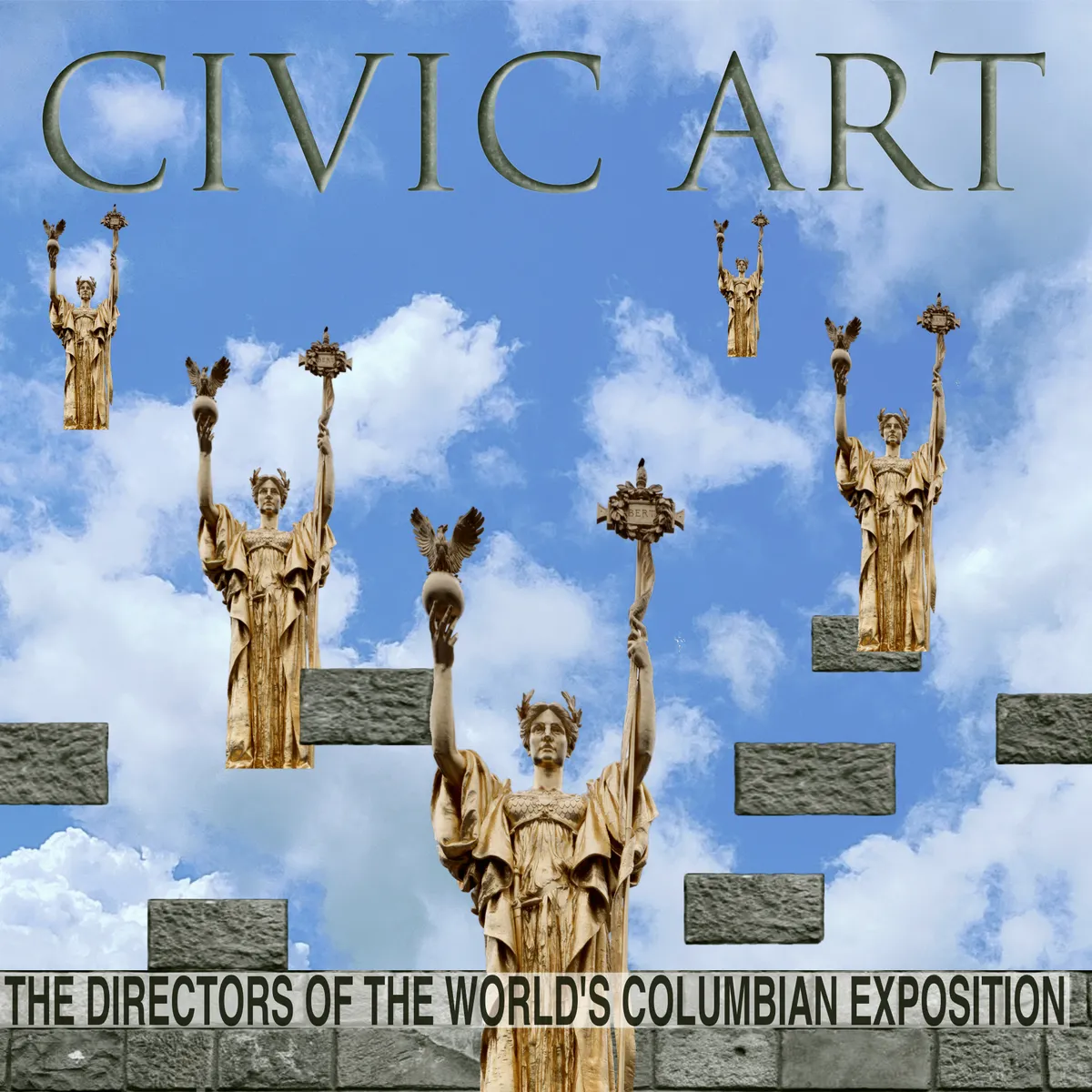
How often do you think about the 1893 World's Fair?
Of all the displeasures that the Trump Administration has brought upon the District of Columbia, the most peculiar was the dinky little fairgrounds thrown up on the National Mall this past July. Crafted from the finest …
以下正文同步自 Hacker News,版权归原站所有,已转换为易读排版。
Of all the displeasures that the Trump Administration has brought upon the District of Columbia, the most peculiar was the dinky little fairgrounds thrown up on the National Mall this past July. Crafted from the finest styrofoam and vinyl that misdirected donations can buy, its design unmistakably evoked the otherworldly classical ensembles of the 1893 World's Fair and its imitators. In some ways, the choice is intuitive. The World's Columbian Exposition was an exuberant expression of American wealth, power, and identity that cultural creators have returned to with fascination again and again. Make America Great Again, right?
The answer to all of these questions is... stranger than I had thought. Whether thinking back to 1893 or 1993, what draws us to an event, story, or image depends less on the context of the events than the context we inhabit. As a result, we interpret—or reimagine—the past differently from our predecessors. And I think the lingering memory of the World's Columbian Exposition shows how it's from these reimaginings, not neutral facts, that we reshape the world.
One aspect of the fair that no historian will dispute is that, like the dinosaurs of Jurassic Park (1993), it blew people's minds. Raves about the Exposition had begun even before it opened in May 1893 and continued well past its closure in October of that same year. Articles, telegrams, and diaries all testified to its wonder. For years after, both licensed and bootleg merchandise sold well, cluttering parlors into the new century.
Writers of all stripes have catalogued the diversity of its appeal. For a population that had only just become majority urban, Chicago was an attraction in and of itself. Down in Hyde Park, the glass-roofed exhibit halls offered unbeatable publicity to manufacturers in an advertising environment of catalogues and newsprint. Over at the fair's Midway, visitors delighted in its carnival attractions while its ethnographic displays shook assumptions about humanity. More than any of that, however, what lingered longer in people's memory was the central complex of the fair. Known officially as the "Court of Honor," and colloquially as the "White City," it was an ensemble of monumental plaster facades that shone in the daytime and glowed after dark in a lavish display of Westinghouse electric light—still radiant with the shock of the new. Hundreds of organizations held their annual meetings behind its facades and nearly a third of all Americans visited.
It is not possible to trace every path that crossed in the White City. Some people were wowed and went home with the merch. Others were transformed. One such pilgrim was a journalist named Charles Mulford Robinson. In the 1897 official history the fair, he described the experience of entering the Court of Honor as something like an ego death:
He was far from alone in seeing the otherworldly in the design. In 1895, Frances Hogson Burnett, better known as the author of The Secret Garden, published a children's parable, Two Little Pilgrims' Progress, A Story of the City Beautiful. The short book follows two orphan children as they visit the fair while reading the 17th century Christian allegory Pilgrim's Progress. In Burnett's retelling, the spiritual journey is a physical one. The Celestial City that serves as Pilgrim's aim in the fable, it turns out, was right there on the shores of Lake Michigan, reached for reasonable fare. Contemporary reviews of the book were mixed. None that I have found, however, objected to the comparison she made between this for-profit festival and actual literal Heaven.
Here's another question. How much do you think about the Barcelona Summer Olympics? Woodstock '94? Michael Jackson's halftime show at Super Bowl XXVII?
Each of these brief events from roughly thirty years ago was deeply influential in its own time and on the industries they were part of. Yet I think it's safe to say that they don't hold our memory as well as media from 1993 like Whitney Houston's rendition of I Will Always Love You or Stephen Ambrose's A Band of Brothers. Events are definitionally less tangible and less accessible. The memory itself persists more in more the fragments of souvenirs. The historian David Burg counted over a dozen novels featured the Fair as a setting or even plot device over the following decades. Some reveled in its heyday; others frolicked in its ruins. In most cases, it was a setting or even a plot device, not the character that Burnett made it.
On the other side of the First World War I, the only people who seem particularly interested in the fair are urban planners. Seeing it as the spark for their movement, they approached it with historical, rather than immediate, reverence. Like the general public, their eyes were focused on the unfolding of modernity. As charted by economist Robert Gordon, the technology that had seemed magical in 1893 grew increasingly mundane. Its aesthetics, on the other hand, looked quainter with every year. Not only was there no jazz at the Columbian Exposition, there wasn't even ragtime. When Chicago again hosted a World's Fair in 1933, it invoked its predecessor primarily to emphasize just how far they had come in two generations.
Perhaps the clearest illustration of the Exposition's faded mystique is its absence in the artistic medium that dominated the 20th century. From the establishment of the first studio in Hollywood in 1912 until 2017, only a single major motion picture covered the Fair—and even then, it dramatizes the Midway, not the White City. It's a biopic of skimpresario Florenz Ziegfeld featuring Myrna Loy as Billie Burke, who herself was about to achieve immortality for introducing the world to another fantasy city—this one, Emerald.
Honestly, I was surprised at how thin the fair's top-line cultural impact was for most of the 20th century. Not that I did a truly exhaustive search, but outside of Chicago it was a topic for the history books and apologetic statements by urban planners, especially when compared to the city's dark side. Only PBR, it seems, held to the faith.
Things changed in the 1990s. The centennial of the Fair in 1993 summoned a host of books, local TV documentaries, and exhibits.
Ultimately, though, it looks like the revival of interest in the World's Fair was actually the work of the Devil: 2003's The Devil in the White City. Hanging 300 weeks on the New York Times bestseller list, Erik Larson's narrative nonfiction book revived not only the magic of the Court of Honor, but also the motif from 19th-century works that the rest of Chicago was a place of lethal danger. The moment by Lake Michigan had an alluring ambiguity, like CK One.
Others saw it too. Novels, movies, shows, video games, memes: every medium and every genre has found its way to the Court of Honor since then. It been a setting for both Thomas Pynchon and the Marvel Cinematic Universe, it was namechecked by Sufjan Stevens, and it inspired the richly disturbing first person shooter BioShock Infinite. Of all the media that has riffed on Fair since hipsters started drinking PBR in Williamsburg, this game best tackles the themes that historians had been uncovering beneath the great plaster facades: Christian nationalism, racism, and patriarchy—all on the eve of Ferguson and Gamergate, organic cultural events that, like the Chicago Fair, continue to shape our culture even if they aren't on our minds.
One advantage the game had over any of the novels about it was that it is a visual medium. Architecture photographs better than it reads. So perhaps it's not a surprise that we also see a simultaneous revival of wonder around the fair on the basis of photographs alone. The internet made sharing image across the globe incomparably easy. With this came a collapse in context. A scan posted by the Art Institute of Chicago with academic reserve might get shared on Reddit with Millennial amazeballs, and then after six other reshares, appear on the Facebook feed of someone who began to wonder if our dysfunctional society really built all that grandeur for a single summer before even the automobile.
By 2016 at least, an the skepticism had hybridized with Russian "phantom time" theories: it like so many other grand 19th Century buildings was, in fact, the ruins of a superior lost airborne Tartarian civilization, destroyed in a great flood that left mud all over the streets. Don't believe it? Then why is there mud all over the streets in these photos I found on Telegram? I bet you really think that guy lit the Olympic cauldron in Barcelona with an arrow.
But as I said at the beginning, I think there is a surprising throughline from Burnett to Larson to u/TengristMulder93, which is... imagination. Both fiction and nonfiction require re-interpreting the bare existence of the Court of Honor, a space that most interpreters did not visit. When trying to re-present historical events, we must undertake process that is inherently imaginative, if not creative in its own right. Both conspiracists and historians of imperialism like Robert Rydell must dig beneath the White City to find a deeper meaning. Others like Burnett or the designer of that sad little Great Fair, architect Nicolas Charbonneau, need to color well outside those lines to get their point across.
The difference, then, is what each of these creators brought to the Fair. Ware built his depression-fueled vision of the White City off of extensive research in both secondary and primary historical sources. Those, in turn were built off of imaginative processes that were disciplined by historical methods: theory, the archive, and a consensus that the centuries between the fall of Rome and the construction of Monadnock Building actually happened.
In contrast, for believers in the Mudflood or those yearning to RETVRN, the historical context is of negative value. For the former group, their deep distrust in the institutions that provide provenance means they are free to read between the lines at a level a historian can only dream of. And once that skepticism has generated has generated a theory, it enables more, richer readings, and on and on until you conclude that H. H. Richardson is a composite character invented by the Preceptors of the Hollow Earth. In that way, Tartaria is an unmistakable a product of another invention released in '93: the World Wide Web.
For the more learned reactionaries who want to reheat the White City (and the National Mall is just the beginning), the images of the fair are likewise a pinboard for their own imagining. While utterly fantastical, the buildings are nevertheless just familiar enough. The spaces are as bare of street filth as they are flush with the kind of ornament that to many seems less possible in 2026 than space travel did in 1893.
So, the minds behind statue avatars on x dot com revel in the capital-o Order and capital-b Beauty of the images, without much concern the underlying reality: the photos show not a city, but a temporary theme park. That is not the point; like Burnett or Charles Mulford Robinson, they believe that the grand halls could be how our cities look. Whether they are willing to develop the expertise and create a social movement like visitors to the fair did is a different story. This past summer's styrene Midway wasn't promising.
As an architect, I get it. Stripping context from a reference is often the beginning of aesthetic innovation. Proof is right there in the White City, where motifs had been borrowed from huts to temples to churches to palaces and last of all to grand light filled halls that helped sell sewing machines. As Fair designer Henry Van Brunt described the design team's objectives in 1892:
So maybe the more revealing question is: why did people stop thinking about it?
In my opinion—and this is just my interpretation—is context. With a new style of architecture debuting at each subsequent fair, even those who experienced the Court of Honor directl
正文由 探How 从来源站点 RSS 同步,内容未经改写;遇到排版缺失或需要图片、视频时请以原文为准。