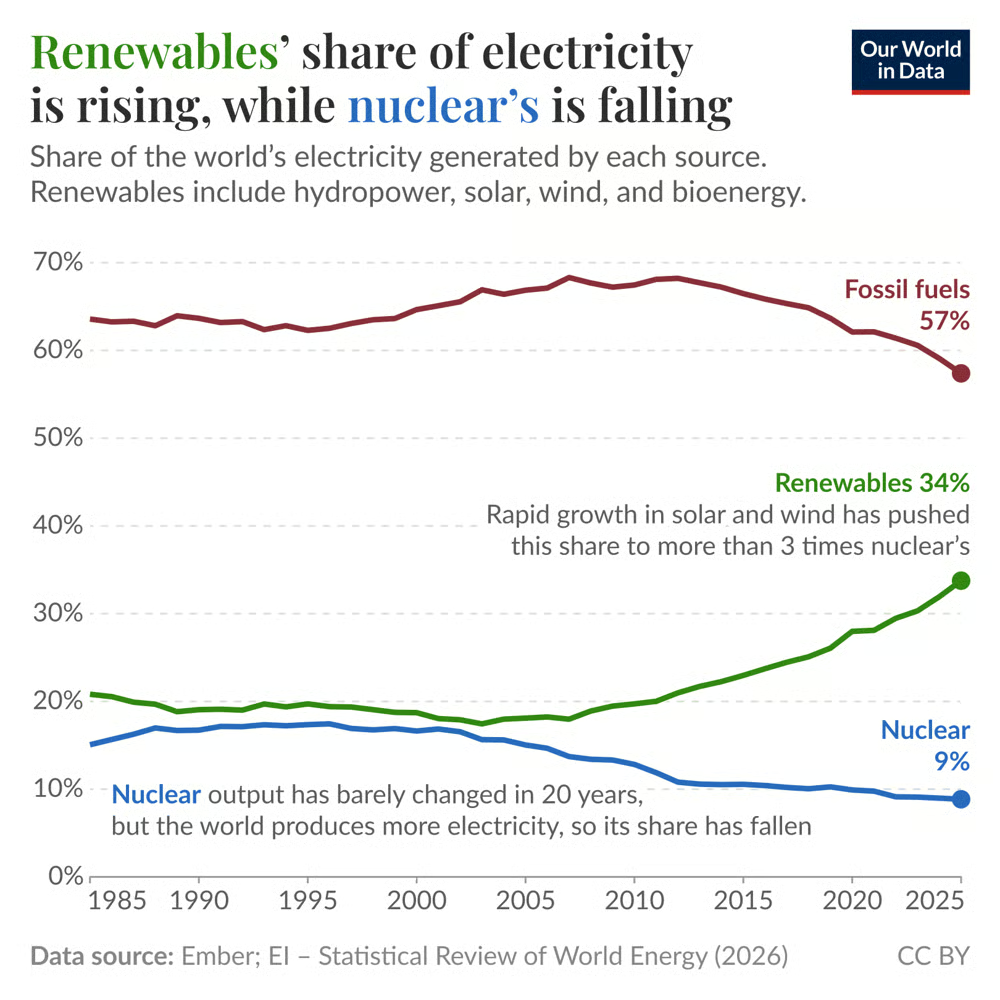
Renewables' Share of Electricity Is Rising While Nuclear Falling
According to the latest data from the World Health Organization, the global death rate from malaria has almost halved since the year 2000.
以下正文同步自 Hacker News 最新,版权归原站所有,已转换为易读排版。
According to the latest data from the World Health Organization, the global death rate from malaria has almost halved since the year 2000.
The chart above puts this recent progress into a larger historical perspective. It combines the latest estimates from the WHO and the Institute for Health Metrics and Evaluation with those for the 20th century published by the late malaria researcher Richard Carter. Since 1900, the global death rate has declined by 96%. If it were still as high as it was then, around 16 million people would die from malaria every year instead of 610,000.
Behind this long-run decline is a shift in the distribution of the burden of malaria. In the first half of the 20th century, most malaria victims died in the Asian tropics. It was the substantial progress there — as well as in the Mediterranean and in the Americas — that made this vast improvement in human health possible.
Today, more than 9 out of 10 malaria deaths occur in Africa. This means that the recent progress shown in the chart is, above all, Africa’s progress.
See all Data Insights
Our World in Data is free and accessible for everyone.
Help us do this work by making a donation.
Our World in Data is a project of Global Change Data Lab, a nonprofit based in the UK (Reg. Charity No. 1186433). Our charts, articles, and data are licensed under CC BY, unless stated otherwise. The source code for our tools and software is made publicly available for transparency and educational reference under a custom license. Re-use requires permission. Third-party materials, including some charts and data, are subject to third-party licenses. See our FAQs for more details.
正文由 探How 从来源站点 RSS 同步,内容未经改写;遇到排版缺失或需要图片、视频时请以原文为准。