Google Fitbit Edge Review: I Still Prefer the Air (2026)
The Edge is a welcome upgrade for longtime Fitbit users, but the missing NFC technology is a puzzling regression.
以下正文同步自 Wired,版权归原站所有,已转换为易读排版。
WIRED
Google’s first repairable tracker. A bigger screen with adjustable brightness. More advanced health metrics and workout tracking.
TIRED
Band fastening can be finicky. Auto-pause can be overly sensitive. No Google Wallet.
Earlier this year, the Google Fitbit Air won me over and made me wonder why I ever wanted a display on my fitness tracker in the first place. Of course, not everyone is ready to quit the screen cold turkey, especially if your wearable doubles as your everyday smartwatch. Google Fitbit hasn’t introduced a new tracker with a screen since 2023, and the older models are starting to fall behind on health features and hardware. That deters both newcomers who want a screen and longtime users who have to choose among aging models.
At $180, the new Google Fitbit Edge costs $20 more than Fitbit's Charge 6 ($160) and $80 more than the screenless Air ($100), but far less than Google's Pixel Watch 5 ($400). After 12 days of testing, I’d recommend it to Fitbit owners looking to upgrade. Personally, though, the Edge hasn’t given me enough reasons to give up my Fitbit Air.
As with any smartwatch, comfort also depends on the band. The Edge comes with Google’s Active Band, which is fine for workouts but isn’t my favorite of the available options. Google also offers the HNBR (high-performance synthetic elastomer) Active Sport, the breathable Performance Loop, the silicone Magnet band, and the Metal Links band.
I found myself alternating between the Metal Links and Performance Loop. I love the look of the former for a night out or a more formal setting, and the latter is best for everyday wear. The Performance Loop’s micro-adjustable fit makes it easy to get a precise fit, but it's just as easy to pull it a little too tight. I also noticed that the band occasionally popped loose while I was adjusting it. The tracker was still attached from one side, so I wasn’t worried about losing it, but the fastening mechanism didn’t feel as secure as it should. I eventually noticed that the locking button was stuck and had to fiddle with the mechanism to fix the issue.
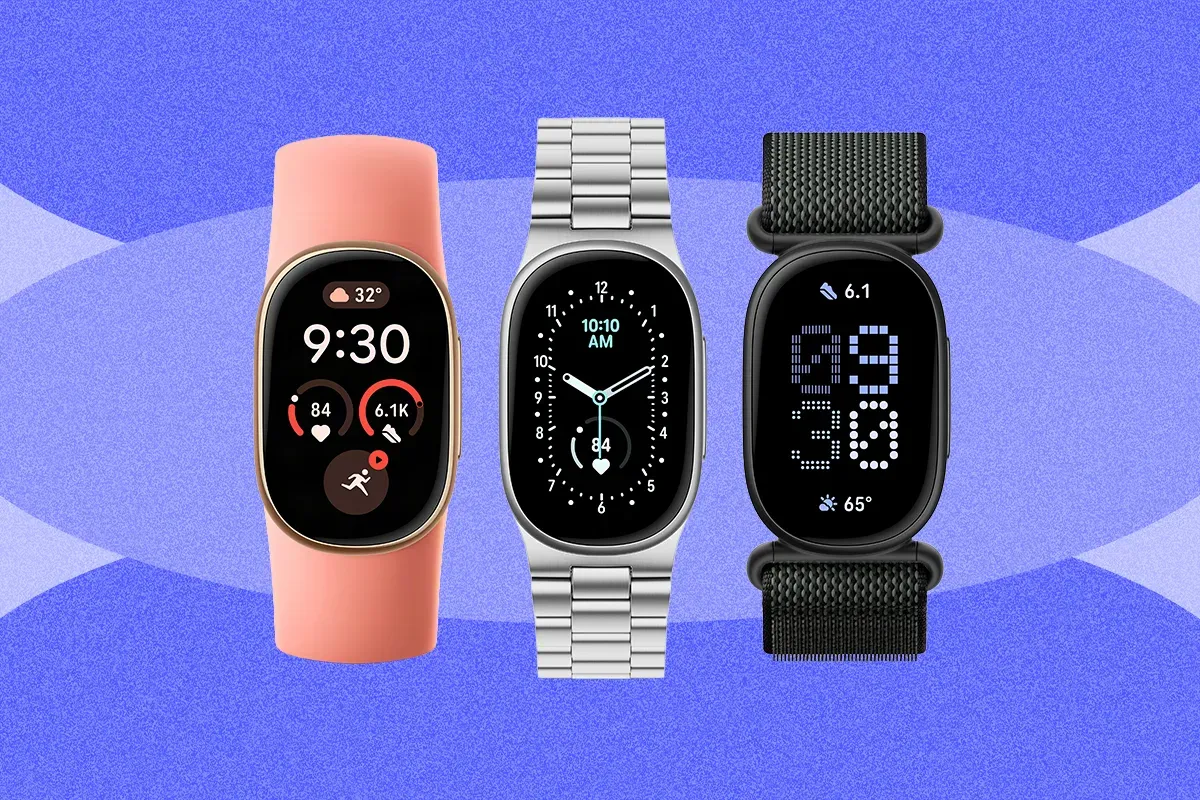
The Fitbit Edge in brushed silver with Metal Links band (left), in Canyon with Active band (middle), and in Fog with Performance Loop band (right)
The 1.34-inch display is the Edge’s obvious advantage over the screenless Air. I noticed the difference most during workouts. On outdoor runs, I could check my metrics and control my music without slowing down. The display also reaches roughly twice the Charge’s maximum brightness, making it easier to read in direct sunlight. With Google Maps integration, I could follow turn-by-turn directions from my wrist while running or cycling, without having to pull out my phone.
I do prefer Wear OS’s more colorful interface; Fitbit’s watch faces also feel a little elementary by comparison. But Fitbit’s software offers up to seven days of battery life, which is a feature the Pixel Watch can’t match. The Edge is also compatible with both iOS and Android, unlike the Pixel Watch. Plus, in a first for Fitbit, the Edge is Google’s first repairable fitness tracker, with modular construction including a replaceable battery, matching the Pixel Watch. This is likely due to battery regulations set to take effect next year in the European Union, which will require removable and replaceable batteries in smartphones, smartwatches, and similar devices starting February 18, 2027.
The Edge is a significant upgrade over the Charge 6 when it comes to health and fitness capabilities. Google has added more detailed workout metrics and a few hardware upgrades that make the Edge a more capable fitness tracker.
Some of the additions are aimed at long-term health tracking. Like the Pixel Watch 5 and the Air, the Edge offers monthly blood pressure and insulin resistance trends. Its SpO2 readings now include nightly averages, ranges, and changes over time. There’s also 24/7 heart rate tracking, cardio load metrics, and an updated ECG app with atrial fibrillation (AFib) detection. Alongside nutrition logging, if you use a continuous glucose monitor (CGM), you can view glucose insights.
Like any Google wearable, most features are locked behind Google Health Premium, which costs $10 per month or $100 annually. Without the subscription, you still get the core metrics and scores, but the deeper analysis and AI coaching are inaccessible. In other words, the Google Health Premium membership is essential to the experience. (Buying any new device gets you a three-month trial.)
The hardware has also caught up to Google’s latest models. A barometric altimeter measures elevation changes and floors climbed. The Edge also finally gets an IP68 rating for dust and water resistance. Its display brings more of these metrics to your watch face, including live workout data and visual guidance.
Fitbit Edge bands (left to right): Olive Active Sport, Champagne Gold Metal Links, Obsidian Performance Loop, Mahogany Magnet, and Obsidian Active.
Google adds a gyroscope that improves automatic activity recognition, but it may have overcorrected a little. During outdoor runs, the Edge auto-paused when I stopped and resumed when I started moving again. At times, it was too sensitive; even taking a single step forward while catching my breath sometimes restarted my workout. It’s not a major downside, but worth noting that I sometimes had to correct the Edge’s decisions.
The Charge 6 supports contactless payments, but the Edge doesn’t, which feels like a regression for a newer model. If you want to use the Edge as a smartwatch, the lack of NFC technology is disappointing. I didn’t miss it much myself because I rarely leave home without my phone, but it’s a beloved feature that shouldn’t have disappeared without good reason.
The Fitbit Edge is a robust smartwatch, and Charge 6 owners will be happy with the improvements. I’m less convinced it’ll win over newcomers. The Fitbit Air remains the most appealing value in Google’s lineup, and the Edge doesn’t offer much more to change that. Without NFC for contactless payment, it feels like a smartwatch with one too many compromises.
正文由 探How 从来源站点 RSS 同步,内容未经改写;遇到排版缺失或需要图片、视频时请以原文为准。