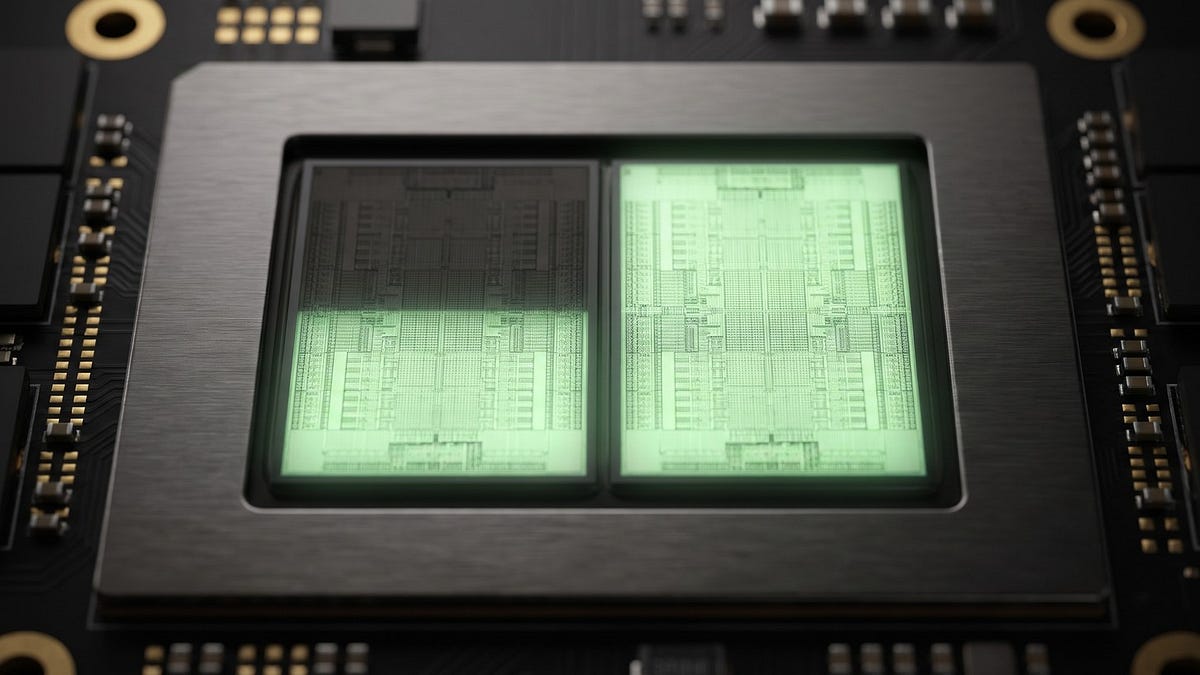
GeForce vs. Workstation GPUs: Nvidia's Half Rate, Priced
On October 25th, 2026, two open-source Linux modules for GeForce cards reached the hardware sites under headlines like TechPowerUp's "GeForce Unlocked: Modders Boost RTX 20, RTX 30, and RTX 40 Compute Performance b…
以下正文同步自 Hacker News 最新,版权归原站所有,已转换为易读排版。
Julien Simon
Oct 28, 2026
Share
On October 25th, 2026, two open-source Linux modules for GeForce cards reached the hardware sites under headlines like TechPowerUp's "GeForce Unlocked: Modders Boost RTX 20, RTX 30, and RTX 40 Compute Performance by Up to 2x".[1] According to their authors, each module loads before NVIDIA's driver, changes a setting on the card and hands it back to the driver, and an RTX 4090 then issues 16-bit matrix math with 32-bit sums, the kind mixed-precision training relies on, at about twice the rate.[2]
Twice compared to what? NVIDIA has printed the answer for years. Its own whitepapers rate GeForce cards at half speed for the math training uses, and its Ampere whitepaper rates the professional cards on the same chip at full speed. The modules show that the gap is a setting, not the silicon: an owner measured 1.9 times as much of that math per clock cycle on an RTX 3090 once the module had run. Counting per cycle takes the card's changing clock speed out of the comparison.[3] NVIDIA sells one chip at two rates. Even at the lower rate, GeForce is the cheapest matrix math to buy, and unlocked it wins by more.
A tensor core multiplies small blocks of numbers and adds up the products. It can keep that running sum in 16-bit precision, which some inference code can tolerate, or in 32-bit precision, which is what mixed-precision training uses because long sums in 16 bits drift. I'll call the gap between the two speeds on GeForce the half rate, because that is what it is.
NVIDIA's own documents give the game away. On each of the last three chips, the whitepaper rates the GeForce card at half speed with 32-bit sums. The Ampere whitepaper rates the professional cards built on the same silicon at full speed, and the RTX 6000 Ada's product page implies the same on Ada.[4][5][6]
A fast.ai forum user spotted it in December 2018: "the Geforce RTX cards (not the Titan RTX) have half-speed FP32 accumulate, when running in FP16 mode".[7] When NVIDIA launched the RTX 3090 in September 2020, it set the card against that Titan RTX, the one with the full rate. By NVIDIA's own ratings, the new card had about half the old one's training math.[8]
Spec sheets are promises, so I measured. On October 26th, 2026, I rented one GeForce card and one professional card for each of the last three chip generations and ran the same matrix multiplications in both modes.[9] The chart says it in one line: per clock cycle, every GeForce card does about half as much math with 32-bit sums as with 16-bit sums, and every professional card does about the same in both. Four of the six cards ran twice, on different hosts, with the same result.
NVIDIA's own datacenter L40 is rated at half the FP16 tensor speed of the L40S, with no accumulate type stated.[10] In NVIDIA's whitepapers, product pages and developer forum, I found no explanation of the half rate.[11]
They prove the half rate is a setting. Since October 22nd, owners have posted before-and-after results on the Ampere module's issue tracker, and the per-clock gain matches the gap between GeForce and the professional cards in my runs.[3] Speed at the power limit rises less, because the card stays under the same limit and drops its clock. Even so, an unlocked RTX 3090 lands where my A6000 did: the professional card's training math, on a used gaming card.[12]
The 4090 gains less, because even its full-speed 16-bit-sum mode already runs into the 450 W wall, well short of the spec sheet. Plan on the 10 to 34% that owners and the module's author report, not 2x. And training and inference gain differently. Fine-tuning and reading a long prompt are the same dense math, so they gain, even with 4-bit weights in vLLM; llama.cpp's integer kernels for quantized weights gain little. Generating tokens one at a time waits on memory bandwidth, not on math, so it gains nothing.[12]
The limits are real too. Some runs fail, and one left the cards unusable by NVIDIA's driver.[3] As of October 25th, the RTX 5090 is out of reach: the entry point the modules use doesn't exist on Blackwell.[13] Blackwell also moved the cap. The 5090 is halved for 16-bit and 8-bit math with 32-bit sums, but NVIDIA rates its 4-bit math at full speed, the format that squeezes the biggest models into 32 GB.[5]
A spec sheet gives a peak. What you pay for is the matrix math a card delivers, so I divided each price by what the cards delivered in my runs with 32-bit sums. These are matrix multiplications, not whole jobs, so the ranking assumes your job keeps every card equally busy.[14]
Pricing by delivered speed reorders the cards, and the reason is power. NVIDIA rates the RTX 6000 Ada, the professional card built on the 4090's chip, for 300 W, against 450 W for the 4090, and the chart below shows the cost: at its limit, the professional card delivers about a third of its rating. It isn't heat. The card stays cool, holds a 300 W limit that NVIDIA lets no one raise, and runs at well under half the clock its rating assumes; per clock cycle, it does nearly all of its rated work.[6] On paper, the RTX 6000 Ada has more than twice the 4090's training math. On the bench, the half-rate 4090 delivers more. Bizon's ResNet-50 runs are closer than my matrix multiplications but point the same way: the professional card edges ahead with 16-bit math and falls clearly behind with full 32-bit math.[6] The previous generation is different: on Ampere, the A6000 out-delivers the 3090, so there the full rate shows up.
Now the prices, from trackers between October 11th and 26th, 2026, in the table below. The cheapest delivered math is a used GeForce card, and a new RTX 6000 Ada costs more than four times as much per TFLOP at either end of the two price ranges. The new RTX 5090 lands in between only because it sells far above its $1,999 launch price.[15] The professional cards I priced add memory, 48 GB against 24 or 32, and ECC. They don't add matrix math per dollar. I priced no used professional card.
Unlocked, the cheap cards get cheaper. By owners' figures, not my runs, a used 3090 becomes the cheapest math in the table, and the gap to a new A6000, the professional card on the same chip, turns into a multiple.[12]
Renting is closer. The unit is dollars per petaflop-hour: what 1,000 TFLOPS of delivered matrix math costs for one hour. On RunPod's secure cloud, the 4090 still rents cheaper per unit of math than the RTX 6000 Ada, and on Bizon's ResNet-50 numbers it is still cheaper per image. The previous generation flips: the A6000 costs more per hour than the 3090 and less per unit of math, because it delivers so much more.[16] RunPod's cards stay capped: a RunPod pod is a container, and it can't load the modules.[9]
Price the GPU you are actually buying
In April, I argued that NVIDIA's consumer line routes serious users toward its highest-margin parts in three layers: memory capped at 32 GB, NVLink gone, a desktop AI box short on bandwidth.[17] The half rate is a fourth layer, and the weakest: on Ada, a 300 W power limit takes back most of what the full rate promises, and on Ampere and Ada a kernel module switches it off.
Twice compared to what? The same chip with a setting switched off. And twice the math doesn't mean twice the training or twice the inference: an owner's fine-tuning step ran 20% faster, and generating tokens gained nothing.[12]
So price every card at what it delivers, not at what the spec sheet promises. If your model fits in 24 or 32 GB, buy GeForce. If your model doesn't fit, pay for 48 GB and ECC, not for speed.
NVIDIA draws its own line in the GeForce driver license, section 2.8: the software "is not licensed for datacenter deployment".[18] The fence that holds is memory, and no module climbs that one.
[1] Hardware Busters, "RTX 4090 Tensor Unlock Doubles FP16 Throughput on Linux, and Ampere Cards Gain Up to 80%", October 25th, 2026, accessed October 26th, 2026; TechPowerUp, "GeForce Unlocked: Modders Boost RTX 20, RTX 30, and RTX 40 Compute Performance by Up to 2x", accessed October 26th, 2026 (no date on the saved page). Both saved in sources/.
[2] JustAResearcher, gpu-unlock-ada, README accessed October 26th, 2026: a Linux kernel module that loads before the NVIDIA driver, runs NVIDIA's signed boot firmware with a payload that writes "SM speed-select" register values, resets the card and lets the stock driver bind. RTX 4090, FP16 with FP32 accumulate: 165.6 to 331.6 TF/s, an issue rate, not an application speedup. The same README reports an independent owner run on an RTX 4090 in which cuBLAS FP16 gained 12 to 34% and BF16 16 to 20%. The Ampere module is Zagitta, gpu-unlock. Its README, accessed October 28th, 2026, after a "Release 2.0" commit on October 27th: Ada Lovelace and Turing cards "Experimental", Blackwell "Not supported". The mechanism is the authors' description; the result has been reproduced by owners (note [3]).
[3] Zagitta, gpu-unlock issue tracker, read October 26th, 2026: repository created October 18th, 2026; 134 issues, 95 of them titled as compatibility or success reports, posted from October 22nd to October 26th by different users (issue dumps saved in sources/repro/). Per-clock result: chflame163, issue #33, October 24th, 2026, stock EVGA RTX 3090 at a 350 W cap: FP16 "70.8 @1680 MHz" before, "111.3 @1380 MHz" after, "0.042 -> 0.081 (x1.94)" TFLOPS per MHz. On the Ada module, JimmyToluene, issue #58, October 26th, 2026, RTX 4090 issue rate "FP16 / FP32 accumulate | 169.4 TF/s | 338.7 TF/s | 2.000×". The owner's figures give 70.8 ÷ 1680 and 111.3 ÷ 1380, about 1.9 times per clock. These are owners' reports, not a lab's; the per-clock doubling matches the stock ratio we measured (note [9]). Failures, counted from the saved dump: seven issues report a run that failed on a card (#11, #20, #23, #38, #67, #135, #171), three report install or build errors (#18, #45, #92); issue #23: "unlock fails with -ETIMEDOUT on non-cold cards and leaves GPUs unusable by nvidia".
[4] NVIDIA, NVIDIA Ampere GA102 GPU Architecture whitepaper, v2, accessed October 26th, 2026. Table 3, "NVIDIA RTX A6000 and NVIDIA A40 Specs": GPU codename GA102 for both; peak FP16 Tensor TFLOPS with FP16 accumulate 154.8 (A6000) and 149.7 (A40); with FP32 accumulate 154.8 and 149.7. Table 9, "Comparison of GeForce RTX 3090 to NVIDIA Titan RTX": RTX 3090 FE 142 with FP16 accumulate, 71 with FP32 accumulate (dense; sparse figures omitted). Second document, which repeats the whitepaper split rather than measuring it: kadirnar, kernel-agent issue #257, October 9th, 2026, which builds the split into a performance tool: "On GeForce Ampere and Ada, fp32-accumulating HMMA is half the fp16-accumulating rate", "RTX 3090 71 vs 142". The A6000's equal rates are checked by our measurement in note [9].
[5] NVIDIA, NVIDIA Ada GPU Architecture whitepaper, Appendix A, "GeForce RTX 4090 GPU Full Specifications": peak FP16 Tensor TFLOPS with FP16 accumulate 330.3, with FP32 accumulate 165.2; the same table rates the RTX 2080 Ti at 113.8 and 56.9 and the RTX 3090 Ti at 160 and 80. NVIDIA, NVIDIA RTX Blackwell GPU Architecture whitepaper, Appendix A: RTX 5090 419 with FP16 accumulate, 209.5 with FP32 accumulate; BF16 with FP32 accumulate 209.5. The same table, RTX 5090, dense: "Peak FP8 Tensor TFLOPS with FP16 Accumulate" 838, "with FP32 Accumulate" 419; "Peak FP4 Tensor TFLOPS with FP32 Accumulate (FP4 AI TOPS)" 1676 (3352 with sparsity). Author's calculation: 1676 ÷ 838 = 2. The FP4 rate, rated with 32-bit sums, is double the FP8 rate with 16-bit sums, so 4-bit math is not halved. The whitepaper says FP4; it does not name NVFP4. Both accessed October 26th, 2026; dense figures. Second document: our measurement in note [9].
[6] NVIDIA, RTX 6000 Ada Generation product page, accessed October 26th, 2026: "Max Power
正文由 探How 从来源站点 RSS 同步,内容未经改写;遇到排版缺失或需要图片、视频时请以原文为准。