Healthy Feedback
Human collaboration, like most things, improves with feedback. But it's not obvious how to make feedback effective. Anuja Karnik and Sumeet Gayathri Moghe pass on a bevy of tips for healthy feedback, based on the princi…
以下正文同步自 Martin Fowler,版权归原站所有,已转换为易读排版。
A guide to exchanging criticism or praise in teams
Peer-to-peer feedback is a powerful growth tool, and yet candid feedback is rare. We treat all feedback as positive — either to strengthen confidence or improve effectiveness. Based on this principle we can form several patterns for both giving and receiving feedback to help teams improve their interactions.
Anuja is a talent development and organisational design strategist and a people nerd. She helps growing organisations build practical talent systems that connect business needs with how people learn, grow and work.
Sumeet is the global head of culture and organisational design at Thoughtworks. In his past life, he was a software technologist for over two decades, working as a business analyst, product manager and transformation consultant.
At Thoughtworks, “cultivation”—helping each other grow—has been a big part of how we work. Our collaboration practices make software development a cognitive contact sport and create many opportunities to share feedback about how we think, problem-solve and interact with one another. In our experience, teams in which people share candid, timely, and instructive feedback with each other are also teams where people experience the most growth. Indeed, peer-to-peer feedback is one of the most powerful tools we’ve used to cultivate others and for our own growth.
Yet, peer-to-peer feedback, as we advocate for at Thoughtworks, isn’t as common across the industry. We know this from working with our counterparts in client teams and from onboarding new colleagues who have worked at other companies. In this article, we want to share what we’ve learned about exchanging feedback from our decades-long experience working at Thoughtworks.
Before we get into the patterns and antipatterns of sharing feedback, let’s list the core principles that underpin this practice.
When Sumeet joined Thoughtworks, he had the opportunity to work with Patrick Kua. Pat helped Sumeet see through one of the biggest myths about feedback — the notion that feedback can be either positive or negative. Sumeet remembers Pat saying, “All feedback is positive.” Kua listed the only two goals for sharing feedback.
Pat argued that both these goals are positive. If you are communicating to achieve some other goal, perhaps you aren’t sharing feedback. Thinking of all feedback as positive changed our perspective towards it. Indeed, that mindset makes it easier to accept feedback.
The word “criticism” often has a negative connotation. It’s common to prefix the word with “constructive” to make clear that the criticism serves a useful purpose. But if we assume that all feedback is positive, the suffix is redundant. So, in the spirit of using one word instead of two, we’ll use the term “criticism” to mean “constructive criticism” throughout this article.
We have found Kim Scott’s “Radical Candor” framework an excellent summary of how we approach feedback. Radical candour happens when we care personally about our coworkers and when we can challenge them directly about their work and interactions. Further down in the article, we’ll explain how to use this approach.
While we suggest you read the book to understand Radical Candor in its entirety, Kim Scott also describes anti-patterns to avoid.
As you can imagine, we prefer radical candour.
Teams at Thoughtworks comprise people at varying levels of seniority and positional authority. When sharing feedback, though, we treat each other as peers. On occasion it’s difficult to look past grades and job titles, but in principle, anyone can strengthen another colleague’s confidence or improve their effectiveness.
The principle of feedback as a peer sport places a heavy onus on senior colleagues to be open to feedback and to seek it out. Indeed, as ex-Navy SEAL Team Six commander says,
The most important words a leader can say are, “I screwed that up”.
Allied practices such as retrospectives and after-action reviews help this team dynamic by fostering a spirit of reflection, psychological safety and collective improvement.
We like to think of teams as social systems. Much like software systems, which need telemetry to know how they’re behaving, teams need telemetry too. Feedback is one such telemetry signal.
A service without logs and metrics can appear healthy until it fails. Similarly, a team without feedback can appear harmonious until a deadline, conflict, or reorganisation exposes the problems everyone had noticed but nobody had named. Like telemetry signals for software, we see continuous, peer-to-peer feedback as a telemetry signal for teams and individuals
The early-and-often feedback loop principle also applies to peer-to-peer feedback. If we could do something better, why not know early? And if we’re already doing something well, how about getting some feedback to strengthen our confidence, so we can repeat that behaviour with gusto?
While reflective feedback—i.e., feedback that you share, looking back at a stretch of time—is instructive, we find that the most useful feedback is the one you receive in the flow of work. The closer the feedback is to an interaction you’ve had, or a piece of work you’ve delivered, the more likely you are to understand it and to learn from it.
Agile teams provide many opportunities for peer-to-peer collaboration. Pairing, for example, is not just a way to problem-solve together, but also a way to offer feedback to each other. Even as many teams begin to pair with AI agents instead of human beings, we don’t see AI replacing how two human beings learn and grow when pairing for a few hours.
Even if your team doesn’t pair often, there are several other opportunities to exchange feedback — a design document you collaborated on, a presentation you delivered together, or a workshop you led with others. Every collaborative activity represents an opportunity to exchange feedback.
Over the years, we’ve observed a few simple practices that promote a healthy feedback culture in teams.
The most important discipline in giving feedback is separating what you observed from the story you told yourself about it. Useful feedback is often grounded in real observations, not judgment. Here’s an example of observation-based feedback.
When you presented today, I noticed you skipped several slides. Skipping slides makes your audience feel that you’re either delivering a canned talk or are underprepared. Next time, if you have slides that aren’t relevant to the audience, how about hiding them before you begin presenting?
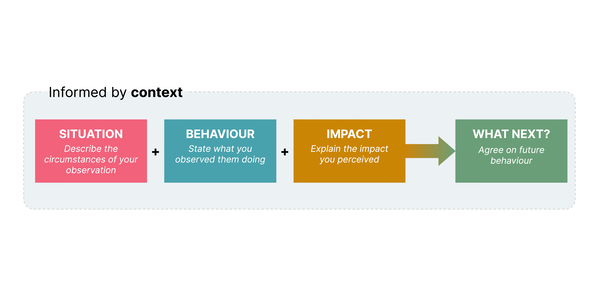
If you dissect that piece of feedback, you’ll notice three constituent parts:
By describing the situation and the behaviour, you lead with objective truths. The impact, of course, is your perception, and that’s the value you offer when sharing feedback. The above example also includes a suggestion for the future, which can be useful when the alternative is evident.
Situation-behaviour-impact, or SBI, is a popular format for sharing feedback, but we find that seeking context before sharing feedback avoids some of the tension that can build up in a feedback conversation.
When sharing feedback to improve effectiveness, remember that no one screws up on purpose. There’s always some context behind people’s actions. Consider the above feedback example. Instead of launching into the SBI, we could begin with a simple question.
Hey, when you were presenting today, I noticed that you skipped a number of your slides. Why was that?
Perhaps it wasn’t lazy prep that led to the skipped slides. Perhaps a late start or unplanned interruptions threw the presenter off, and they had to skip some of their content. There’ll still be room for feedback, but now the feedback won’t be about preparing better. Instead, it’ll be about elegant ways to skip slides.
When you seek context before sharing feedback, you also create safety in the conversation. You position yourself as “curious, not judgmental”, much like Ted Lasso (the TV character) would advocate for. A CSBI (context-situation-behaviour-impact) pattern for sharing feedback sets you up to be curious before you offer any judgment.
Feedback is most effective when our colleagues are open to hearing it. After all, we don’t want to ambush our colleagues with feedback. So, it helps to ask if they’re ready to listen.
“Is now a good time to share some feedback with you?” works for a short conversation. For something more significant, explain the purpose and the time needed: “I have an observation about how the workshop went. It may be useful to talk about it for 20 minutes. Is now okay, or should we find another time today?”
If the person is not ready, agree on another time. Sometimes you may notice the other person avoiding the feedback discussion. That reluctance to hear feedback may mean that there are other issues to address in your work relationship. Address those topics first.
Feedback to improve effectiveness is often safer in private. Public criticism adds an audience to the problem. The receiver now has to manage the content and their status in the room. Psychological safety takes an immediate hit.
We also prefer sharing such feedback in real time — either in person or on a video call. Text is a poor default for feedback that carries tension. The written word doesn’t promote conversation and lacks pauses, body language, and facial expressions that can help defuse tension.
Of course, if both people agree, you can document the feedback afterwards, but a private, synchronous conversation has always been our sensible default.
Public recognition is different, by the way. People don’t mind receiving praise in public. At Thoughtworks, our company’s social network lets people share kudos for colleagues, and it’s a popular system for recognising value-aligned behaviour. Here’s an example of how those kudos work.
Figure 2: Peer-to-peer recognition can be public and asynchronous
When sharing criticism, it’s natural to prescribe a different way to do things. If you’re helping your colleague align to team norms, prescriptions can be effective. In most cases, though, we find that involving the receiver helps identify the way forward. Take the example of the presenter skipping slides. You could offer a prescription, or you could say,
How can you prepare your presentation in a way that allows you to be flexible to the situation you find yourself in?
Asking an open-ended question can help your colleague think of solutions that work for them. Remember, they have to take action, not you. If they identify a viable solution, they’ll be more likely to follow through. So, when possible, open up the conversation instead of offering a prescription. Who knows—together, you may identify a solution better than the one you had in mind!
Figure 3: The SBI feedback model, informed by context, turned into a conversation
When we share feedback early, often, and close to the context of the work we do, we can match it to the level of impact. The level of impact can escalate between feedback-sharing moments.
The first time you notice a behaviour you want to give feedback about, your feedback will most likely focus on the content of the incident. For example, you notice a colleague’s commit message is not clear and descriptive enough. You can speak with them about the specific commit message and show them how to write an eff
正文由 探How 从来源站点 RSS 同步,内容未经改写;遇到排版缺失或需要图片、视频时请以原文为准。