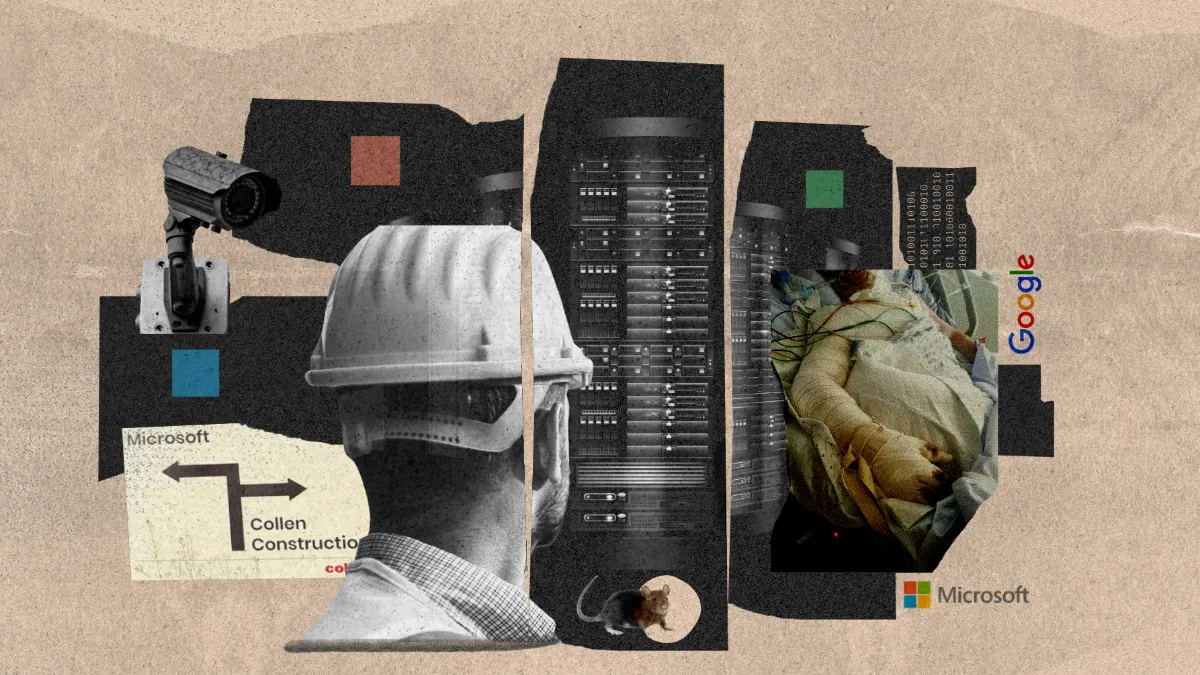
Electrocutions, Intimidation and Wage Theft Haunt Europe's Data Center Workers
A five-month investigation by Investigate Europe in partnership with Tech Policy Press and media partners in eight countries reveals the harsh realities facing some working on the continent's vast AI infrastructure…
以下正文同步自 Hacker News 最新,版权归原站所有,已转换为易读排版。
A five-month investigation by Investigate Europe in partnership with Tech Policy Press and media partners in eight countries reveals the harsh realities facing some working on the continent's vast AI infrastructure developments.
Share
Sandu Dumitrescu* checked his watch. He was winding down the last 15 minutes of his shift at the Google data center site in Saint-Ghislain, Belgium, in March, when the call came in. He had just finished performing electrical checks on the site’s hall fans when his manager communicated a final request: could he run two quick tests right before he left? The 34-year-old electrical tester says he had to make a decision: he had already worked almost 10 hours. Yet in the highly pressurized environment of GBL-6, Google’s sixth data center in the vast €5 billion campus, such last-minute requests were normal.
“I had no choice,” Sandu says. “People have been fired after saying no.” He believed his Estonian-based supervisors on the Google site, where Irish company Dornan Engineering is the main electrical subcontractor, would not take a refusal well. Relying on his week-by-week contract and with hopes to call his wife and young son back in Romania that night, he resigned himself to finish the job.
The task was one he had done many times before and involved a series of tests measuring the safety and integrity of the electrical wiring. It should have taken about an hour. Sandu says the request came to him verbally, via an intermediary. A protective suit was locked away in an equipment room. The trip would have added another 15 minutes to the job, he says, and people were waiting. In the rush, Sandu decided not to retrieve the suit.
Once in the voltage room, Sandu says the managers confirmed the lines had been de-energized. In the first round, everything went as planned. Then, on the second test, while holding insulated tongs, he linked the cables. But this time, the lines were live.
The blast was immediate and catastrophic. In milliseconds, 400 volts and 12,000 amps hit Sandu’s face and across the right side of his body. A colleague who was down below the platform and witnessed the incident told Investigate Europe that he “heard a loud bang, saw a lot of smoke, and saw [Sandu] screaming in pain.”
“I went completely blind,” Sandu recalls. “I told the managers three times that I could not see.” But no managers answered, he claims. According to the witness who called for help, untangling Sandu from his harness in a mass of blackened flesh, the managers had run off, while Sandu writhed in pain on the ground.
Workers rushed to carry Sandu to an ambulance. When doctors received him in the Grand Hôpital de Charleroi, he was placed in an induced coma for five days.
Hospital records seen by Investigate Europe show that the arc flash electrocution had burned 12 percent of Sandu’s body, with second-degree burns to the face and neck as well as third-degree burns across his right shoulder and fingers. Photographs show scorched ears and swollen raw lips, with his arm a mess of hematoma and clotted skin.
When Sandu woke in the intensive care unit a week later after surgery, his wife was at his bedside. He says his entire body felt like a “white-hot blister…. It was so much pain. The human heart cannot comprehend it,” he recalls.
Two days after waking from his coma, the regional director of Google, along with a representative from Dornan and his Dutch recruitment agency, Wanted, came to visit. Sandu says that while he lay bandaged in the hospital bed, Google and Dornan each took a statement from him about the accident. The Google director told him he was lucky to be alive.
Sandu’s electrocution is both brutal and harrowing. Yet to date, no fines or sanctions are known to have been issued. Belgium’s federal labor inspectorate closed its investigation into the accident at the end of October and found no wrongdoing. Sandu says, however, that he was never interviewed directly by the labor authorities.
Despite repeated formal requests for his accident report from Wanted and Google, he has yet to receive it.
A month after his accident, the recruiter messaged Sandu to see how he was. They then asked: “[The company] is recruiting more testers (perhaps you know people?).”
A Google spokesperson told Investigate Europe: “Our supplier code of conduct and contracts require all suppliers to comply with local labor laws and uphold safe, healthy working conditions. We maintain active dialogue with union leaders and trade groups, and are committed to providing transparent information about our workplace."
A Wanted spokesperson said: “As an employer, we can, will and should be held accountable by the proper authorities. Although we agree that freedom of speech and press is a great asset, we cannot comment on the content besides the fact that your statements or claims are not correct.”
A five-month investigation led by Investigate Europe with media partners in eight countries into working conditions on data center sites across Sweden, Norway, Belgium and the Netherlands reveals that Sandu’s case is far from unique.
Workers at one major Microsoft project described a culture of fear and intimidation where construction managers “rule on mental terror“. The testimonies are supported by dozens of health records, pay slips, phone messages, photographs and videos shared with reporters.
The investigation found a recurring pattern where tech companies and their many Irish construction partners embed US-style working practices, often in defiance of national working norms.
In Italy, Denmark, Finland, Sweden, Belgium, the Netherlands and Norway unions told reporters they had difficulty accessing certain sites to speak with workers and document conditions. One union representative in Denmark said some sites are “more closed than a state prison.”
The European data center industry is experiencing an infrastructure surge the continent has not seen in decades, dispatching tens of thousands of migrant workers to make its vision of tech sovereignty a reality.
A data center construction site can contain up to 2,000 workers and dozens of contractors, with up to a quarter of a million people working on sites across Europe every day.
The industry is one of big budgets and even bigger secrecy. Construction firms are often required to keep their tech clients secret, while contractors and intermediaries are also typically hidden from view.
At the same time, construction continues to rank as the most dangerous economic sector in the European Union. According to the latest Eurostat data, the sector recorded 776 deaths in 2024, representing nearly a quarter of all fatal workplace accidents in Europe.
By 2030, the industry is forecasting €100 billion of investments into European data centers. With over 2,300 facilities rapidly altering the physical and energy landscape of Europe, and hundreds more planned or in construction, the industry’s priorities appear abundantly clear: where to build, how fast to build, and which companies are prepared to build under budget.
A video Adrian shared with Investigate Europe shows a large rat scurrying across a hallway and into an electrical storage room. In a string of text messages sent in August, Adrian begs the housing manager to get rid of them. The reply comes back: “Brother, I understand. But I have to wait for these other companies to come in and remove them, I can’t come in alone and just pull them out of the walls…”
If you head northwest out of Gävle, a town two hours from Stockholm, past timber-framed cottages and dense pine forests, a sign points you to a smooth road rolled out specifically for Microsoft. The remote clearing is part of a 130-hectare, 33.7 billion Swedish kronor (€3 billion) expansion plan started in June 2024 to scale up Microsoft’s AI data center infrastructure in the country.
Signs for Collen Construction line the drive, their banners draped across the large metal perimeter. Collen is among many Irish contractors overseeing data center build-outs across Europe. Hired by big tech clients to deliver projects on a strict timeline, these years-long projects manage a syndicate of other firms.
In the distance, beyond the security fencing, an airport-sized building looms, reflectionless and inscrutable. In the foreground, a bright red turnstile entryway welcomes workers in white lettering: ‘Thank You for Working Safely’.
One of Collen’s subcontractors, the Irish-owned construction company Benbau, employs hundreds of workers across Europe, including in Sweden, to work in areas such as site management, concrete and carpentry.
The workers are housed 20 minutes off-site in modular housing managed by Benbau.
For months, there has been a growing sense of outrage among Adrian and his colleagues working for Benbau on the Microsoft site. They have reported vermin infestations, broken ventilation systems, and lack of heating during the sub-zero Swedish winters, but they claim the problems remain unresolved.
One 50-year-old Romanian worker, who is diabetic, shared images of his toes that had lost circulation after wearing what he claims were poor work boots issued by Benbau. He had to have his toe amputated several months ago.
Adrian says it has been months since he first reported the rat infestation, and the rodents have multiplied inside the 40-room modular housing unit. Another video appears to take the viewer down a narrow hallway into a shared kitchen and lounge, where surveillance cameras are mounted in the corners. Inside the crowded housing, workers say the stress runs high: 24 people to a kitchen, 14 men to a single bathroom, with a boarded-up hole where the rats crawled through and a bathroom window that is sealed shut.
Such crowded confines can make the transmission of disease more likely. In February this year, one Romanian worker on the site became extremely ill. Following several trips to the hospital, it was confirmed he had active tuberculosis, Investigate Europe was shown the individual’s medical record confirming the positive diagnosis. Shortly after, others showed similar symptoms.
After the first worker who contracted the disease had left for hospital, workers in the accommodation became worried about possibly also getting the disease.
One worker who had recently moved into a new room said: “I bought bedding myself, washed the mattress with chlorine, scrubbed the walls, left the window open for a long time - it was very cold.”
Benbau initially informed only a few men who shared close quarters with the first infected worker and then told the men testing was optional, according to seven workers who spoke with Investigate Europe. Freedom of information requests to Sweden’s national work authorities and Public Health Agency revealed no outbreak had been reported.
The county medical officer in Gävle told Investigate Europe that only one case was reported in March and shared with the national health authority, which also confirmed the case. In Sweden, tuberculosis is a notifiable disease that is subject to mandatory contact tracing, which workers claim did not occur.
Eight Benbau workers living in the same housing and union representatives told reporters that they believed at least 10 to 12 men also had the infectious disease.
Mihai*, a 60-year-old worker, also tested positive for tuberculosis, hospital records shared with Investigate Europe reveal. He says that Benbau offered to transfer him to another Microsoft site in Denmark, along with others he claims were also infected. Considering his age, Mihai says he decided against traveling.
Then, in May 2026, witnesses who lived in the housing where some were confirmed positive with latent tuberculosis say a group of vans arrived to relocate workers to the Denmark site. Two of the witnesses say that many of those who left that day had tested positive for tuberculosis. Some men were diagnosed with latent tuberculosis, yet told reporters they experienced symptoms
正文由 探How 从来源站点 RSS 同步,内容未经改写;遇到排版缺失或需要图片、视频时请以原文为准。