UX Research for AI Products: The AI-Native Research Lifecycle
TL;DR: UX research for AI products works best as a four-phase loop, the AI-native research lifecycle: Discover where AI is worth building, Define what "good" means, Evaluate the AI against real people, and Monitor trust…
以下正文同步自 Hacker News 最新,版权归原站所有,已转换为易读排版。
TL;DR: UX research for AI products works best as a four-phase loop, the AI-native research lifecycle: Discover where AI is worth building, Define what "good" means, Evaluate the AI against real people, and Monitor trust after launch. Each phase hands the next one something it needs, which is why researchers belong in every phase and not only in testing.
Who this is for: UX researchers, product designers and product managers building AI features, assistants or agents.
Every AI team has a meeting where someone says, "The model scored really well. Are we good to ship?" Nobody in the room can fully answer. The score came from a benchmark, the benchmark came from the team's own guesses about what users ask, and no real user has touched any of it yet.
That gap is where researchers belong. I'd go further: of all the roles on an AI product team, ours is the one that can speak for the person on the other end of the prompt, at every step of the build, not only the last one.
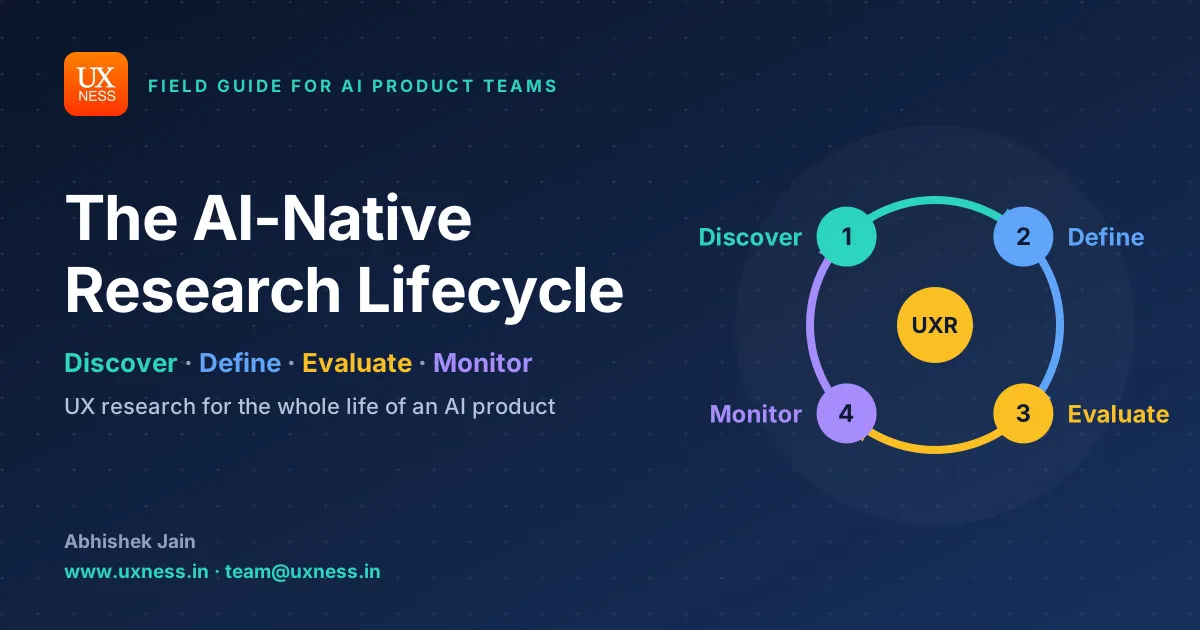
In classic software, you design, build, test, ship, and then mostly move on. AI products don't work that way. The thing you ship is probabilistic, the quality bar is a judgement call, and the behaviour keeps changing after launch because models, data and user habits keep changing. So the life of an AI product is a loop with four moves:
Each of those four moves hinges on a human question that no dashboard can answer for you. Where does work really hurt? Whose idea of a good answer counts? Do users accept what the model produced? Is their trust going up or down? Those are research questions. If researchers only show up at usability testing, the team has already made the big calls on instinct.
This is the framework I use to stay involved from the first idea to the long tail after launch. It gives you a clear role at every stage, a named set of methods you already know, and one thread running through it all: build it with the people who will use it. Each phase also produces something the next phase cannot start without, which is what turns four activities into one story.
Read it clockwise. Whatever you learn at the end of the loop goes straight back to the start.
In short: Discover is the first phase of the AI-native research lifecycle. Researchers map real workflows, combine behavioural data with fieldwork, and run an AI opportunity workshop to find friction worth solving. The output is a prioritized AI opportunity map that shows the team where AI will genuinely help.
Most AI projects start with a technology and go looking for a problem. Discovery flips that. Your job is to find the places where people lose time, switch tools, repeat themselves or hold things in their head, and then ask honestly whether AI would help.
You are the person who sees the whole workflow, not just the screen the team owns. Start with a signal, usually from data science: a lot of people hopping between two tools, a task that takes far longer than it should. Then make "is this a real problem, and why?" the research question. Name the riskiest assumption and test it with people before anyone gets excited.
The design underneath is explanatory sequential mixed methods. The numbers tell you what is happening, the fieldwork tells you why, and you check both in one shared findings document so nobody argues from half the picture.
A data scientist from day one, because the signal is theirs and the explanation is yours. Then the PM, a designer and a couple of engineers for the workshop, plus the people who do the work every day. Engineers in the room keep the list honest about what is feasible.
A prioritized AI opportunity map: each opportunity scored on severity, frequency and how suited it is to AI, with an owner and an evidence trail behind it. This is the raw material for Define. Without it, Define has nothing real to write prompts about.
In short: Define turns a chosen opportunity into something testable. Researchers crowdsource real prompts from expert users, agree a rubric, and run co-creation workshops to write expected answers. The output is a prompt set, a rubric and a golden dataset that the AI will be measured against.
Discover gave you an opportunity. Define turns it into something a team can build against and test. In practice that means three things: real prompts, a shared rubric, and a set of expected answers, often called a golden dataset. Here is the part I care about most as a researcher: whoever writes those expected answers is setting the standard the model will be judged by for the rest of its life. That is enormous influence, and it should not sit with whoever happens to be closest to the code.
You make sure "good" is defined by users, not guessed by the team. You collect the questions people truly ask, help the group agree which ones matter most, and sit people with real expertise in a room to describe what a great answer looks like.
Expect more than one acceptable answer for many prompts. Capturing those variations is not messy, it is accurate. A single "right" answer will later mark good responses as failures.
The expert users whose judgement defines quality, plus engineering and design. Add a data scientist to check that the prompt set reflects the real spread of use, not just the loudest cases.
A prioritized prompt set, a plain-language rubric, and a golden dataset with approved responses and accepted variations. Engineering gets a head start on building. Evaluate gets something concrete to test against. Nothing in the next phase works without these.
In short: Evaluate tests whether the AI is good enough according to real users. Researchers compare human-as-judge and LLM-as-judge scores, study where they disagree (the judge gap), and turn rejection reasons into fixes. The output is a launch-readiness view and a repeatable evaluation step.
Now you have prompts, a rubric and expected answers, so you can finally ask whether the AI is good enough. Most teams answer with an automated judge: another model that scores the output. That is fast and cheap, and it can also be confidently wrong. The researcher's move here is simple and powerful: put human judgement beside the automated score and study the gap between them.
I have seen an automated judge report that a feature was nearly ready while real users, rating the same outputs, accepted far fewer of them. The headline number was not lying on purpose. It was measuring something slightly different from what users care about. Finding that out before launch is one of the most valuable things a researcher can do.
You are the check on the checker. You compare human-as-judge and LLM-as-judge results, work out where and why they diverge, and turn user rejections into specific things engineering can fix. You also agree the launch bar with the team before the results come in, so the goalposts stay put.
The design here is convergent mixed methods: gather the acceptance signal and the rejection reasons side by side, then merge them. You need confidence quickly, from two angles.
The expert raters from Define, engineering and applied science who will act on the findings, and data science for the agreement statistics. Keep the people who built the automated judge close. They know where it is likely to fail.
A judge-gap readout, a ranked list of rejection factors with real examples, and a launch-readiness view against the agreed bar. You also leave behind a repeatable evaluation step the team can rerun after every model change. That step is what Monitor will keep running once the product is live.
In short: Monitor keeps trust measurable after launch. Researchers run a longitudinal in-product survey, track behavioural signals and re-run the evaluation set after every model change. The output is a trust trend, plus new failure cases and unmet needs that restart the loop.
Shipping is not the finish line for an AI product. Models get updated, data shifts, and people learn new ways to use the thing, so quality moves even when nobody touches the code. Monitoring is how you notice. As the researcher, you build the always-on listening that tells the team whether people trust the AI more or less than last month, and why.
You turn a one-off study into a standing signal. The most useful version compares the AI experience with the traditional one sitting next to it, because that comparison tells you whether the AI is earning its place. You also watch for drift, by segment, so a healthy average doesn't hide a group that is quietly giving up.
Product and engineering own the response when a signal moves, so agree up front who acts on what. Data science helps with trend and segment analysis. A small group of recurring users gives you the depth behind the lines on the chart.
This is where the loop closes. Monitoring gives you three things. New failure cases go back into the golden dataset in Define. Rejection reasons and unmet needs go back to Discover as fresh opportunities. And the regular readout keeps the roadmap honest about where trust is rising or slipping.
The reason this works as a story, and not as four separate studies, is that each phase produces the one thing the next phase cannot start without.
That handoff is also your protection against being treated as a service that runs studies on request. When every phase hands the next one something it needs, researchers are part of how the product gets built.
I've put the whole framework on one A4 page you can print and stick next to your desk or in the team room: the four phases, the methods, who to bring along, the handoffs and the traps.
Print it at A4, or save the image above for a slide or a desk reference.
It is a four-phase framework for UX research on AI products: Discover, Define, Evaluate and Monitor. Researchers find where AI is worth building, define what a good answer looks like, test the AI against real users, and track trust after launch. Each phase produces an output the next phase depends on.
UX research speaks for the person on the other end of the prompt. It finds real friction worth solving, collects the prompts and expectations users actually have, checks AI output against human judgement, and keeps listening after launch. It turns "the model scored well" into "users accept what the model produces".
In human-as-judge evaluation, trained people rate AI responses against a rubric. In LLM-as-judge evaluation, another language model scores the same responses. The LLM judge is faster and cheaper, but it can disagree with people, so researchers compare the two and study the gap before trusting an automated score.
A golden dataset is a set of real user prompts paired with expert-approved expected responses, including acceptable variations. It is the standard an AI is tested against. Researchers should facilitate it with expert users, so quality is defined by the people who use the product, not guessed by the team.
The judge gap is the difference between how an automated AI judge scores outputs and how human raters score the same outputs. A large gap is a warning that the headline score is measuring something users do not value. Studying why humans reject outputs turns the gap into specific fixes.
The mix changes by phase. Discover uses journey mapping, behavioural log analysis, micro-surveys and contextual inquiry. Define uses prompt crowdsourcing, co-creation workshops and rubric design. Evaluate uses human-as-judge rating, agreement analysis and thematic coding. Monitor uses longitudinal in-product surveys and behavioural telemetry.
Run a short in-product survey at the moment of use, compare the AI experience with the traditional one, and track behavioural signals such as retries and switching back. Re-run the evaluation set after every model or prompt change, and agree up front who acts when a signal moves.
Pick one workflow with visible friction and run a small version of each phase. Map the workflow, pair with a data scientist to find the signal, collect real prompts, agree a rubric and launc
正文由 探How 从来源站点 RSS 同步,内容未经改写;遇到排版缺失或需要图片、视频时请以原文为准。