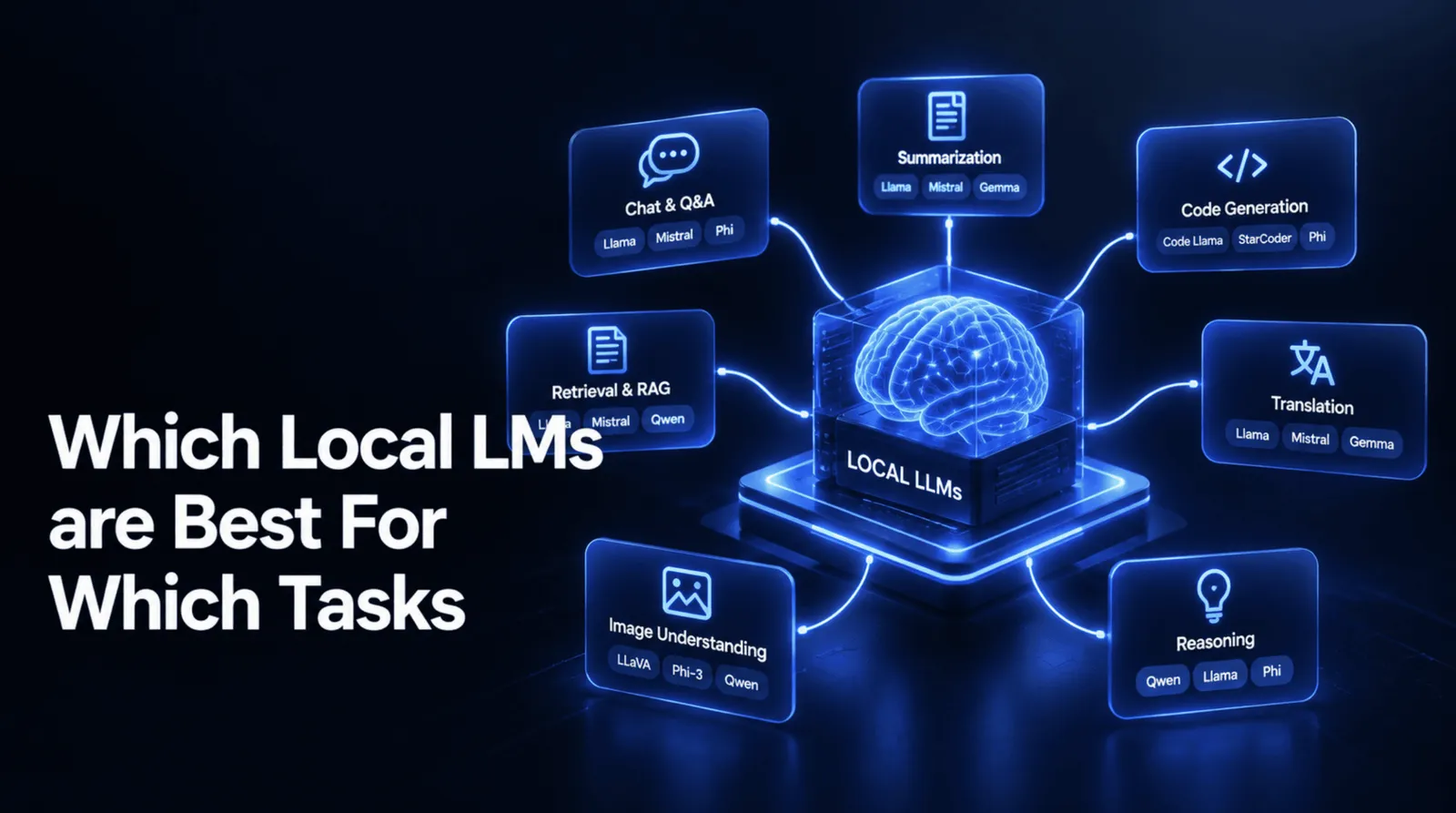
Which Local LMs are Best For Which Tasks
A local language model is one whose actual weights, the enormous file of learned numbers that constitutes the trained model, you download and run entirely on your own hardware.
以下正文同步自 KDnuggets,版权归原站所有,已转换为易读排版。
Someone spends an evening reading "best local LLM" roundups, settles on whichever name keeps showing up at the top, downloads it, and points it at the thing they actually needed help with that week, say, cleaning up a Python script. But it's mediocre at that. Not broken, just unimpressive, in the specific way a generalist is unimpressive at a specialist's job. The model wasn't bad. It was never a coding model to begin with, and nothing in the roundup that recommended it ever said so.
That mismatch is the entire reason this guide exists. "Best" was never a single ranking, and treating it like one is how a genuinely capable model ends up feeling disappointing for no fault of its own. This article works the other way around: what a local language model actually is, why running one on your own hardware is worth doing at all, and then, model by model, with real cited proof rather than vibes, exactly what each one is good at. It closes with one table built specifically to answer the only question that actually matters: for the task in front of you right now, which model should you reach for?
A language model is, at its core, a system trained to predict text: given everything that came before it in a conversation or a document, what's the most plausible next piece of text? That simple mechanism, applied at enormous scale, is what lets a model answer questions, write code, summarize a document, or hold a conversation. Every well-known AI chat product, whether it's ChatGPT, Claude, or Gemini, is built on top of a language model doing exactly this.
"Local" describes something about how you access that model, not what it is. A local language model is one whose actual weights, the enormous file of learned numbers that constitutes the trained model, you download and run entirely on your own hardware. No API call leaves your machine. No account is required to use it. No company's server ever sees your prompt. That's a genuinely different relationship to the technology than using a hosted model through a website or an API key, where every request travels to someone else's infrastructure and the model itself is something you can query but never actually possess.
Ollama, the tool that's become the de facto standard for running these models locally, hosts a public library of ready-to-pull GGUF builds for every model covered in this article, and the real download numbers behind some of these models, covered in detail later in this piece, run into the tens of millions.
This is the idea the rest of the article is built around, so it's worth making explicit. A single aggregate benchmark score, or a raw parameter count, tells you surprisingly little about whether a specific model will actually serve you well on a specific task. A model can score well on general knowledge and still write mediocre code. A small, efficient model can lead its entire weight class on tool calling while trailing badly on creative writing. Treating any one number as "the" ranking is how people end up disappointed by genuinely good models used for the wrong job.
It helps to know, briefly, what the benchmarks that show up throughout this article are actually measuring, since they're not interchangeable. Massive Multitask Language Understanding (MMLU) tests broad general knowledge across dozens of academic subjects, a reasonable proxy for how much a model "knows."
HumanEval specifically tests whether a model can write correct, functioning code for a given problem, a direct measure of coding capability rather than general intelligence. MT-Bench measures how well a model follows instructions and holds a coherent multi-turn conversation, closer to what "feels good to actually talk to" captures. Keep those distinctions in mind as the numbers show up model by model below, since a model leading on one says nothing certain about where it lands on the others.
Seven models make up this article: six general-purpose chat models plus one embedding model that plays a different but essential role in any local retrieval-augmented generation (RAG) setup. Every claim below is checked against the model's own official card or a cited independent benchmark, not repeated secondhand.
正文由 探How 从来源站点 RSS 同步,内容未经改写;遇到排版缺失或需要图片、视频时请以原文为准。