Found studies to show my parents: Waymo's robo-cars are safer than human drivers
The best independent study finds 68% fewer police-reportable crashes per mile in four cities. It cannot yet speak to other companies, highways or deaths.
以下正文同步自 Hacker News 最新,版权归原站所有,已转换为易读排版。
The best independent study finds 68% fewer police-reportable crashes per mile in four cities. It cannot yet speak to other companies, highways or deaths.
By various bots and Ryan Porter · 9 Nov 2026
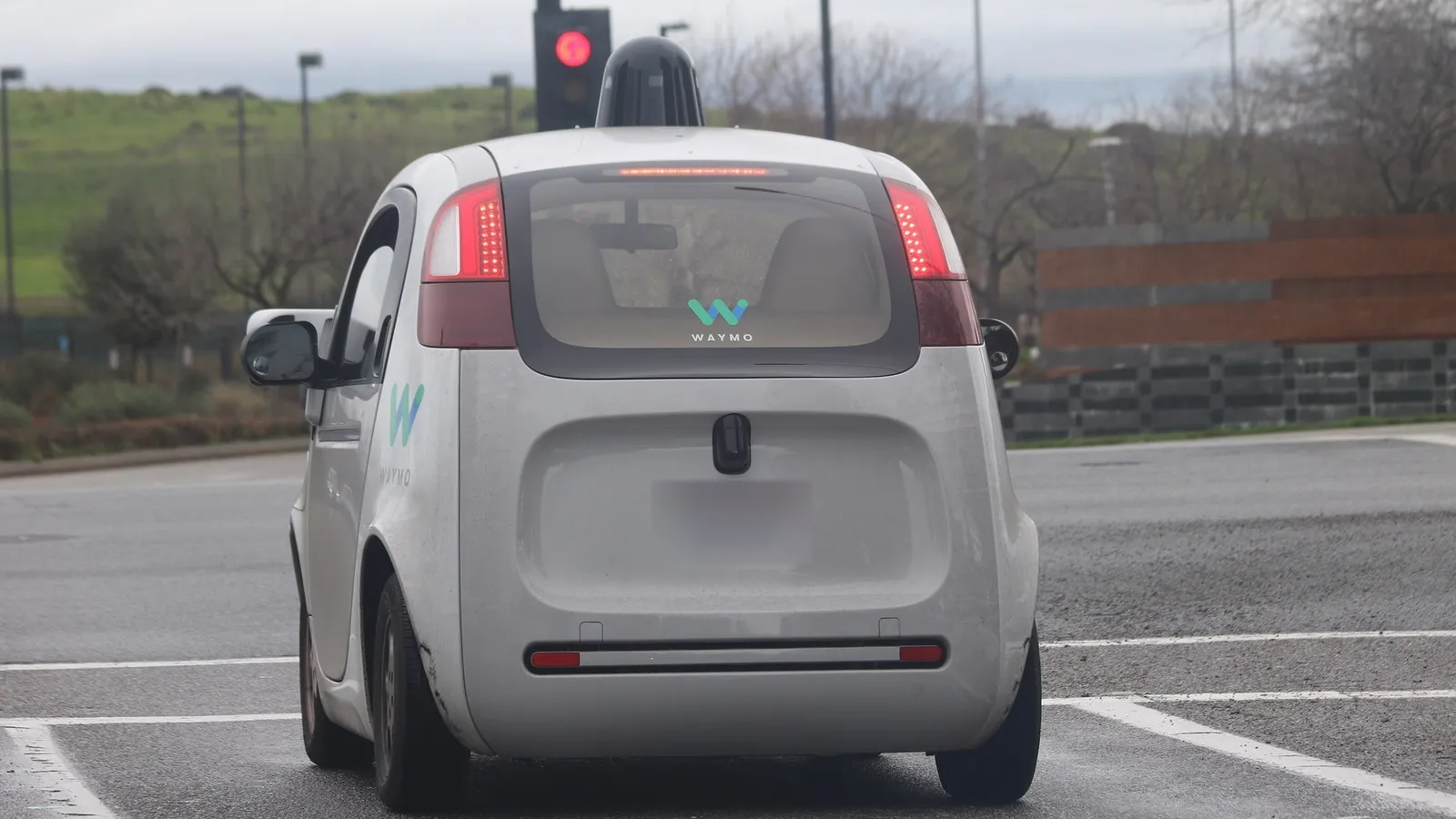
A Waymo car waits at a red light in Mountain View, California. · Photo: Grendelkhan, Wikimedia Commons, CC BY-SA 4.0.
Waymo's driverless taxis are safer than human drivers. That is the finding of the best independent study so far, and three other analyses point the same way. The claim has edges: it holds for one company, on city streets, in a few cities, and the data cannot yet say how the cars compare on fatal crashes.
In July 2026 the Insurance Institute for Highway Safety (IIHS), a research group funded by auto insurers, compared Waymo's driverless cars with human drivers in four American cities, using crashes from 2021 through 2024. Per mile traveled, the Waymo vehicles were involved in 68% fewer crashes of a kind likely to be reported to police, and 81% fewer crashes with injuries. 1
Where it has been measured, Waymo's driverless cars crashed far less often per mile than people. How far that extends to other companies, highways, bad weather and deaths is not yet known.
Four sources test the claim in different ways. Two come from Waymo's own researchers, so they are best read as a check on the independent one.
The sources count different things. The IIHS counts crashes a person would likely report to police. The hub counts every crash Waymo reports to federal regulators, regardless of fault, against police records of human crashes. The insurer's study counts liability claims, a stand-in for crashes that were the car's fault, and compares them with the claims history of more than 500,000 claims across the general driving population. 124
That the direction agrees across counts, benchmarks and analysts is the strongest reason to take the result seriously. Each method has weaknesses, but they are mostly different weaknesses.
Companies running automated vehicles must report even minor crashes to the federal government, while people are not required to report scrapes, and about half of all crashes go unreported to police. A sensor-laden car can also cross a property-damage threshold that a bumped human-driven car would not. So the researchers removed duplicates and incidents where automation was not engaged or no real crash occurred, which cut about a quarter of the records. They then judged which of the remainder a reasonable person would have reported to police. 1
Of 736 public-road crashes with automation engaged, about 22% met that bar, 89 of them involving Waymo and 64 of those in driverless operation. Only Waymo reported mileage, so the institute could calculate rates for no other company. 1
Critics say the coding involved judgment calls on a small count of crashes, and the IIHS agrees the narrative-coding method will not scale. 15
Other companies. The headline names Waymo because Waymo is the only company with a measured rate. Federal crash reports cover every company running automated driving systems; IIHS worked from 736 public-road crashes with the system engaged. Rates need miles as well as crashes, and IIHS notes that Waymo provides driverless mileage voluntarily while other companies do not. 1 So Cruise, Zoox and the rest appear in the crash counts, but there is no way to say how often they crash per mile. A good result for Waymo says nothing about a different system, and nothing about cars that still need a driver's attention. The gap is also a finding: the public cannot yet compare driverless companies with one another, or with people, unless each one publishes how far it drives.
Deaths. Waymo says it has not driven enough miles to detect a difference in fatal crashes alone, and its hub does not report them. "Serious injury or worse" includes deaths, and the 95% figure comes from a modest number of crashes. 2
Where the cars drive. The benchmarks cover surface streets in Phoenix, San Francisco, Los Angeles and Austin, with freeways excluded, so the comparison does not cover highway speeds. 2 Waymo picks where it operates and where it grows, and Jalopnik points to its mostly urban, lower-speed driving. 5 The IIHS gap ranged from 76% lower in Phoenix and 71% in Los Angeles to 35% in San Francisco, with Austin 4% higher from a sample the institute treats as unreliable. 1
Hidden human help. Waymo says remote assistance agents answer questions from the software but do not drive. It said about 70 are on duty worldwide at any time, some in the Philippines. Remote help can matter for safety in either direction, and its effect on crash rates has not been measured outside the company. 6
Averages can hide a specific failure. Waymo recalled its software in late 2025 after its cars passed stopped school buses. The NTSB investigated in January 2026 after at least 19 illegal passes in Austin, including after the fix. 7
On January 23, 2026, a Waymo struck a child who ran into the street near a Santa Monica school. Waymo says it braked from about 17 mph to under 6 mph and the child had minor injuries. NHTSA opened a preliminary evaluation. Waymo's claim that an attentive human would have hit harder rests on a calculation it has not backed with released video. 8
None of this cancels the crash-rate result. A system can crash less overall and still have repeatable faults, and a fault can persist while the average improves.
Supported by the evidence: in these cities, for Waymo's driverless taxis, per mile, on surface streets, crashes of a kind police would hear about and crashes with injuries were far less common than for human drivers.
Not yet supported: that robot drivers in general are safer than human drivers, that they are safer on highways or in snow, or that they save lives. The last one needs more miles, and the IIHS says the federal data system is not good enough to monitor a large expansion. The agencies need mileage reports from every company, not just one. 1
正文由 探How 从来源站点 RSS 同步,内容未经改写;遇到排版缺失或需要图片、视频时请以原文为准。