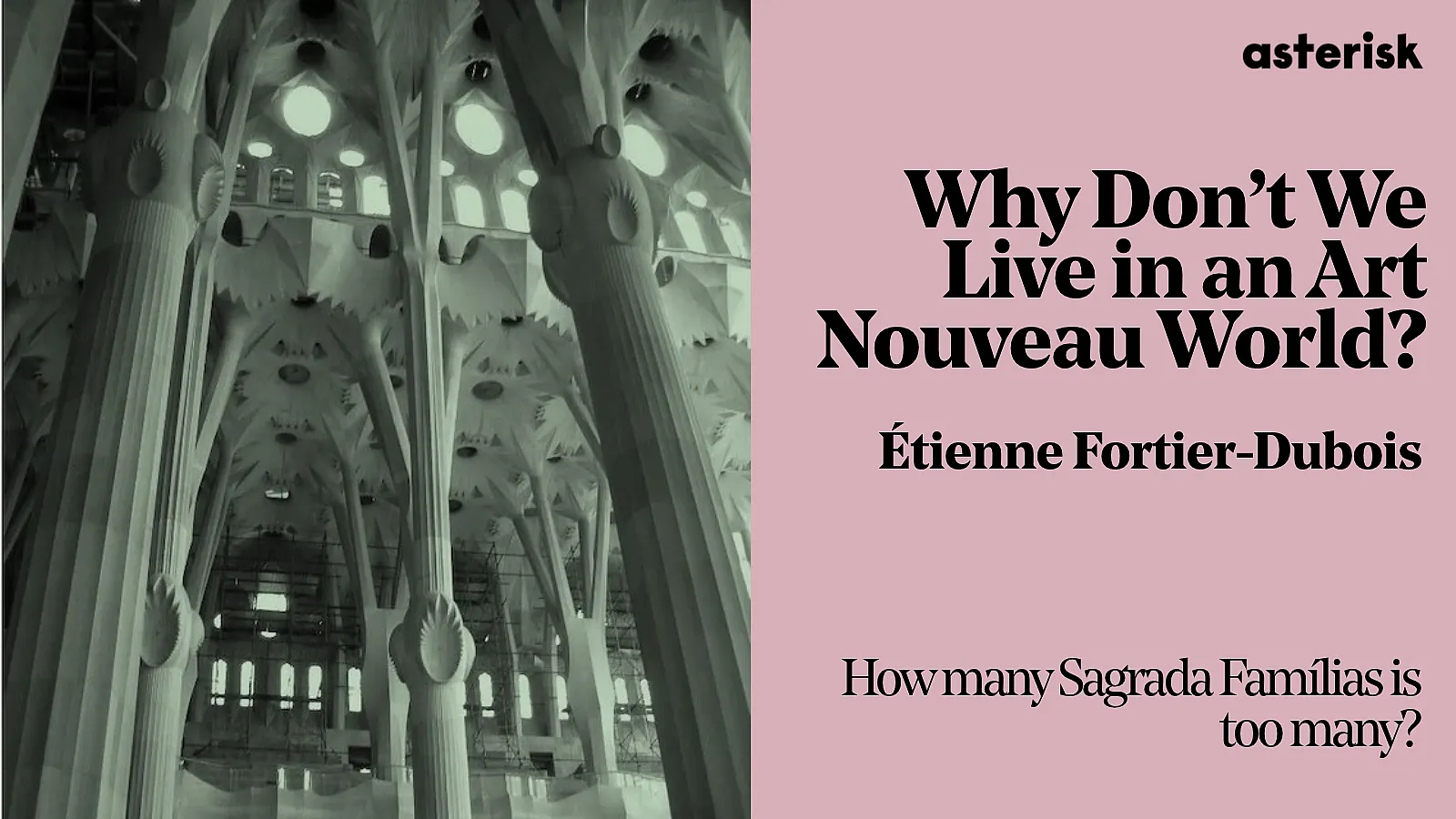
Why Don't We Live in an Art Nouveau World?
A hundred years after the death of its architect and 144 years after the start of construction, the Sagrada Família’s main spire was completed this February, making it the tallest church in the world.
以下正文同步自 Hacker News 最新,版权归原站所有,已转换为易读排版。
A hundred years after the death of its architect and 144 years after the start of construction, the Sagrada Família’s main spire was completed this February, making it the tallest church in the world.
In addition to being the tallest, it is also one of the most bizarre. It looks like no other building, anywhere. The Sagrada Família is an expression of Antoni Gaudí’s very personal view of architecture, which incorporates Gothic elements into Modernisme,1 the Catalan version of Art Nouveau. The whole thing vaguely resembles a termite mound. The two completed façades are covered with countless sculpted ornaments in multiple styles (the third and main façade’s construction is still pending, and it will require demolishing some apartment blocks). The interior is an airy forest of stone columns that rise to meet a vaulted ceiling like the branches of trees in a canopy, bathed in the multicolored light of the stained glass windows. Trencadís, a mosaic technique that uses irregular pieces of glass, is used abundantly. Since 2005, the church has been recognized as a UNESCO World Heritage Site.2
Left: La Sagrada Família, Barcelona, Spain, by Antoni Gaudí, under construction, c. 1915. Right: Interior of La Sagrada Família. Both images courtesy Wikimedia Commons.
Most people think this is incredibly beautiful. Every now and then, and especially this year, the Sagrada Família makes the rounds on social media. Tourists flock to Barcelona just to see it, along with other Modernista works of architecture. I did that three times, also visiting Gaudí’s intriguing Park Güell and his curvy apartment buildings like the Casa Batlló and Casa Milà, as well as works by other architects of the movement like the Palau de la Música Catalana, designed by Lluís Domènech i Montaner.
All of that is wondrous; it is also, like most Art Nouveau, somewhat strange. This movement, whose name means “new art” in French, was a deliberate attempt to create an innovative aesthetic across the fine arts, the decorative arts, and architecture around 1890 to 1910. In architecture, Art Nouveau was a break with the general background of historicism, the dominant tendency in the 19th century to build with an outlook to the past, constituted of various “revivals” — Neo-Gothic, Neoclassical, Renaissance Revival, etc. — as well as eclectic and mixed styles like Beaux-Arts.
Art Nouveau began in Brussels, pioneered by architects such as Victor Horta and Henry van de Velde. The style soon spread to Paris and the rest of Europe, spawning national variants that are often called something like “modern style” or “new style.”3 Some of them, like Catalan Modernisme, are highly specific to their region, but the style overall carries a fondness for curves, asymmetry, and abundant ornamentation, often inspired from plants. Art Nouveau and its regional variants are often contrasted with the more angular and mineral aesthetic of Art Deco styles, which flourished in the 1910s to 1930s, most notably in France and the United States.
One result of Art Nouveau’s anti-historicist stance is that it does not quite match the older architecture of Barcelona or anywhere else. It is also, obviously, very different from what we usually call modernism — the minimalistic, non-ornamented form of architecture that has come to dominate anything built after the middle of the 20th century. Art Nouveau sits between historicism and modernism as a whimsical, almost utopian style. Today it is still beloved, but rarely built.
Why isn’t there more? Why are only a small fraction of Barcelona’s buildings Modernista?4 Indeed, why do only a few cities in the rest of Europe — Riga, Brussels, Vienna, Budapest, Nancy — have strong Art Nouveau traditions, and even in those cities, why does it remain a minority style?
This is an interesting question in part because of a common view of the history of architecture that has started to proliferate on social media, especially among a certain conservative, “trad” demographic. For centuries, the argument goes, humanity infused its buildings with beauty, decorating them with ornament and remixing classical knowledge accumulated across generations. This practice last flowered in the early 20th century with Art Nouveau and Art Deco, both of which are still admired today. But immediately after that, circa 1940 to 1950, humanity turned its back on all this beauty and decided to do plain, unornamented, ugly modern buildings everywhere, forever.
Let’s call this the trad critique of architecture. The trad critique is an oversimplified, naïve account, smuggling in a lot of questionable assumptions. But it does point to a real puzzle. If, as proponents of this viewpoint believe, most people prefer older-styled, ornamented constructions over modern ones,5 why are rich countries today — with greater means to achieve their goals than any previous society — mostly building the latter?
It is an extremely difficult problem, not because we can’t think of any answers but because we can think of too many. There are dozens of plausible explanations: cost of labor, cost of materials, changing tastes, elite status games, misaligned market incentives, architect credentialism, disdain for pastiche, high demand for large windows, software constraints, short project timelines, excessive building regulation, NIMBYism, the global monoculture, atonement for the horrors of war, you name it.6
I harbor no illusions of solving it, but maybe we can make some progress by examining one clear case study: the excesses of Catalan Modernisme and its quick transition to the more sober Noucentista style.
A 15-minute walk from the Sagrada Família, the Hospital de la Santa Creu i Sant Pau is another Modernista complex, and arguably an even more interesting one than the big tall church.
Sant Pau was built from 1901 to 1930 under the architectural direction of Lluís Domènech i Montaner. It was a replacement for the medieval, and very obsolete, Santa Creu hospital; Pau Gil, a rich banker, provided the necessary funds in his will. It served its purpose for a century before closing in 2009, when its medical functions moved to a new hospital with the same name nearby (built, of course, in a clean, unornamented contemporary style). The old hospital, by then also a UNESCO World Heritage Site, was converted into a tourist attraction and office space.
On my third visit to Barcelona, I made a point of visiting it. I wanted to see what a beautiful hospital was like — one that at least tried to counteract the inherent dreariness of such places, which are filled with sickness and pain, by surrounding it with pleasant architecture and decoration.
But I left Sant Pau with mixed feelings. To be sure, it absolutely is the most beautiful hospital I have ever seen. It consists of several above-ground pavilions, each filled with the signature moves of Catalan Modernisme and international Art Nouveau: rich, colorful ornament, from mosaics to stained glass to sculpture; motifs inspired by flowers and nature, but also neo-Gothic elements like turrets and crenelations, harking to Catalonia’s medieval golden age; just the right amount of asymmetry. The wards for the sick are filled with light and lined with tasteful green and floral tiles. A network of utilitarian tunnels links the buildings together. There are orange trees everywhere.
Hospital de la Santa Creu i Sant Pau, by Lluís Domènech i Montaner, 1902–1930, Barcelona, Spain. Both images courtesy the author.
Yet in some sense Sant Pau was a little disappointing. This is partly due to the fact that all this beauty has been replaced by a new facility with presumably normal (i.e., modest) amounts of hospital beauty. You sort of get why they had to do this, though. The historic Sant Pau is clearly outdated as a medical facility, and it’s frankly surprising it kept functioning into the 21st century.
More disillusionment occurred when I learned that the most ornate pavilion, lavishly decorated with mosaics and colored glass, was not for the sick — it was the administration building.
It turns out that during construction, a conflict erupted between the leadership of the old hospital on one hand and Pau Gil’s will executors and their architect on the other. According to two articles by the hospital’s archivists, the hospital leadership wanted to quickly build the operational infrastructure (the quarters for the religious order providing the care, the kitchen, the pharmacy, and so on) to transfer operations as fast as possible and to keep fulfilling their mission of serving the poor. The other party wanted to honor Gil’s wish of creating a distinct, prominent hospital as an architectural statement, starting with the administration building as a showpiece.
The latter group won, which is why there’s an architecture masterpiece in Barcelona that we can visit. However, this had the unfortunate consequence that some of the pavilions built later are less elaborate, because the project was running out of money.7 So we can dispel the thought that everyone just prioritized aesthetics more in the Art Nouveau era. Disagreements pitting utility against beauty were definitely normal then too, and I’m not sure I would have necessarily sided with the architect and executors if I had been there.
Most importantly, my visit to Sant Pau made me like Modernisme less. I quickly got over it. I got the sense that it was built to create a “wow” effect, and to be sure I was “wowed,” but the beauty quickly faded after direct contact. Some of this was due to unmet expectations: Online postcard-perfect pictures, some of which are artificially saturated to heighten the colors, created a fairy-tale mental image that wasn’t quite matched by the real place. Some of it was habituation: The novelty of all those ornaments, and the contrast with the more ordinary architecture of the city around it, just didn’t register as much after half an hour in the complex.8 And some of it was that the ornamentation created a cognitive load: It got more tiring than restful after I had become habituated.
What I liked most, in the end, were the orange trees. This is in agreement with the scholarly evidence on hospital architecture, which suggests that natural elements contribute most to the well-being of patients. The solariums and garden-like design of Sant Pau were indeed wonderful, but those features are only tangentially related to Modernisme.
Gaudí’s idiosyncratic masterpieces left me with a similar impression. They’re great, but would I want to see them every day? Not particularly. Do I wish that there were more of them in Barcelona, or in other places? Not really. I’m glad Modernista architecture exists, and I’m glad we have the Sagrada Família as an absurdly ambitious experiment, but my feeling is that there is just the right amount of this style in the world. I wouldn’t wish for an entire city to look like this.
Art Nouveau was a short-lived movement. The earliest building to be included within Modernisme is the Castle of the Three Dragons, built by Domènech i Montaner in 1888 — it is not quite Art Nouveau yet in the usual sense, but clearly reaching for something new. In Brussels, the first houses to belong to Art Nouveau proper date to 1893. By the mid-1900s, the reaction against the style had already begun in most places where it existed at all, and after the First World War this reaction would be recognized as part of a conservative “return to order” movement, which emphasized sober classicism and historicism. It seems that people got tired of Art Nouveau fast, like I did.
As a result, we never got an entire Art Nouveau city. The closest thing is perhaps Riga, the capital of Latvia, which happened to experience fast growth during the Art Nouveau era. The population roughly doubled between 1897 and 1913, while it was part of the Russian Empire, and a fair amount of the new construction was built in the style, locally called Jūgendstils.
正文由 探How 从来源站点 RSS 同步,内容未经改写;遇到排版缺失或需要图片、视频时请以原文为准。