Here Be Monsters
I’d been noticing monsters everywhere. It was 2025 and President Donald Trump had been calling immigrants “monsters.” His opponents hurled the term right back at him. Monsters appeared at the movies, from Sinners to Fra…
以下正文同步自 Hacker News 最新,版权归原站所有,已转换为易读排版。
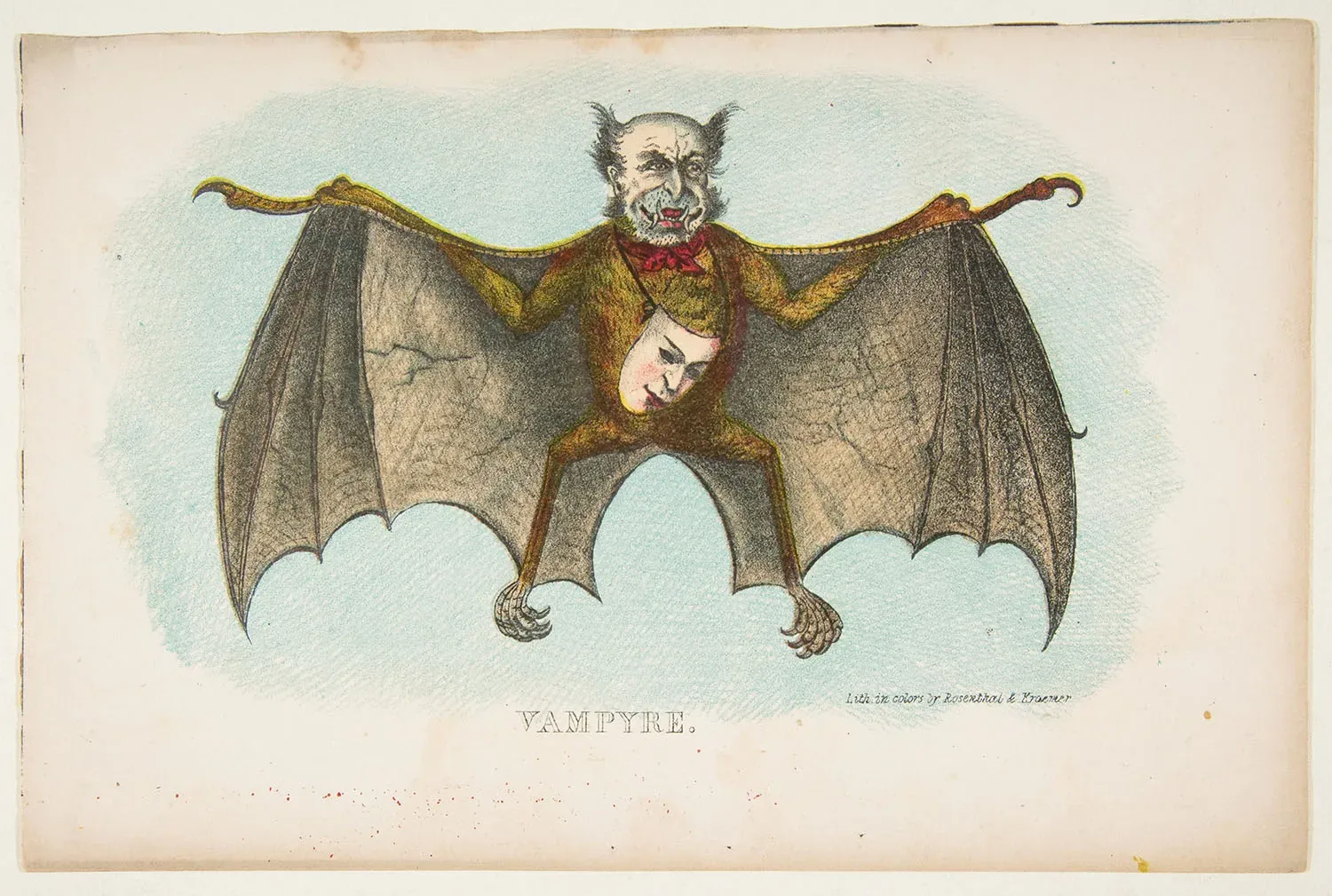
I’d been noticing monsters everywhere. It was 2025 and President Donald Trump had been calling immigrants “monsters.” His opponents hurled the term right back at him. Monsters appeared at the movies, from Sinners to Frankenstein, and on the radio, from Lady Gaga’s “The Beast” to the chart-topping songs from KPop Demon Hunters. My three-year-old daughter was terrified and fascinated by monsters. She pulled a pair of tights over her head and pretended to be a monster during the day, then at night asked me to check for monsters in the wall, before wondering: “What is a monster?” I realized I had no idea how to answer. So I started reading about monster studies, a niche academic field, and became bewitched by Michael Chemers, director of the Center for Monster Studies at UC Santa Cruz. I called him to ask how he defined monsters and why they seemed to be everywhere. He immediately launched into a speech about all the ways “monster theory” can illuminate the problems of our times: zombies and environmental collapse, werewolves and fascism, vampires and gender equality. And that wasn’t all, he added, leaning conspiratorially toward the eye of his laptop camera. It could be personal: if you looked at the monster, really looked, and saw yourself, then it could be a portal to self-transformation. I told him I wanted to know more, and with a gregarious smile he invited me to the Festival of Monsters conference, held annually at UCSC in (when else?) October. Monster studies is ancient and new. Pliny the Elder cataloged monsters alongside real beasts in his first-century encyclopedia Natural History; in The City of God, Saint Augustine of Hippo ponders what it might mean for God to have created monsters. But most US scholars mark the birth of monster studies as a modern academic field to thirty years ago, with the publication of the collection Monster Theory: Reading Culture, edited by Jeffrey Jerome Cohen, in 1996. The book features essays by a range of scholars on everything from Beowulf and Tom Thumb to conjoined twins and Jurassic Park, but it is most well-known for Cohen’s introduction, “Monster Culture (Seven Theses).” Cohen had intended the book as a kind of “love letter” to a community that didn’t yet exist. “It was a cry for company,” he said at a recent symposium. He’d written his grad school dissertation in 1992 on giants and was frustrated by its frigid reception. It seemed to Cohen that the academy was almost embarrassed about monsters, that it was a subject in bad scholarly taste that would never secure him a job. “I thought of the book as a good-bye to a humanities that reached its limit at the welcome of the monster—a figure always at the gate, never in the home for long,” Cohen later said. But it ended up not being a goodbye at all. Instead his “love letter” worked as a kind of rallying cry. The field grew and gained wider legitimacy, spawning books, academic journals, scholarly societies, and the conference I was about to attend. Many of these retain a whiff of monster studies’ early insecurities. The Center for Monster Studies, which hosts the yearly conference, has as its motto “We take monsters seriously.” One of the field’s societies is called MEARCSTAPA. The moniker comes from Beowulf, where Grendel and his mother are both described as a “mearcstapa,” which, translated from the Old English, means “boundary-walker,” a creature that lives at the edges. The group back-formed the acronym (Monsters: The Experimental Association for the Research of Cryptozoology Through Scholarly Theory and Practical Application) because they saw themselves as people who stalked the margins of academia. Nonetheless, the professors I spoke to in the field said enrollment in their classes was booming. Cohen’s essay outlines what he calls a “modus legendi”—a way of trying to understand cultures by looking at the monsters they imagine. He laid out seven theses for how monsters function, such as “Thesis III: The Monster Is the Harbinger of Category Crisis” and “Thesis IV: The Monster Dwells at the Gates of Difference.” Monsters can be slips of the tongue, something people or cultures reveal about themselves that they might otherwise keep hidden—fears and forbidden desires made fleshy. Like dreams, monsters often evoke the thing that cannot yet be comfortably said. They are, Cohen writes, “a glyph that seeks a hierophant.” Cohen’s essay is beautiful, but labyrinthine and difficult to parse. Even after reading it half a dozen times, I couldn’t really define the word “monster.” The closest I could get to pinning it down was the Latin monere, from which the word derives, which can mean both “to warn” and “to teach,” as in the word “demonstrate.” Perhaps in Santa Cruz I could figure out what lessons monsters had to impart. The Courtyard Marriott was bustling that weekend. In addition to being the go-to hotel for the conference, it was also hosting a meeting for the California Statewide Law Enforcement Association. Just down the street, at the Santa Cruz Beach Boardwalk, there was a marching band competition. I felt confident in my ability to sort the crowd into their respective categories—band nerd, monster nerd, cop. So I said to the man waiting for the elevator wearing a hoodie with a colorful demon embossed on the front: You must be here for the monster conference. His eyes widened: You mean real monsters? Having a conference? He looked genuinely concerned. No, I assured him. Academics. People who read monster stories and talk about them. He seemed relieved and told me he was just visiting because he thought Santa Cruz was “dope.” Santa Cruz is a fitting place for a monster conference. Besides historically being a sanctuary for weirdos and misfits, it has served as a backdrop for a bevy of horror classics, including The Lost Boys, Killer Klowns from Outer Space, and Jordan Peele’s Us. The mascot for UC Santa Cruz is a banana slug, which, while not technically a monster, does show the college’s affinity for the slimy and betentacled. The group of monster experts waiting for the shuttle to the opening reception, at the Santa Cruz Museum of Art and History, looked tamer than I expected, sensibly dressed and well-coiffed. When I told them I was a journalist, I got a chilly reception. In the van someone explained to me that the conference organizers had sent out a warning about a right-wing journalist who was working on a hit piece about the event. While monster studies had gradually become accepted inside the academy, it also seemed to epitomize tendencies that have been ridiculed by conservatives. More than three years ago, when Florida governor Ron DeSantis laid out his plans to overhaul higher education by mandating an emphasis on Western civilization and eliminating diversity programs, he said: “We don’t want students to go through, at taxpayer expense, and graduate with a degree in zombie studies.” The conference attendees had, broadly, two theories about why they were being targeted by the right. The first was that the field was seen as impractical: How does studying the history of Godzilla make students productive, tax-paying members of society? The second was about monster studies’ entanglement with queer studies, disability studies, feminism, and critical race theory. Monsters are often metaphors for people on society’s edges—the word monstre was even used in the fourteenth century to refer to people and animals born with abnormalities or disabilities. Studying the meaning and history of monsters is inherently an exploration of diversity. In other words, some think monster studies is under attack because it is perceived as useless, while others think it is under attack because of what it is useful for. In this respect the response to the field reflected the larger war on the humanities, as departments across the country were targeted for being both too “woke” and too useless in the job market. The opening reception was small, with finger food and nonalcoholic drinks. Wandering around the crowd, I met a young academic and writer balancing a paper plate of appetizers in her hand. She told me she studied cryptids like Bigfoot and explained her anthropological interests in how people construct narratives. It was fascinating work, but I hadn’t been able to stop thinking about what Chemers had told me about the monster as a portal for personal discovery. I asked if studying monsters had transformed her. “Absolutely,” she said, and pointed to her name tag, which identified her pronouns as “she” and “it.” She explained that she was neurodivergent and queer. “I’ve had these moments of feeling like I was inhuman,” she said. But monster studies had taught her that she didn’t need to be palatable or normative to exist. She embraced herself as a monster: “It pronouns have brought me a lot of joy.” We took our seats for the first keynote of the weekend, by David Livingstone Smith, a professor of philosophy at the University of New England, who was presenting his book Making Monsters: The Uncanny Power of Dehumanization. He flicked through slides showing how marginalized groups have been depicted as monsters by those in power: Jewish people drawn as humanoid rats in Nazi Germany; a newspaper clipping from North Carolina in 1898 showing a Black man with bat wings and claws, standing on a ballot box. Then he paused and told us the next slides were ones he’d been increasingly forced to censor when presenting on college campuses. First, a picture of Donald Trump with his infamous quote, “Democrats say, ‘Please don’t call [immigrants] animals, they’re humans. I said, ‘No, they’re not humans, they’re animals.’” And then former Israeli defense minister Yoav Gallant saying, “We are fighting human animals and we are acting accordingly.” This wasn’t a trend you needed a scholar to point out. But Livingstone Smith had a somewhat subtler observation to make. Racist and antisemitic propaganda doesn’t show just rats and bats—they have human faces. The imagined beasts are hybrids, impossibilities, creatures that don’t follow rules or fit into categories. He listed creatures that were frightening, but not monsters: grizzly bears, mosquitoes carrying West Nile virus. “These are all physically threatening beings. We need something else to make them monsters,” he explained. A monster must be uncanny—creepy and unsettling; it must disrupt our sense of reality, must be, to use Livingstone Smith’s term, “metaphysically threatening.” Zombies are both dead and alive. Werewolves are man and beast. This is how monsterization of people works too: Jewish people, in Nazi propaganda, were both weak and able to control the entire world. The morning after the opening reception, I caught the shuttle from the hotel to the UC Santa Cruz campus. We passed a group of preteens on bikes, and at the very back was a kid who looked to be six or seven years old, peddling furiously to keep up with the older crowd. He was wearing a helmet with rubber spikes protruding from the top, making him appear like a miniature Godzilla. Someone in the van pointed: Look at that! That’s a little monster. That’s our guy! Everyone cheered. Go little monster! Go! The conference panels covered a wide range of topics, from medieval artifacts to the Tyler Perry TV show Beauty in Black. The theme for the year, loosely followed, was “nourishment,” so panels sometimes focused on food. There was, just before lunch, a presentation called “Snacking in Hell.” The audience squirmed in their chairs at the descriptions of eating in Dante’s Inferno: a man chewing another man where his neck joins his brain, like a hunk of bread. Then everyone went off to eat a conference lunch of warmed-over chicken and pita. Many of the sessions considered monsters to be sympathetic, if complicated, creatures. The hydra, the multiheaded monster from Greek myth, was presented as a powerful symbol of collective action. A pane
正文由 探How 从来源站点 RSS 同步,内容未经改写;遇到排版缺失或需要图片、视频时请以原文为准。