BazelCon 2026 Recap
We are right in the middle of fall, and that means BazelCon 2026 just took place. This time around it was hosted in Amsterdam and spanned three days: one day of tutorials and an overlapping Buildbarn meetup that I wasn’…
以下正文同步自 Hacker News 最新,版权归原站所有,已转换为易读排版。
Julio Merino
Oct 21, 2026
2
2
Share
We are right in the middle of fall, and that means BazelCon 2026 just took place. This time around it was hosted in Amsterdam and spanned three days: one day of tutorials and an overlapping Buildbarn meetup that I wasn’t aware of, and two days of main-conference talks and events. And as the event is behind us, it’s time for the now-traditional recap.
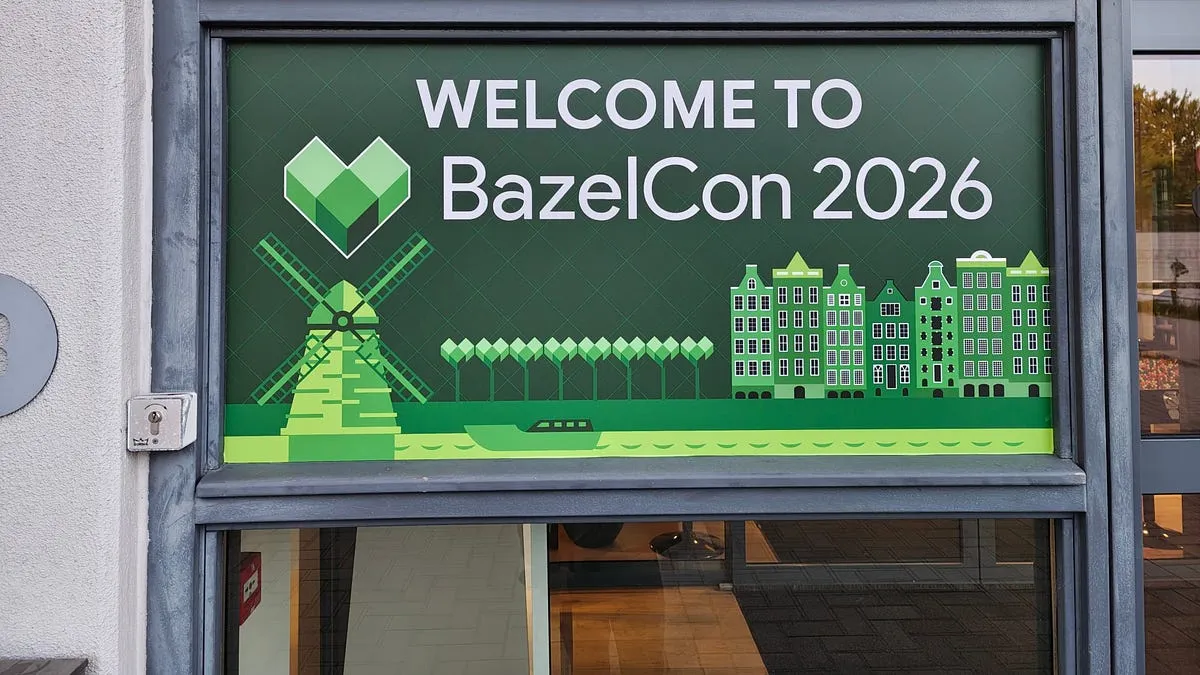
Welcome to BazelCon 2026 sign.
What follows is a recollection of my notes arranged by topic and intermixed with my own commentary and thoughts. Some sections and topics are more detailed than others because in some cases I didn’t have a seat and couldn’t type enough, and in others I got distracted in the hallways chatting with people. Speaking of people, several of you approached me to praise previous editions of these recaps, so I now feel obliged to write another one. Thanks for the kind comments!
As we will see, “scale” was a central theme of the conference: AI is multiplying concurrent builds and tests, artifacts and graphs are growing at an accelerated pace due to new features like configuration transitions, and the ecosystem is responding by making execution, caching, and analysis more efficient.
There is a lot to cover but here are a few things that felt memorable to me:
The BUILD Foundation is now a reality, giving the Bazel ecosystem a vendor-neutral home. Its goal is to act as a proxy between the community and Google to help Google understand what to prioritize and to fund projects. If your company can spare “a few” dollars, please donate!
AI-driven development is having a broad impact on the industry and, in particular, everyone is seeing their CI systems become overloaded. Well, news at 11: I’m dealing with this day in and day out. But what was new to me was that we at Snowflake are not the only ones struggling with local system overload. Lots of people out there have likewise “discovered” Git worktrees as a way to run multiple agents in parallel, which in turn means multiple concurrent Bazel servers.
Bazel 10 is shaping up to be a substantial release that will help with the problem right above due to its many performance improvements and memory consumption optimizations. Have you struggled to keep Bazel up-to-date before? These days, if you want to get any platform-related work funded you have to spin it in terms of AI, so this release will be an easy sell.
Let’s “Rewrite it in Rust”? I’m impressed. Google is seriously evaluating a progressive rewrite of Bazel in Rust, and this is probably the most exciting news I got out of the conference. You know I’ve been critical of Bazel’s usage of Java since day one so, if this takes off, I’ll be the first in line to evaluate the results (and it will likely push me to actually contribute to Bazel again).
Fast and correct sandboxing on macOS remains a problem. This is “interesting” to me because it’s a problem I tried to fix almost ten years ago with the original sandboxfs, but I failed because of unexpected bugs in macOS’s FUSE support and eventually abandoned the idea when FUSE became a dead end on Apple’s platforms. Funnily enough, other folks have now reinvented sandboxfs—and even given it the same name (ugh)—and there is even another implementation of a similar idea in the form of actiondFS.
Types are coming to Starlark, but Bazel’s late arrival to the party means that multiple competing approaches now exist. We have at least two LSPs with different annotation mechanisms and Buck 2’s own syntax. Hopefully they can all converge.
Platforms and configurations remain difficult to model at scale. Careless use of transitions and build settings can produce an explosion of configured actions. Apparently, as one speaker noted, AI agents love transitions for some reason, which is interesting because they are not a popular feature and they are not particularly easy to use.
Let’s dive into the full report now. You’ll find my notes arranged by talk but I’ve tried to group them into higher-level themes for easier navigation.
These conference summaries take effort to write, and some of you are waiting for them. Show your true support by subscribing!
The two keynotes are usually the most information-packed events but… as you can imagine they are also the most popular. The venue this year was not roomy enough to host BazelCon’s attendance (Helen quoted that we got 600 registrations), so I had to stand for these two events. The recordings and slides are not out yet, so consequently, I can only tell you a few details from memory.
The conference opened with the usual Bazel Community Update, presented by Helen Altshuler from EngFlow and Chuck Grindel from Glydways.
The biggest announcement is that the BUILD Foundation is now a reality. The effort had been discussed at the previous two BazelCons and likely various meetups, but it had remained mostly invisible while its organizers worked through the legal and financial details. The foundation now provides a neutral organization to support the broader build ecosystem (in their words this is not just for Bazel), and it is looking for both members and concrete proposals to fund. If you want to get involved, get your company pumped up and email info@buildfoundation.dev.
Documentation continues to receive attention as it has always been a lowlight in previous surveys. Work is underway to make the docs easier for the community to own and improve by decoupling them from Google’s internal systems. But one must wonder: what exactly is the biggest problem with documentation in today’s world? AI agents used to do terribly with Bazel just a year ago and nowadays do… fine as we shall see in the any2bazel summary. Maybe the work on documentation needs a different spin now.
And as usual, a reminder to fill the annual Bazel user survey. Your input is necessary to quantify ecosystem-wide pain points and influence future work, especially now that the foundation exists.
John Field and Tobias Werth from Google followed with the State of the Union, which presents a recap of major improvements during the year and the path ahead for Bazel 10 and beyond.
Performance remains a major theme. Google reported improvements of about 15% in some workloads together with reductions in memory consumption. Some of these speedups come from upgrading from Java 25 to 27, while others come from correct action rewinding, optimizations to Skyframe cache pruning, and content-defined chunking. These changes are very relevant because Bazel’s large memory consumption gets in the way of scaling CI and prevents using multiple AI agents in parallel.
And here is where we heard about Skymetal: the codename for the Google-internal exploration of rewriting Bazel in Rust. The rationale for this rewrite is obviously performance, and I’m guessing it’s now a real consideration because AI can make such large-scale changes feasible. Tobias acknowledged that Java was a reasonable choice back in 2006 when Blaze started and that the JVM can deliver great throughput performance at scale… but it is not the best choice for a tool like Bazel in this day and age, especially when optimizing for memory efficiency is critical. I called it in 2015.
I have been in the BazelCon Program Committee (PC) for 3 years now. I remember that, during last year’s review, we encountered a few AI talks but I think none made the cut: they all looked too hype-y and out of place. But it was impossible to ignore the topic this year, and it was actually important to bring AI-related talks on board to not sound tone deaf. AI is a reality in our industry, and Bazel is a key component to survive the transition.
Nicolas Lopez from EngFlow and I, representing Snowflake, presented AI Development: Challenges and Early Learnings for Bazel. Agentic workflows have expanded rapidly throughout 2026, and the effects are visible well beyond code generation.
At Snowflake, we were fortunate enough to finish our Bazel migration and to stabilize remote execution by moving from our self-hosted open-source deployment to EngFlow’s fully-managed service before all of this happened. And I say fortunate because the increase in CI load that AI workflows brings can only be handled with a good build system and caching story. But none of that is news, so the core of the talk was to look at how Bazel usage looks different in agent-initiated environments.
Agents run more builds more frequently than humans, discover and invoke targets that were often “internal only”, and explore several approaches in parallel. Your intuition about how to evaluate which builds matter and how to measure them is probably wrong by now.
Bazel and IDEs have never played great together and maybe that just doesn’t matter anymore. We are seeing a sharp decline in IDE usage, although developers still want a way to browse code changes and debug them. This means LSPs are key now to support “leaner” IDEs, and maybe standalone debuggers.
Short build and test latency is critical when a human must remain focused on a coding task but, in an agentic workflow, the constraints are different. You know that, after you hit “execute this plan”, the agent will take many minutes to return so minimal build latency is not as important. And actually… maybe you now want to trade some latency in exchange for extra validations so that agents have to take fewer turns to converge.
And because humans are now waiting for agents to finish for long periods of time, they have to fill that time with other tasks, which has driven them to adopt Git worktrees en masse. This is leading to scalability problems on dev machines because multiple concurrent Bazel server processes are not great for memory and disk usage.
The rest of the talk, presented by Nicolas, focused on trying to understand behavioral changes by looking at anonymized backend data across companies. One specific insight was that people’s work days have lengthened over the year. Cynically, the promise of “working less because of AI” has not materialized: in fact, we are all seemingly working longer hours and with fewer chunks of focus time, so the dangers of burnout are higher.
Maggie Lou from BuildBuddy presented Taking Humans Out of the Build Loop. The premise was that coding agents have improved quickly, but people still spend too much time copy/pasting logs, triggering builds, explaining failures, and reviewing the results.
In her presentation, we witnessed many new features in BuildBuddy to allow agents (and humans!) to interact and diagnose remote builds with ease:
bb view to download filtered logs for a build.
bb agent analyze-profile to answer questions such as “Why was my build slow?” which are extremely common in the Bazel ecosystem.
bb remote test //... to start a remote Firecracker VM and run Bazel inside of it. The VMs are snapshotted for quick reuse, and the runners can execute arbitrary commands rather than Bazel alone.
bb agent fix to diagnose a failed build and either create a pull request or push a commit with the proposed correction.
bb agent review to perform a review and post comments to GitHub.
The need for these features is unsurprising this late in 2026, but what’s really useful in their offering is how these features integrate with build data. Inspecting the BEP, profiles, remote execution metadata, and logs in unison via an agent can yield much better diagnostics and automated improvements than staring at just a few lines of console output.
One thing that surprised me in chatting with the presenter is that BuildBuddy is not particularly big in terms of headcount but they churn out features at a very high rate—and that was true even before AI. Impressive!
Armando Montanez (and Ulf Adams, but he didn’t make it) from EngFlow presented Proving Equivalence in any2bazel Build System Migrations.
The talk described a structured way to use AI agents for build system migrations and started with a reflection: AI agents used to be terrible at Bazel less than a ye
正文由 探How 从来源站点 RSS 同步,内容未经改写;遇到排版缺失或需要图片、视频时请以原文为准。