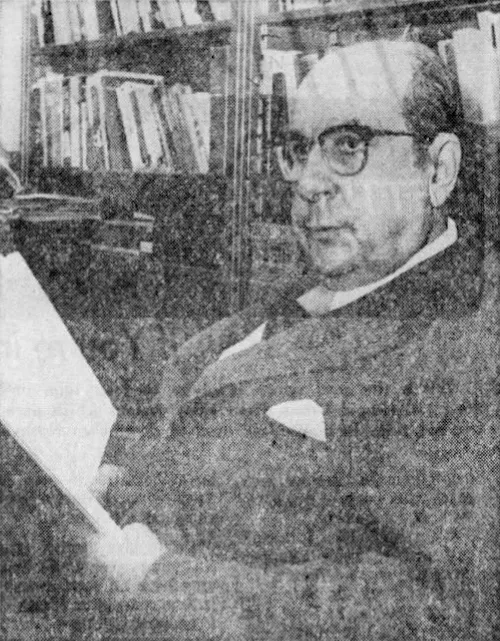
The Entropy Law and the Economic Process (1971)
Nicholas Georgescu-Roegen (born Nicolae Georgescu, 4 February 1906 – 30 October 1994) was a Romanian mathematician, statistician and economist. He is best known today for his 1971 magnum opus The Entropy Law and the Eco…
以下正文同步自 Hacker News 最新,版权归原站所有,已转换为易读排版。
Nicholas Georgescu-Roegen (born Nicolae Georgescu, 4 February 1906 – 30 October 1994) was a Romanian mathematician, statistician and economist. He is best known today for his 1971 magnum opus The Entropy Law and the Economic Process, in which he argued that all natural resources are irreversibly degraded when put to use in economic activity. A progenitor and a paradigm founder in economics, Georgescu-Roegen's work was decisive for the establishing of ecological economics as an independent academic sub-discipline in economics.
In the history of economic thought, Georgescu-Roegen was the first economist of some standing to theorise on the premise that all of earth's mineral resources will eventually be exhausted at some indeterminate future point.[1]: 13 [2]: 164f [3]: 160–171 In his paradigmatic magnum opus, Georgescu-Roegen argues that economic scarcity is rooted in physical reality; that all natural resources are irreversibly degraded when put to use in economic activity; that the carrying capacity of earth – that is, earth's capacity to sustain human populations and consumption levels – is bound to decrease sometime in the future as earth's finite stock of mineral resources is being extracted and put to use; and consequently, that the world economy as a whole is heading towards an inevitable future collapse, ultimately bringing about human extinction.[4] Due to the radical pessimism inherent to his work, based on the physical concept of entropy, the theoretical position of Georgescu-Roegen and his followers was later termed 'entropy pessimism'.[5]: 116
Georgescu-Roegen graduated from Sorbonne University in 1930 with a PhD in mathematical statistics with the highest honors.[6] Early in his life, Georgescu-Roegen was the student and protégé of Joseph Schumpeter, who taught that irreversible evolutionary change and 'creative destruction' are inherent to capitalism.[7]: 138f Later in life, Georgescu-Roegen was the teacher and mentor of Herman Daly, who then went on to develop the concept of a steady-state economy to impose permanent government restrictions on the flow of natural resources through the (world) economy.[8]
As he brought natural resource flows into economic modelling and analysis, Georgescu-Roegen's work was decisive for the establishing of ecological economics as an independent academic sub-discipline in economics in the 1980s.[9]: 150f [10]: 65–68 [11]: 422 [12]: 302f In addition, the degrowth movement that formed in France and Italy in the early-2000s recognises Georgescu-Roegen as the main intellectual figure influencing the movement.[13]: 1742 [14]: xi [15]: 1f Taken together, by the 2010s Georgescu-Roegen had educated, influenced and inspired at least three generations of people, including his contemporary peers, younger ecological economists, still younger degrowth organisers and activists, and others throughout the world.
Several economists have hailed Georgescu-Roegen as a man who lived well ahead of his time, and some historians of economic thought have proclaimed the ingenuity of his work.[16]: 79 [3]: 1 [17]: 102 In spite of such appreciation, Georgescu-Roegen was never awarded the Nobel Prize in Economics, although benefactors from his native Romania were lobbying for it on his behalf.[18]: 270f After Georgescu-Roegen's death, his work was praised by a surviving friend of the highest rank: Prominent Keynesian economist and Nobel Prize laureate Paul Samuelson professed that he would be delighted if the fame Georgescu-Roegen did not fully realise in his own lifetime were granted by posterity instead.[19]: xvii
The inability or reluctance of most mainstream economists to recognise Georgescu-Roegen's work has been ascribed to the fact that much of his work reads like applied physics rather than economics, as this latter subject is generally taught and understood today.[20]: 71 [21]: 695 [22]: 106–109
Georgescu-Roegen's work was blemished somewhat by mistakes caused by his insufficient understanding of the physical science of thermodynamics. These mistakes have since generated some controversy, involving both physicists and ecological economists.[23]: 21–28 [24][25]: 56f [26]: 1215–1218
Nicolae Georgescu was born in Constanța, Romania in 1906. His father, of Greek descent, was an army officer, and his mother, an ethnic Romanian, was a sewing teacher at a girls school. After having lost his position in the army for disciplinary reasons, his father died when Nicolae was only eight years old.[4]: xiv [27][28]: 1–3
In primary school, Nicolae excelled at mathematics, and he was encouraged by a teacher to apply for a scholarship at a secondary school, the Lyceum Mânăstirea Dealu ("Lycée of the Monastery of the Hill"), a new military prep school in the town. Nicolae won a scholarship there in 1916, but his attendance was delayed by Romania's entry into World War I. His widowed mother fled with the family to Bucharest, the country's capital, where they stayed with Nicolae's maternal grandmother during the rest of the war.[29]: 9–11 [30]: 16–20 [14]: 1–3
Georgescu accepted a scholarship at the University of Bucharest in 1923, and earned the equivalent of a master's degree in mathematics from the university in 1926. In college, he adopted Roegen as an additional last name, using the first and the last letter of his first name, plus the first four letters of his last name, reversed, to create Roegen. Later in his life, he also changed his first name to its French and English form, Nicholas.
After a year of teaching as a secondary school teacher in Constanta, Georgescu-Roegen moved to Paris to study at the Sorbonne, following a recommendation from his professor, Traian Lalescu.
Georgescu-Roegen's stay in Paris broadened his field of study well beyond pure mathematics. Not only did he attend the lectures of the best statistics and economics professors in France, he also immersed himself in the philosophy of science, especially the works of Blaise Pascal, Ernst Mach, and Henri Bergson. Daily life was not easy for a poor foreign student in a great city. The meager means he received from Romania could barely support even his most basic necessities, and French students habitually referred to all foreign students by the derogatory term métèques, 'strangers'. But his studies progressed splendidly: in 1930, Georgescu-Roegen defended his doctoral dissertation on how to discover the cyclical components of a phenomenon. He passed with extraordinary honour. Émile Borel, one of Georgescu-Roegen's professors, thought so highly of the dissertation that he had it published in full as a special issue of a French academic journal.[29]: 11f [31]: 129f [14]: 3–5 [30]: 20–23
While studying in Paris, Georgescu-Roegen learned of the work of Karl Pearson at University College London. Pearson was a leading English scholar of the time, with a field of interests that coincided with Georgescu-Roegen's own, namely mathematics, statistics, and philosophy of science. Georgescu-Roegen made arrangements to lodge with the family of a young Englishman he had met in Paris and left for England in 1931. During his stay in London, his hosts not only accepted Georgescu-Roegen as their paying guest, but also taught him the basics of the English language, in preparation for his studies in the country.
When he approached Pearson and the English university system, Georgescu-Roegen was amazed with the informality and openness he found. There was no more feeling like a métèque, a stranger. Studying with Pearson for the next two years and reading Pearson's work on the philosophy of science, titled The Grammar of Science, further shaped Georgescu-Roegen's scientific methodology and philosophy. The two became friends, and Pearson encouraged Georgescu-Roegen to carry on with his studies in mathematical statistics. They co-pioneered research on the so-called "problem of moments", one of the most difficult topics in statistics at the time, but neither was able to solve the problem. This was a great disappointment to Pearson, but Georgescu-Roegen was pleased by their joint effort nonetheless.
While studying in London, Georgescu-Roegen was contacted by a representative of the U.S.-based Rockefeller Foundation. Due to his past academic achievements, the foundation wanted to grant Georgescu-Roegen a research fellowship in the U.S. Georgescu-Roegen had earlier learned of the use of time series analyses by the then famous Harvard Economic Barometer at Harvard University, so he accepted the grant. The trip was put off for about a year, however, as he had more pressing obligations in Romania: He needed to conclude his first national editorial project, a 500-page manual on Metoda Statistică, and he had to care for his aging widowed mother who was in bad health.
In autumn 1934, Georgescu-Roegen went to the United States. On arriving at Harvard University, he learned that the Economic Barometer had been shut down years before: The project had completely failed to predict the Wall Street Crash of 1929, and was soon abandoned altogether. After several failed attempts to find another sponsor for his research, Georgescu-Roegen finally managed a meeting with the professor at the university teaching business cycles to see if there were any other opportunities available to him. This professor happened to be Joseph Schumpeter.[29]: 11–13 [28]: 3–5 [30]: 22–24 [14]: 5–8
Meeting Schumpeter at this point completely changed the direction of Georgescu-Roegen's life and career. Schumpeter warmly welcomed Georgescu-Roegen to Harvard, and soon introduced him to the now famous 'circle', one of the most remarkable groups of economists ever working at the same institution, including Wassily Leontief, Oskar Lange, Fritz Machlup, and Nicholas Kaldor, among others. Georgescu-Roegen was now in a stimulating intellectual environment with weekly evening gatherings and informal academic discussions, where Schumpeter himself presided as the 'ringmaster' of the circle. In Schumpeter, Georgescu-Roegen had found a competent and sympathetic mentor. Although Georgescu-Roegen never formally enrolled in any economics classes, this was how he became an economist: "Schumpeter turned me into an economist ... My only degree in economics is from Universitas Schumpeteriana."[31]: 130
While at Harvard, Georgescu-Roegen published four important papers, laying the foundations for his later theories of consumption and production.[32][33][34][35] The scholarly quality of these articles impressed Schumpeter.
Georgescu-Roegen's trip to the U.S. was not all spent at Harvard. He managed to obtain a modest stipend for himself and his wife Otilia that enabled them to travel about the country, journeying as far as California. Through Schumpeter's contacts, Georgescu-Roegen had the opportunity to meet Irving Fisher, Harold Hotelling, and other leading economists of the day. He also met Albert Einstein at Princeton University.
During his stay, Georgescu-Roegen's relationship with Schumpeter developed. Realising that Georgescu-Roegen was a promising young scholar, Schumpeter wanted to keep him at Harvard. He offered Georgescu-Roegen a position with the economics faculty, and asked him to work with him on an economics treatise as a joint effort, but Georgescu-Roegen declined. He wanted to go back to Romania in order to serve his backward fatherland that had sponsored most of his education so far; besides, his return was expected at home. Later in his life, Georgescu-Roegen would regret having turned down Schumpeter's generous offer at this point in his career.[31]: 132 [14]: 7f
In spring 1936, Georgescu-Roegen left the U.S. His voyage back to Romania came to last almost a year in itself, as he paid a long visit to Friedrich Hayek and John Hicks at the London School of Economics on the way home. He was in no hurry to return.
From 1937 to 1948, Georgescu-Roegen lived in Romania, where he witnessed all the turmoil of World War II and the subsequent rise to
正文由 探How 从来源站点 RSS 同步,内容未经改写;遇到排版缺失或需要图片、视频时请以原文为准。