What's New in React 19.3 and How It Changes UI Development
A closer look at View Transitions, Fragment Refs, and browser-aware rendering, with practical examples of where each feature fits.
以下正文同步自 Hacker News 最新,版权归原站所有,已转换为易读排版。
A closer look at View Transitions, Fragment Refs, and browser-aware rendering, with practical examples of where each feature fits.
React 19.3 arrived on September 9, 2026. It’s not a major release, but there are a few changes worth looking at, especially if you build interactive interfaces or work with server-side rendering.
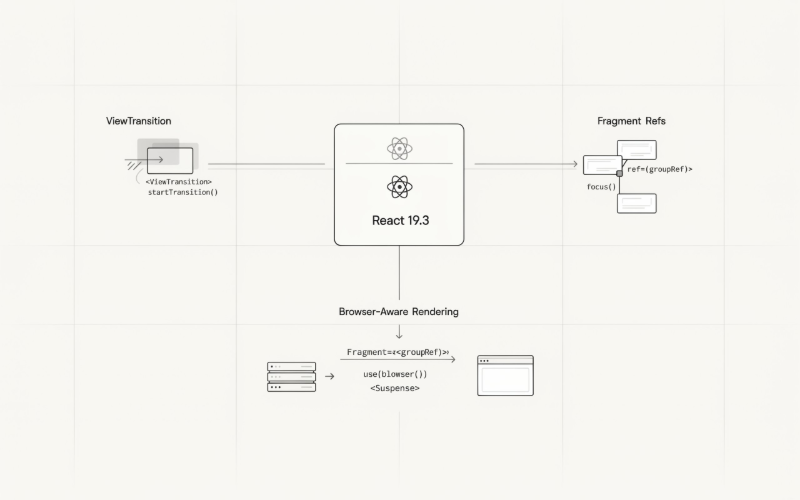
The two features that caught my attention are <ViewTransition> and Fragment Refs. Both were available experimentally before this release. Now they’re stable.
There’s also a new browser() API that makes it easier to handle components that depend on browser-only features.
None of these additions will completely change how you write React. They do, however, address problems developers have been solving with extra wrappers, effects, third-party libraries, and various workarounds.
Let’s go through them with some practical examples.
Animating an element when it enters or leaves the screen isn’t particularly difficult. CSS can handle simple cases, and libraries like Motion offer more advanced options.
The tricky part comes when animations need to follow React’s rendering process.
Imagine switching between two screens. One component disappears, another appears, and the layout changes along the way. You want that transition to look natural without manually coordinating every animation.
React 19.3 introduces a stable <ViewTransition> component for exactly this kind of situation. It integrates with the browser’s View Transition API and React’s own scheduling system.
Let’s build a small panel that appears when a button is clicked.
Here you can find the latest project updates.
正文由 探How 从来源站点 RSS 同步,内容未经改写;遇到排版缺失或需要图片、视频时请以原文为准。