Will Humans Become a Luxury?
I went to the dentist a few weeks ago. I lay back in the chair and he displayed the X-ray results on the screen above me. Each tooth was labeled, and some of them were shaded blue or red. The blue referred to previous f…
以下正文同步自 Hacker News 最新,版权归原站所有,已转换为易读排版。
Yennie Jun
Oct 24, 2026
2
Share
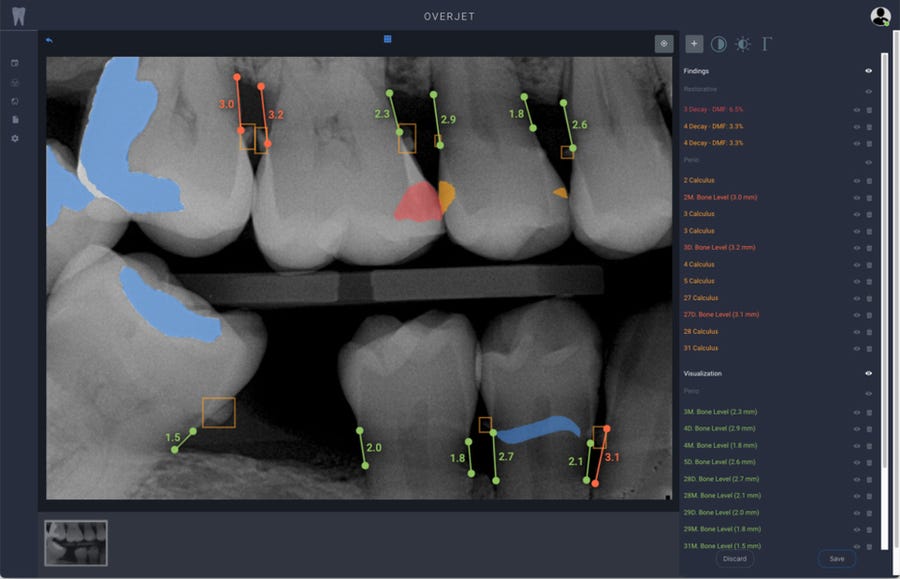
I went to the dentist a few weeks ago. I lay back in the chair and he displayed the X-ray results on the screen above me. Each tooth was labeled, and some of them were shaded blue or red. The blue referred to previous fillings and the red to cavities. “Don’t worry though,” he said, circling each red speck with a pointer and clicking on it to make it disappear. “These are not correctly marked. You don’t actually have any cavities.”
He began inspecting my teeth. “The AI is pretty good, isn’t it?” he said. “It still makes a few mistakes, but it’ll be perfect in a few years.” He poked at the edges of my gums and teeth with his silver instruments, doing whatever dentists do. “The AI will probably be better at my job soon. Then what will I do? Will anyone want to go to a human dentist anymore?” He continued his lamentations for a few more minutes. I wanted to reassure him that I would still very much prefer to see a human dentist, but I could not, as my mouth was very full. (Why do dentists always insist on monologuing with their hands in their patients’ mouths?)
Caption: Example of X-Ray with fillings (in blue) and cavities (in red) marked by an AI (NOT my teeth!). Image src
Then he deemed my gums healthy, reminded me to keep flossing, and left the room before I could sit up and rinse my mouth.
I know many people are worried about AI taking their jobs, but I was intrigued that my dentist, of all people, was so morose about his job security. Even if it were possible to fully automate a doctor or dentist and replace them with an AI, I would very much prefer to see a human instead of a robot. Something about the imagery of robot arms hovering over my vulnerable body, pulling my mouth open to clean my teeth with sharp tools, made me deeply uncomfortable.
Perhaps this felt especially unsettling because it reminded me of when I had received a massage from AI-powered robot arms.
Example of the Aescape AI robotic-arm massages available at certain gyms (ALSO not me!). Image src
To receive the massage from the robot arms, I was instructed to put on a tight compression shirt and leggings (so the robot would not get stuck on my clothes) and lie face-down with my face in an opening, looking down at an iPad to control speed, intensity, and music. When I pressed ‘start’, the robot arms rearranged themselves and began applying pressure up and down my body: shoulders, back, glutes, hamstrings, calves.
I think you’re supposed to either close your eyes or stare into the void of the iPad, but at one point I was curious and twisted my head up to watch the robot massage arms at work. They were like two giant spider legs, clawing at the knots in my muscles. I realized that the arms could very easily snap my spine in half and render me a paraplegic. Even though I was “controlling” the arms via the iPad, the reality was that I was under its control — at any moment, if it went awry (whether “on purpose” or “by accident”) it could swiftly maim me.
I suppose a human masseuse (or chiropractor?) could also break my spine, but the scary thing for me was the steel strength and precision of a robot arm, and its general disconnection from human empathy.
As much as I would prefer a human dentist, I would also prefer a human masseuse, although I will admit that having a robot massage was better than no massage at all. On the other hand, I have a friend who very much prefers a robot massage over a human one, because they like the anonymity of the service and don’t like other people touching them.
In a Tweet from July, someone shared that their mother, riding alone in a Waymo, missed having a driver to talk to, so began having a conversation with ChatGPT.
“paula”@paularambles
my mom was missing having a driver to talk to in our waymo so she talked to chatgpt
3:44 AM · Jul 19, 2026 · 395K Views
45 Replies · 18 Reposts · 1.02K Likes
Why did the mother feel compelled to do this? Clearly, ChatGPT is not a real “driver,” even if it pretends to be one — there is no human driver on the other end whose day she can ask about. Was it loneliness, habit, or the sheer unfamiliarity of riding in a driverless car? Is this a transition period, where we are used to having a human in the seat, but we will easily get used to the removal of that human, or is it more fundamental that we seek that human touch in our lonely hours?
When I was in Korea in early 2024, I took a long taxi ride and chatted with the driver. He told me it was very unusual for Korean passengers to talk to him. People used to chat, he said, but these days, the back of a taxi is the only private time they might get. Many passengers do not even say hello and continue their phone calls or stare at their smartphones without ever looking up.
A taxi in Korea, image src
He opened up and told me about how he met his wife, and the business he started during Covid that failed, and how he started taxi driving a year ago. He starts driving at 5 pm and drives until 5 am, 12 hours straight without eating. He doesn’t play music in order to give the passengers more privacy. “Without music, without chatting, I can focus on the road much better,” he told me.
I imagined the assembly line of passengers, headphones in, speaking or texting someone else, ignoring him, maybe a hello if he was lucky. I asked him what he does or thinks about while driving. He responded simply: “I focus on driving.”
The relationship he described between driver and passenger seemed so impersonal to me. He seemed professional yes, but almost mechanical in his duties: driving in silence, his full attention on the road, invisible to his passengers. In a way, the taxi driver was already being treated by the passengers as if he were not there, as if he were already a robot.
The mother in the Waymo sought conversation in the driverless car, but perhaps she sought the familiar feeling of company more than actual human connection. But when was the last time you spoke with your train conductor or airplane pilot? If trains and planes became fully autonomous, we might not even notice. Is having a human in the seat what gives the perception of safety — of human control?
In the future, I can imagine lonely passengers in driverless cars hiring an audio assistant to chat with them and play some role (pretend to be my driver; pretend to be my friend); pay a discounted price for an AI, pay extra to talk to a real human. Will human touch, human connection, human conversations become this sort of scarce, coveted commodity?
A lake in Sweden
I recently visited my economist friend in Sweden. At dinner, we were talking about AI and automation; his theory was that what we value as a society might change over time as tasks that were once costly (such as menial, repetitive tasks) become cheaper and easier to perform with AI. Having a human do the job, he postulated, will be the new luxury or new scarce good. Being able to afford what is scarce will become a new status symbol: the premium of talking with a human banker, therapist, waiter, nurse, cleaner, nanny, or taxi driver.
Already, products labeled “human-made,” “handcrafted,” or “homemade” — furniture, clothing, artwork — often sell at a premium over the mass-produced version and are often assumed to be better. We value artistry and craftsmanship, something that seems to be more difficult to find in large-scale automation.
Table comparing factory-made vs. handmade violins, made by ChatGPT, adapted from a table found in Fiddlover
Will it be the same with other “human” services? Will it be that using an AI doctor or nanny is the “standard” option for everyone because it is cheap and effective, and access to a human doctor or a human nanny might become a luxury status symbol? Or that both options will be available, so that one can choose to have a human or robot nanny, or masseuse, or dentist? Will human craftsmanship and human labor be seen as “higher quality,” or will they be coveted specifically because it is scarce?
There are plenty of professions where I would prefer interacting with a human over an AI, not just the dentist and masseuse. For example, when it comes to movement, I would prefer my personal trainer and athletic coaches for the personal insights and cues they’ve learned from their own bodies. In music, I would prefer to learn from teachers who can listen and feel the way I do, and listen to songs created by human musicians. In the world of personal health, I would prefer my doctors, therapists, and dentists to be humans, for the same reason that I prefer to have a female doctor over a male doctor — someone who I can relate to and connect with on very specific experiences.
I could explain this preference partly as being about safety, partly about familiarity, partly about valuing and connecting with another person’s real life experiences and expertise, and partly about simply wanting another person in the room. I am not sure if, in a few years, having that person there will be something we will have to pay extra for.
正文由 探How 从来源站点 RSS 同步,内容未经改写;遇到排版缺失或需要图片、视频时请以原文为准。