What Happened to Epyx
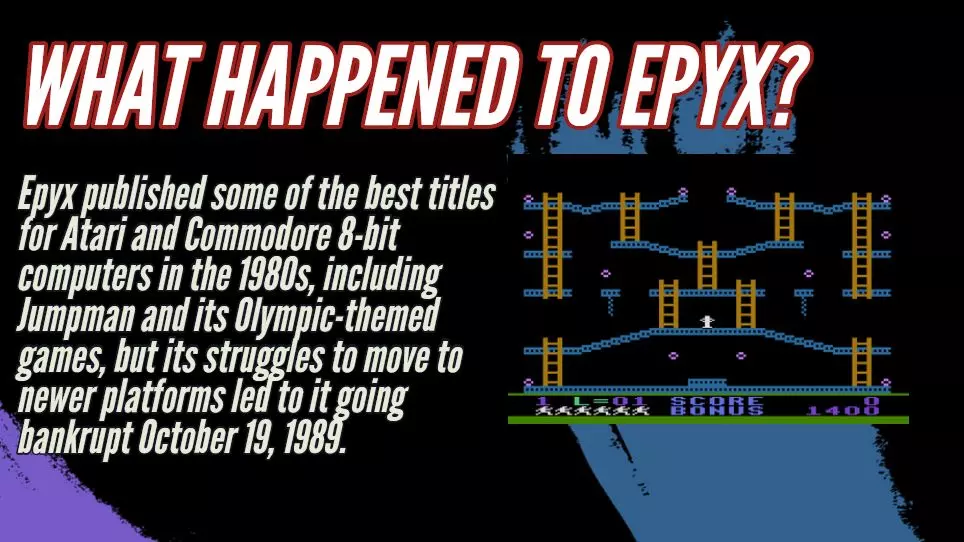
Epyx was one of the most celebrated and prolific software publishers for 8-bit home computers, especially Atari and Commodore, and, to a lesser degree, Apple. But they struggled to transition to newer platforms and that…
以下正文同步自 Hacker News 最新,版权归原站所有,已转换为易读排版。
Epyx was one of the most celebrated and prolific software publishers for 8-bit home computers, especially Atari and Commodore, and, to a lesser degree, Apple. But they struggled to transition to newer platforms and that ultimately led to bankruptcy, on October 19, 1989.
Initially Epyx was called Automated Simulations and its first product was a space-themed war game called Starfleet Orion written in PET Basic for the Commodore PET. They quickly ported it to the Apple II and TRS-80 as well, and followed it up in 1979 with Invasion Orion, which included a computer-controlled opponent.
The next game wasn’t a simulation, requiring a new brand name. Epyx was an appropriate name for a dungeon crawl roleplaying game called Temple of Apshai. Initially released in August 1979 for the TRS-80 and Commodore PET, Epyx ported it to the Apple II, Atari 800, IBM PC, Commodore 64 and VIC-20, Atari ST, Amiga, Mac, Amstrad CPC, and Thomson TO8, updating it for the newer machines in the process. It sold 400,000 copies by 1986, a huge number for the time. It spurred two add-ons, Upper Reaches of Apshai and Curse of Ra, and a prequel, Gateway to Apshai. The first game and its two add-ons were later re-released as the Temple of Apshai trilogy. Epyx released additional games using the same engine, including Crush, Crumble and Chomp!, Rescue at Rigel, and Star Warrior.
A power struggle led Jon Freeman, one of the cofounders, to leave to form Free Fall Associates, who published several hits with Electronic Arts. The remaining cofounder, Jim Connelley took on venture capital and clashed with the new management, leading to his departure as well.
An independent submission from Randy Glover called Jumpman, a platform game with 30 levels inspired by Donkey Kong, changed the company. It became a huge hit on the Commodore 64 and Atari 800, and was ported to the Apple II, IBM PC, and Coleco Vision as well. Epyx shifted focus from strategy/role-playing games to more arcade-like games after the success of Jumpman. This worked, leading to hits like Impossible Mission and Summer Games, a sports game based on the Summer Olympics. Summer Games turned into a series that included Summer Games II, Winter Games, World Games, California Games, The Games: Summer Edition, and The Games: Winter Edition. Epyx’s racing games, Pitstop and Pitstop II, and its Street Sports series, also became classics.
In 1983, Epyx sold $10 million worth of software. That made it the 16th largest software publisher for microcomputers.
The Epyx Fast Load cartridge was a must-have for C-64 owners. By replacing the protocol the C-64 and 1541 used to communicate, it made the 1541 disk drive five times faster. And in case you’re wondering, it worked with other publishers’ games too, not just Epyx titles.
But by 1986, Epyx was struggling. It tried to pivot, even creating a game system that became the Atari Lynx. But cashflow problems continued, leading to bankruptcy on October 19, 1989. Epyx’s library didn’t lend itself well to porting to late 80s PCs, partly due to its games’ heavy reliance on sprites. This meant Epyx couldn’t quickly cash in on the popularity of PC gaming like some of its competitors did.
Epyx reorganized but was a shadow of its former self, shrinking from 145 employees to fewer than 20. By 1993, with only 8 employees left, Epyx sold its remaining assets. Bridgestone Media Group bought Epyx’s software library and still owns the rights today.
Bridgestone licensed new versions of many Epyx titles for newer platforms. It also licensed them to be included in retro products like Retro Games’ TheC64 Mini. Of the 65 titles included on TheC64, 20 of them are Epyx titles.
share
share
save
share
share
share
share
RSS feed
Dave Farquhar
David Farquhar is a computer security professional, entrepreneur, and author. He has written professionally about computers since 1991, so he was writing about retro computers when they were still new. He has been working in IT professionally since 1994 and has specialized in vulnerability management since 2013. He holds Security+ and CISSP certifications. Today he blogs five times a week, mostly about retro computers and retro gaming covering the time period from 1975 to 2000.
正文由 探How 从来源站点 RSS 同步,内容未经改写;遇到排版缺失或需要图片、视频时请以原文为准。