The Designer Fallacy
Everywhere you look nowadays it seems like someone else is talking about taste. How in the world of AI, of infinitely cheap lines of code, the only differentiator that a human being can add is taste. I heard this from t…
以下正文同步自 Hacker News 最新,版权归原站所有,已转换为易读排版。
Everywhere you look nowadays it seems like someone else is talking about taste. How in the world of AI, of infinitely cheap lines of code, the only differentiator that a human being can add is taste. I heard this from the chief designer of the company I work for on stage, with 2 other directors to her side droning about the sea of sameness and how people in the world of design try to avoid the sea of sameness. They showed a bunch of similar looking coffee shops and described the idea as good design in the industry converges into a sea of sameness. As a side not, it didn’t help convince me that they knew what they were talking about given that they were all wearing the exact same type of wide-leg pants with a plain t-shirt in some variation of brown, grey or black. It became clear to me in that moment that this role the industry has defined as “the designer” is meant to be this proxy for culture, for trend, and as such, by definition, it must converge in the median aka the sea of sameness. There is a circular logic to the definition of this role.
Quick example, if you look at the navigation bars of your favourite apps they all look the same, either a floating rounded edge, or a bottom fixed bar.
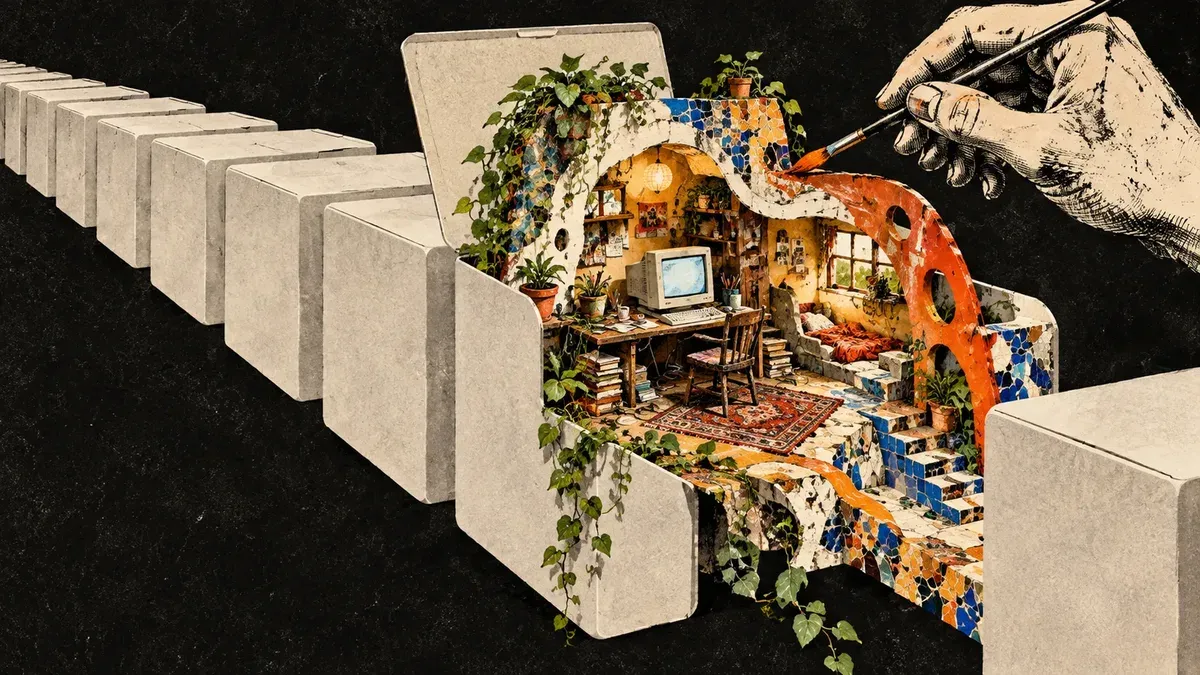
On the other hand, you take a look at legendary “designers” who were not labeled as such. Think about architects like Gaudi. His work was seen as great because it was a manifestation of his authentic selve. Of whatever the fuck he wanted to put on paper that he found interesting. Think about La Sagrada Familia and how crazy and impractical it was, taking 144 years to complete. Have you ever made anything that required even a tenth of that? These people didn’t follow trends or design patterns. The weren’t trying to sell a tablet. They painstakingly developed their own style. A style that didn’t scale I may add. And that’s another important concept to focus on here. Companies are obsessed with things that scale and that’s what pushes this new wave of designers into trend following, which honestly, makes them utterly uninteresting.
I’m reminded of the early days of the internet when we didn’t have all of these design patterns and prepackaged boostrap UI libraries. It was a time when you would hear about a website either by word of mouth, or because someone mentioned it in passing in some niche publication. What you would find would be a pixelated, sharp edged css mess. Not only that, but chances are that this website you just entered was served by a real computer sitting next to someone’s desk at home acting as a server. In a sense, visiting these sites was like visiting that persons home. Getting a glimpse of their personality from what they chose to display and how they chose to display it. Whether they had good or bad taste, who gives a shit. It was personal and the beauty is in the eye of the beholder.
I’ve seen new glimpses of that old internet here and there. Fugly mascots released by companies eliciting disgust. Has AI revived bad taste? Not necessarily, AI after all has the problem of mode collapse, which is a very similar problem to the sea of sameness. I think insofar as someone wields AI to extract something within them to put out there for the world to see, then yes, AI can revive bad taste. So long as you don’t try to pass a purple gradient as your own of course.
So wtf is the iPhone moment and why does everyone drone about it like “<insert industry / AI> is going to have an iPhone moment”. I guess its this idea that some fucking saviour like Steve Jobs is going to find the right design that the world doesn’t know it needs, and then scale the shit out of it and make a fortune. I’ve also heard “If I had asked people what they wanted, they would have said a faster horse” in the same context. But Henry Ford never even actually said that. There’s this myth of the hero designer that unearths greatness that we keep embellishing. AI having an iPhone moment implies that there is a convergence of experiences, a high speed blended puke mixture of human parts that technically represent “100% human” on a nutritional contents label, but come on, the human is gone.
In my opinion a true iPhone moment is the climax of someone’s will to power. Nothing to do with the scale of the outcome. The undeterred battle for pure self expression with little to no external influence, which arguably Steve Jobs may have done and that perhaps was his Gaudi moment. The tsunami of sameness damage happened later when we got X many decades of marginal changes of the same UI in the same touch screen rectangle across every company making a smart phone.
I want to explore a time in which we all can share whimsical creations of our own with each other. A time where we’ll create ugly, interesting things, filled with personality. That’s all I can wish for you as well dear reader. And maybe one day we’ll break through the mental chains that tell us “let’s build an app for this”, and we’ll actually get our hands dirty building something cool.
Tell me how you really feel. All comments are anonymous so do your worst potatobanana69
正文由 探How 从来源站点 RSS 同步,内容未经改写;遇到排版缺失或需要图片、视频时请以原文为准。