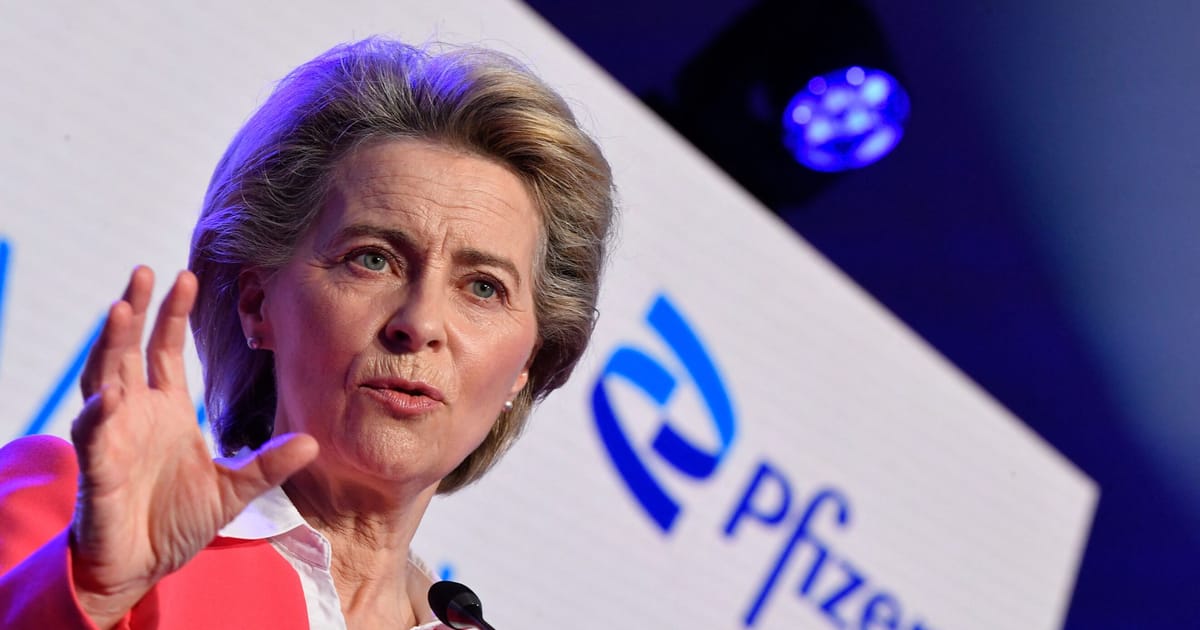
EU prosecutors still have questions for von der Leyen over Pfizergate
Little demonstrable progress has been made on the EPPO’s probe into the Commission chief’s negotiations on Covid-19 vaccines with Pfizer CEO Albert Bourla.
以下正文同步自 Hacker News 最新,版权归原站所有,已转换为易读排版。
Little demonstrable progress has been made on the EPPO’s probe into the Commission chief’s negotiations on Covid-19 vaccines with Pfizer CEO Albert Bourla.
Listen
AI generated Text-to-speech
ATHENS — Ursula von der Leyen has not yet provided an in-person statement to the European Public Prosecutor's Office for its investigation into the procurement of coronavirus vaccines, according to an individual involved in the effort who was granted anonymity to speak freely.
In 2024, EPPO took over the Belgian-led probe into alleged criminal wrongdoing in connection with vaccine negotiations between the European Commission chief and Pfizer CEO Albert Bourla. Prosecutors have been investigating von der Leyen for "interference in public functions, destruction of SMS, corruption and conflict of interest," according to legal documents seen by POLITICO.
Asked to respond to the assertion that von der Leyen has failed to provide a statement on the so-called Pfizergate affair, Commission spokesperson Thomas Regnier said: "The Commission has demonstrably cooperated extensively with EPPO to clarify facts and assess events."
"This was always done on behalf of and with the full support of the President. The President has always been, and continues to be, very cooperative in answering to any open questions — within the limits of her duties and her availability as President of the Commission.”
In an interview with POLITICO, EPPO chief prosecutor Laura Codruța Kövesi, who wraps up her seven-year tenure on Friday, said she has on multiple occasions dealt with EU officials who refused to answer summons from her office. “Some politicians think that they are above the law,” she said. “If you are called in for a statement, you have to come.”
She added: "I will not be shy to tell you that especially when important people are involved in the investigation — be it high-profile politicians or rich people who are connected to the political class, we have difficulties in exercising our competence."
When asked whether von der Leyen was one of the officials in question, Kövesi said she wouldn't comment on specific investigations.
EPPO, set up in 2017 and operational since 2021, is tasked with rooting out crimes involving EU funds. As head of the organization, Kövesi said she has faced repeated attacks and attempts to undermine the institution and its work.
“As I leave my office, I think of this famous Danish TV show, Borgen. There is a very famous saying there: 'In Brussels, no one can hear you scream,' and unfortunately, this is true," she said, in a nod to the Ridley Scott blockbuster Alien. "I am concerned that the EPPO is going to be killed softly because it's doing its job."
Kövesi cited three main factors undermining the institution's work: chronic underfunding, delays in the revision of the organization's legal framework and the complexity of its bureaucratic architecture, which she said leads to "endless discussion about how to complicate the life of the prosecutors."
Asked what she would do differently if she could start over again, the chief prosecutor said she “would do the same things, but maybe the others should change their behavior," adding that the biggest challenge her successor, German prosecutor Andrés Ritter, will face is keeping EPPO “independent and credible.”
Kövesi said that during her tenure, “the most blatant attempt" to intimidate EPPO prosecutors was in Greece, which was hit by a farm funding scandal last year — leading to the resignation of ministers and deputy ministers. The cases of four MPs from the ruling New Democracy party are currently being heard in court. They all plead innocent.
Last May, EPPO sent a formal complaint to the Commission regarding moves by the Greek government to block EU prosecutors from investigating Greek lawmakers. It also complained about the Greek Supreme Judicial Council’s refusal to renew the mandate of European-delegated prosecutors for five years at EPPO's request. Kövesi warned that this could result in EU funding cuts for Greece under Article 16 of the EPPO Regulation.
The cooperation between EPPO and the Greek government has been difficult, with Prime Minister Kyriakos Mitsotakis hinting at a political agenda by EPPO by complaining of "selective leaks."
“All the noise was created to blame EPPO that we play politics instead of discussing what happened in reality,” said Kövesi. “Some politicians speak about an independent and efficient judiciary, until you touch them and until you go close to their inner circle. In that moment, the prosecutors are abusive, they have a political agenda, they are not needed.”
Some Greek government officials have suggested that Greece could simply opt out of the EU institution, but Kövesi said this is “almost impossible.”
The chief prosecutor also raised concerns about the impact of budgetary restrictions on EPPO's work elsewhere in the bloc. The organization is currently setting up its operations in Hungary, which officially became a participating member of EPPO in August 2026 — but Kövesi is skeptical about how successful it will be.
“We explained exactly what we need to do our job, but the Commission proposed half of [the budget] we need,” she said, adding that EPPO's "credibility is at stake" in countries like Poland, where "expectations were huge" but the organization has not been able to deliver on its promises.
EPPO is also investigating the alleged misuse of more than €4 million by the Identity and Democracy group, a defunct political grouping in the European Parliament whose debts Patriots for Europe could be forced to repay. The latter group includes France’s far-right National Rally, led by Marine Le Pen, the frontrunner ahead of France's 2027 presidential elections.
“If you ask EPPO to abstain and to not do anything because there are elections in Europe, we will not work at all,” said Kövesi.
Related Tags
Conflict
Conflict of interest
Cooperation
Corruption
Courts
Democracy
Elections
Elections in Europe
EU funding
Exclusive
Farms
Judiciary
Negotiations
Regulation
Vaccines
Related Countries
France
Greece
Hungary
Poland
Related People
Kyriakos Mitsotakis
Laura Codruta Kovesi
Marine Le Pen
Ursula von der Leyen
Related Organizations
European Commission
European People’s Party (EPP)
European Public Prosecutor's Office (EPPO)
National Rally
New Democracy
Patriots for Europe
Our readers read next
Serbian opposition landslide exposes cost of EU’s bet on ousted Vučić
6 HRS ago
5 mins read
The US and Canada are talking trade. That doesn’t mean they’re near a deal.
11 HRS ago
7 mins read
Quebec’s separatist leader threatens to play spoiler at Carney’s EU summit
13 HRS ago
4 mins read
UK budget 2026: What we’re watching
15 HRS ago
9 mins read
More from Nektaria Stamouli
EU Public Prosecutor’s Office will be ‘killed softly for doing its job’ says outgoing chief
In an exclusive interview with POLITICO to mark the end of her seven year tenure, Laura Codruța Kövesi spoke frankly about the problems facing the EPPO.
Rubio called Greece a “strong and model NATO ally” and a “source of stability in an unstable world.”
Kimberly Guilfoyle has caused a stir in Athens and Bucharest.
A pilot project to send migrants who have been denied the right to stay in the EU to designated ‘return’ countries will be in place by early next year, Greece’s migration minister told POLITICO.
正文由 探How 从来源站点 RSS 同步,内容未经改写;遇到排版缺失或需要图片、视频时请以原文为准。