When AI Does the Work, What Will Humans Do?
Everyone seems to be asking the same question about artificial intelligence: which jobs will it replace? It’s a reasonable concern. As someone who has spent years building software, I find it remarkable how quickly AI i…
以下正文同步自 Hacker News 最新,版权归原站所有,已转换为易读排版。
Massimiliano Genta
Oct 28, 2026
1
1
Share
Everyone seems to be asking the same question about artificial intelligence: which jobs will it replace? It’s a reasonable concern. As someone who has spent years building software, I find it remarkable how quickly AI is becoming capable of work that once required considerable experience. But the more I work with AI agents, the more convinced I become that we’re overlooking another important question: what happens to the value of everything people learned while doing that work?
As AI becomes better at performing tasks, it also has the potential to learn from the experience behind them. If those lessons can be preserved and shared across intelligent systems, they could continue creating value long after the original work is complete.
If AI can learn from human experience and use those lessons to create economic value, the people who contributed that experience should have a way to participate in the benefits.
We’ve built much of our working lives around a familiar relationship: people develop skills, use those skills to perform work, and earn a living in return. But that relationship becomes more complicated when machines can perform the work while continuing to benefit from the experience people accumulated over years of doing it.
I don’t believe AI will necessarily eliminate most jobs, or that we’re inevitably heading toward a world where nobody needs to work. But I do believe we need to reconsider some of our assumptions about work, intelligence, and economic value.
Software development offers an interesting glimpse into this transition. For much of my career, building software has meant understanding requirements, writing code, debugging problems, and maintaining systems. Increasingly, AI agents can assist with these activities, and it’s becoming easier to imagine a future where much of the implementation happens automatically.
But suppose an AI agent can build an entire application in minutes. Does that mean the person who would previously have built it no longer has anything valuable to contribute?
Imagine a hospital asking an AI system to improve patient scheduling. It might optimize appointments, reduce waiting times, and produce technically excellent software. But its efficient schedule could also make life more difficult for elderly patients, create unexpected pressure on nurses, or fail to account for emergencies.
The software might work exactly as designed while still producing the wrong outcome.
Someone still needs to understand what the hospital is trying to achieve, which tradeoffs are acceptable, and who is responsible when decisions have consequences. AI may become increasingly capable of reasoning about those questions too, but greater technical capability doesn’t eliminate the need to decide which outcomes matter.
As AI makes production easier, deciding what is worth producing - and understanding the consequences of those decisions - becomes increasingly important.
The scarce skill may shift from knowing how to do something to knowing what is worth doing.
Much of what makes someone good at their work isn’t simply their ability to perform a task. It’s everything they’ve learned while becoming good at it.
An experienced mechanic might recognize a problem from a sound that’s difficult to describe in a manual. A nurse might notice subtle changes in a patient’s behavior. A software engineer might recognize that an elegant solution will become a maintenance nightmare six months later. These judgments emerge from years of mistakes, observation, and learning. They aren’t always easy to explain, and they don’t necessarily appear in textbooks.
As AI becomes capable of performing more of this work, we need to think differently about the value of the experience behind it. Consider an agent investigating a difficult software failure. It might examine logs, test hypotheses, and try several approaches before discovering the underlying cause. Once it succeeds, the immediate problem is solved.
But what happens to everything it learned along the way?
In many current systems, much of that useful experience remains tied to the original interaction. Another agent encountering a similar problem may need to repeat much of the investigation.
Humans have advanced by preserving and sharing discoveries across generations. We don’t expect every engineer to rediscover electricity or every doctor to independently develop the same medical knowledge. Yet we’re still figuring out how to give AI systems a similarly reliable way to build on experience.
The challenge isn’t simply storing more information. A solution that worked in one environment might fail in another, and a convincing explanation isn’t necessarily evidence that something is true. For experience to become genuinely reusable, intelligent systems need ways to preserve its context, evaluate its reliability, and understand when it applies.
Perhaps the most valuable thing we can preserve isn’t simply someone’s contribution or even the outcome of a decision. It’s the experience that led to that outcome: the conditions that existed, the people involved, how they interacted, what they attempted, and why things unfolded as they did. With that understanding, an intelligent system could begin to ask a more important question: what might have happened if one condition had been different? Could a mistake have been prevented, or a better outcome achieved? Without the evidence of what actually happened, those questions become speculation. Preserving experience gives us a starting point for investigating them, testing alternatives, and learning what to do differently next time.
Solving this problem would do more than make individual agents more efficient. It could change how intelligent systems improve over time.
Intelligence could begin to compound through experience, rather than repeatedly starting over.
Imagine a mechanic helping an AI agent diagnose an unusual engine failure. The mechanic recognizes something the agent overlooked, explains why it matters, and helps verify the solution.
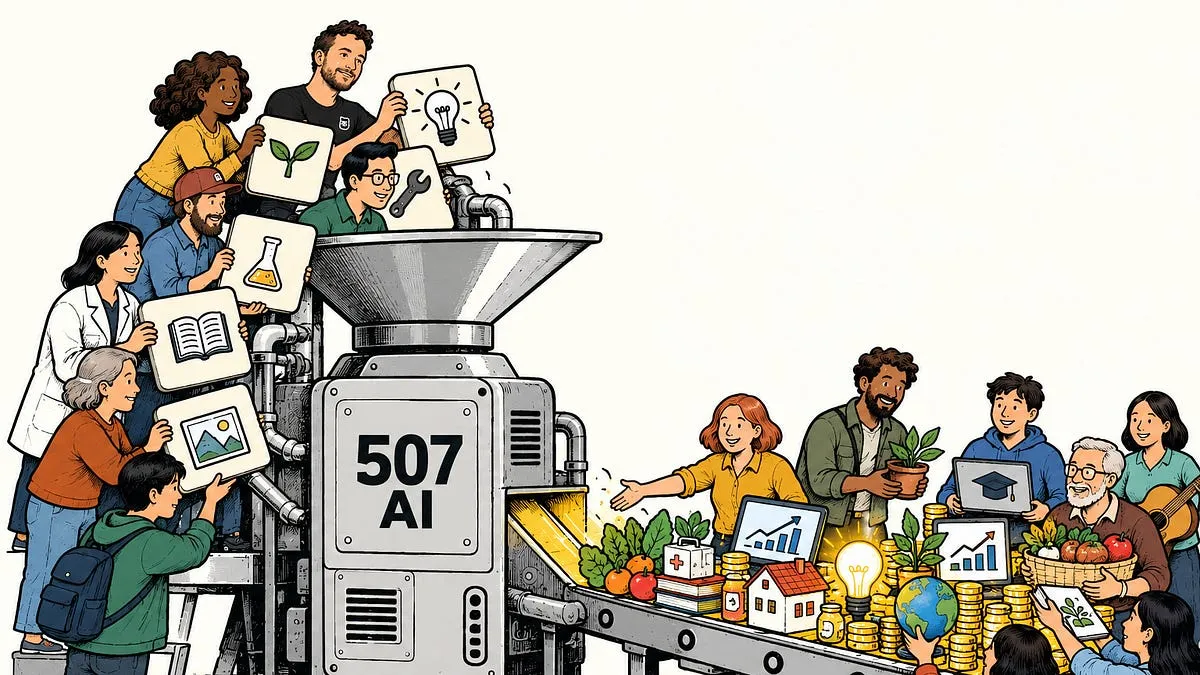
Now imagine that lesson is preserved in a way that other agents can evaluate and reuse. Months later, another agent encounters a similar problem somewhere else in the world. Instead of starting from scratch, it benefits from the mechanic’s experience.
If intelligent systems can continue benefiting from someone’s experience long after their work is finished, we should explore ways for that person to participate in the value they helped create.
That doesn’t mean every useful insight should generate a payment. It means our familiar ways of thinking about work and compensation may be missing an increasingly important form of contribution.
We’re already seeing a related tension in the real world. In 2024, Stack Overflow announced a partnership with OpenAI to make its collection of developer questions and answers available for AI products. For years, programmers had shared solutions, explanations, and hard-earned lessons to help other programmers. That accumulated knowledge had become valuable to companies building intelligent systems.
The partnership included provisions for attributing Stack Overflow content in AI products. But attribution raises a broader question: when knowledge contributed by millions of people becomes an input to commercial AI, how should the economic benefits be shared?
This isn’t the same as an agent preserving and reusing a verified lesson. But it demonstrates that the economic question is no longer entirely hypothetical. Human knowledge is already contributing to the value of commercial AI products, while the relationship between contribution and compensation remains unsettled.
Making experience reusable, however, is not the same as making it economically rewardable. An agent might learn from a mechanic, then combine that lesson with hundreds of other discoveries. Even if we can verify that the original contribution was useful, determining how much value it created could be extraordinarily difficult. We’d also need to address privacy, manipulation, and the risk of turning every human interaction into something that must be measured and monetized.
And even if we develop ways to measure useful contributions, who should decide what they’re worth? A single company or AI system shouldn’t have unquestioned authority over those decisions. Any credible approach would need rules that contributors can understand, examine, and challenge.
I don’t know whether recurring payments for reusable experience could work fairly at scale. That remains an open question. But the difficulty of designing a fair system is not a reason to ignore the value being created.
Instead of only asking how people will earn money when AI performs more tasks, we should also be asking how people can share in the value that AI creates.
This is where the technological questions begin to overlap with economic ones.
Capitalism allows people to participate in economic growth through wages, business ownership, investment, and intellectual property. But for many households, employment remains the primary source of income.
What happens if AI allows businesses to create dramatically more value while relying on fewer workers?
Technological progress has displaced jobs before while creating new industries and opportunities. AI may follow that pattern, and we should be careful about assuming otherwise. But AI is unusual because it is increasingly capable of performing cognitive work, including some of the activities people might otherwise move into when their previous jobs disappear.
If productivity grows much faster than employment opportunities, we could end up with an uncomfortable contradiction: an economy capable of producing extraordinary abundance while many people struggle to earn enough to participate in it.
That doesn’t mean capitalism needs to disappear. It means the ways people participate in economic prosperity may need to evolve alongside the technologies creating it. One possibility is broader ownership of AI-driven businesses and infrastructure. Another is recognizing contributions to the knowledge and experience that make intelligent systems more capable.
These approaches are different in an important way. Ownership doesn’t simply provide a share of economic returns; it also carries authority over how an asset is used and who gets to make decisions about it. Contribution-based income, by contrast, could reward people whose experience makes intelligent systems more capable without giving them any influence over how those systems operate. That distinction matters. If people help create the intelligence on which these systems depend, should they only share in the economic benefits, or should they also have some say in how that intelligence is used?
But perhaps we’re still thinking about value too narrowly. In any complex system, not everything essential directly produces the outcome we’re measuring. Some elements make that outcome possible, others prevent things from going wrong, and many influence the system in ways that aren’t immediately visible. Society is no different. People’s actions and interactions shape the conditions in which others live, work, and make decisions. To understand their value, we need to look beyond what they produce and examine how their behavior affects the larger system, why those effects occur, and what might have happened if something had been different. AI could help us develop that understanding, rather than simply becoming another way to measure productivity.
If intelligent systems become more capable by building on knowledge accumulated throughout human history, should the people who own those systems also have the primary claim to the wealth they create and the authority to decide how they’re used?
There’s another tension we can’t afford to overlook. If experience becomes increasingly important, what happens when AI starts removing the very experien
正文由 探How 从来源站点 RSS 同步,内容未经改写;遇到排版缺失或需要图片、视频时请以原文为准。