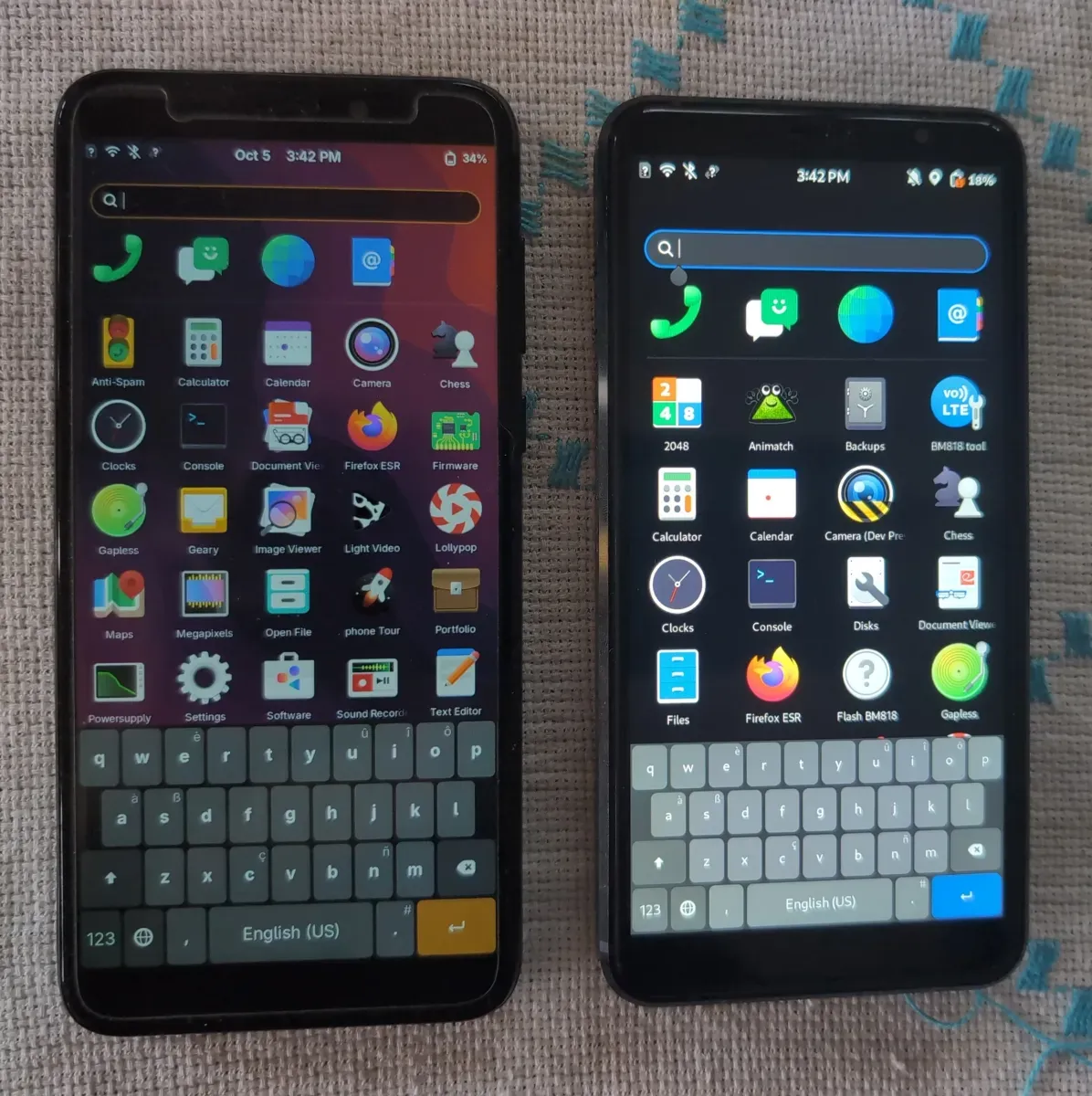
Will Linux phones become a viable alternative to the Android/iOS duopoly?
by Amos Batto (2026-10-05), License: CC BY 4.0, Download: PDF, ODT
以下正文同步自 Hacker News,版权归原站所有,已转换为易读排版。
by Amos Batto (2026-10-05), License: CC BY 4.0, Download: PDF, ODT
Five years ago, Linux phones looked like they were poised to become a viable alternative to the Android/iOS duopoly that has an iron grip on the mobile phone industry. Sadly, after a brief flash of activity and community engagement with the release of the Purism Librem 5 and the PINE64 PinePhone in 2020, the Linux phone market has generally stagnated. This stagnation occurred partly because of the problems at Purism and PINE64, but also because the available Linux SoC’s weren’t up to the task of running a modern smartphone, and the hardware industry wasn’t providing any good alternatives with good free/open source drivers. In addition, Plasma Mobile and Phosh were still inchoate mobile interfaces at the time, and there wasn’t a good distro option to run these interfaces on Android kernels with a normal integrated mobile SoC. The poor performance of the PinePhone and Librem 5 and the problems with the PinePhone Pro and the Librem 5 refunds sapped people’s enthusiasm and willingness to take a chance on the next Linux phone.
Fortunately, all of these conditions are changing, and I believe that there is now the possibility that Linux could finally become a viable alternative to Google’s Android and Apple’s iOS in the mobile space, just like desktop Linux has become a viable alternative to Windows and Mac OSX on the PC over the last three decades. This isn’t to say that mobile Linux will fundamentally challenge the business of Google or Apple, but the conditions are ripe for a small market to arise for Linux phones, similar to the way that people can currently buy Linux PCs from a number of small companies, such as TUXEDO, System76, Purism, Slimbook, ThinkPenguin, Ubuntushop.biz, Entroware, Star Labs, Juno, Laptop with Linux, Linux Certified, ArkPC, etc.
It isn’t impossible that one of the big phone brands might sell a few models of phones with mobile Linux in the future, just like Lenovo and Dell currently sell a few PC models with Linux preinstalled in some limited markets. Motorola just announced that it will start selling some high-end phone models with GrapheneOS in 2027, which indicates that Google will allow the big phone makers to sell alternatives, probably because it fears anti-trust regulation. As the mobile industry increasingly shuts down the ability to unlock the bootloaders of Android phones, more people will be looking for an alternative to AOSP derivatives, and mobile Linux could provide that alternative.
Five years ago, it looked like mobile Linux had finally arrived. The Purism Librem 5 and PINE64 PinePhone had just been released, and even a big tech reviewer like Linus Tech Tips was trying them out. Mrwhosetheboss’s video, “Are Linux Smartphones about to KILL Android?,” where he held up the Librem 5, got 7.8 million views on YouTube. The Librem 5 had been ported to Mobian and postmarketOS, and the PinePhone had been ported to 20 different Linux distributions. There was a growing number of phone models that could run Jolla’s Sailfish OS and Ubuntu Touch on top of Android kernels, and many people were testing postmarketOS on their old phones. Plasma Mobile and Phosh were advancing fast as mobile interfaces. KDE had adopted Kirigami and GNOME was adopting Adwaita, so both KDE and GNOME apps could become adaptive between desktop and mobile interfaces. The Waydroid project was making it possible to run Android apps inside a Linux container. The future seemed bright for mobile Linux, but that future never seemed to arrive. It is worth examining what held back mobile Linux to understand how those conditions can be overcome in the future.
There has been great deal of experimentation with different mobile operating systems based on a Linux kernel over the last 25 years since the first mobile Linux devices were released—the Sharp Zaurus, the G.Mate Yopy and the Motorola A760. I count 29 different varieties of commercial mobile Linux that have existed over the years, and there are probably many more that I missed. There have been many different waves of mobile Linux, which at the time looked like they might become the next big thing, including EZX, MotoMagx, Maemo, LiMo, Moblin, Meego, Tizen, Firefox OS, webOS, Ubuntu Touch and Sailfish OS. For years Motorola experimented with different Linux varieties that were based on the idea of using Java apps available in a community store, so Google’s Android was hardly unique, but it was the flavor of mobile Linux which succeeded. Today, all of them are often lumped together under the label of “Linux” as a separate category from Android, but Tizen and Firefox OS are just as distinct architecturally as Android from a standard desktop Linux distro.
The mobile Linux operating systems live on, although they are less visible today. Much of the MeeGo code that Nokia created for the N9, continues to be developed by the tiny Finnish company, the Jolla Group, which is once again selling phones with its Sailfish OS. Firefox OS, which was abandoned by Mozilla Foundation in 2016, was reborn in 2017 as proprietary KaiOS for low-end phones without touch screens, but that market is slowly disappearing as Android now reaches even the cheapest segments of the mobile phone market. Ubuntu Touch, which was abandoned by Canonical in 2017, lives on as a community-based project under the volunteers at UBports. Even, webOS and Tizen still exist, although they are no longer used as mobile operating systems. webOS runs LG TVs and Tizen is used in Samsung TVs.
Although it doesn’t generate many headlines in the tech press, a tiny Linux phone market still exists. Purism, PINE64, FuriLabs, Jolla, Jolla-Devices, Volla and PrivacyPortal (plus Brax in the future) all sell phones with some flavor of Linux preinstalled. The number of people buying Linux phones today is fewer than in 2020-22 when PINE64 was launching the PinePhone and PinePhone Pro, but there are actually more companies selling Linux phones than there was 5 years ago. There are good reasons to believe that many of the problems that plagued Linux phones in the past are going to be overcome in the future.
In the past, the available hardware choices limited the viability of Linux phones. Systems-on-a-Chip (SoC’s) which support Linux are generally used in single-board-computers (SBC’s), TV setup boxes, internet of things (IoT) devices and embedded microprocessors in industrial and automotive applications, where the price points are lower, so their performance is generally weaker and they are less energy efficient than the typical mobile SoC designed for smartphones, because they are fabbed on older process nodes. However, they offer long-term support, because they are used in applications that have long product life cycles. For example, automobiles contain dozens of SoC’s and they typically takes 3 to 5 years just to design and need to be able to run for the next 20 years. In contrast, the mobile SoC’s with Android support are very powerful, but they are only produced for 1 to 3 years.
If the designers of Linux phones want to be able to run a Linux kernel (as opposed to an Android kernel), most of their options offer little processing power, poor energy efficiency and poor thermals. If they want to avoid proprietary blobs as much as possible, they either have to choose an older SoC which the community has been worked on for years to iron out the bugs in the free/open source drivers (e.g., the Allwinner A64 in the PinePhone), or they have to spend years patching the Linux kernel to properly support a newer SoC (as Purism did with the NXP i.MX 8M Quad in the Librem 5). If they decide that it is too much trouble to send their patches to mainline Linux, then it will be harder to support their hardware in the future, because they will have to keep applying those same patches to each new Linux kernel release. Purism chose to upstream their changes to mainline Linux, whereas the volunteers working on the PinePhone’s kernel generally didn’t.
The chipmakers like NXP, Rockchip, Allwinner, Amlogic and Broadcom who make SoC’s with Linux support simply don’t generate enough revenue to justify using a leading-edge process node in their chips. Even thought they can sell a Linux SoC for 10 to 15 years, they still won’t sell enough to recoup the extra $400 – $600 million that it would cost to use a 3nm process, and the costs keep going up with each new generation of process node. It is enormously expensive to design a chip at the cutting edge of the silicon industry. Silicon Analysts estimates that fabbing a wafer at TSMC costs an average of $19,500 at a 3nm node, but only $3000 at a 28nm node. Most Linux SoC’s are low-priced chips with very thin margins, so they have to sell millions of them to make much profit. Some Linux SoC makers like NXP focus on specialty markets, so they they have higher margins, but they tend not to sell many of them, so the profits are still limited.
Another way that chipmakers reduce their costs is by using older generations of Cortex cores, which have lower licensing fees from ARM, and by using lots of low-power Cortex-A5 series cores, rather than the higher-power Cortex-A7 and Cortex-X series cores, which have higher licensing fees. NXP was clearly employing these cost cutting strategies with its i.MX 9 series processors. The most powerful chip in the series is the i.MX 95, which contains six Cortex-A55 cores, when it would have made more sense to use two Cortex-A78 cores for better performance and four Cortex-A55 cores for low power. The i.MX 95 was fabbed on a 16nm FinFET node, which is a slight regression compared to Samsung’s 14nm node used in the previous i.MX 8M Plus processor. Another example of this cost cutting was the decision by Broadcom to use older Cortex cores and larger process nodes in its BCM2836 (40nm, 4x Cortex-A7), BCM2837 (40nm, 4x Cortex-A53), BCM2711 (28nm, 4x Cortex-A72) and BCM2712 (16nm, 4x Cortex-A76), despite knowing that millions of these chips would be sold (e.g. in the Raspberry Pi 2, 3, 4 and 5, respectively). Even Nvidia, which is the world’s richest chipmaker due to the AI boom, appears to be avoiding the costs of using a leading-edge process node in its Tegra SoC. It canceled its planned Tegra Atlan series which was announced in April 2021, and still hasn’t released its Tegra Thor series, which was announced in September 2022. Its Tegra Orin series which was announced in March 2018 is now getting long in the tooth using an 8nm node.
In contrast, the smartphone market, which sold 1.25 billion units in 2025, has enormous volumes, and phone makers are willing to pay much higher prices for processors, especially for higher-end models, which allows Qualcomm, MediaTek, Apple, Samsung, Google, Xiaomi and Huawei to make the enormous investment in designing mobile SoC’s for an expensive 3nm process node. Integrated mobile SoC’s such as the Qualcomm Snapdragon and MediaTek Dimensity have so much volume, that they can make a profit despite the fact that they generally are only produced for 2 to 3 years. The flagship models (e.g. the Snapdragon 8 series and Dimensity 9000 series) lose most of their market after the first year, so SoC makers have to charge much higher prices to cover the enormous costs of using a leading-edge process node.
In addition, the integrated mobile SoC’s that run Android incorporate many additional functions, such as WiFi, Bluetooth, cellular modem, GPS/GNSS, audio DAC, charge controller and USB-C controller, which require separate chips on Linux phones like the PinePhone and Librem 5. This makes the circuit boards for these phones much more expensive to design, because they can’t just take a standard reference design from Qualcomm or MediaTek and tweak it. They have to custom design their circuit boards, which requires two to three times more components than the circuit board for a typical smartphone. The Librem 5 contains 74 integrated circuits (IC’s) and i
正文由 探How 从来源站点 RSS 同步,内容未经改写;遇到排版缺失或需要图片、视频时请以原文为准。