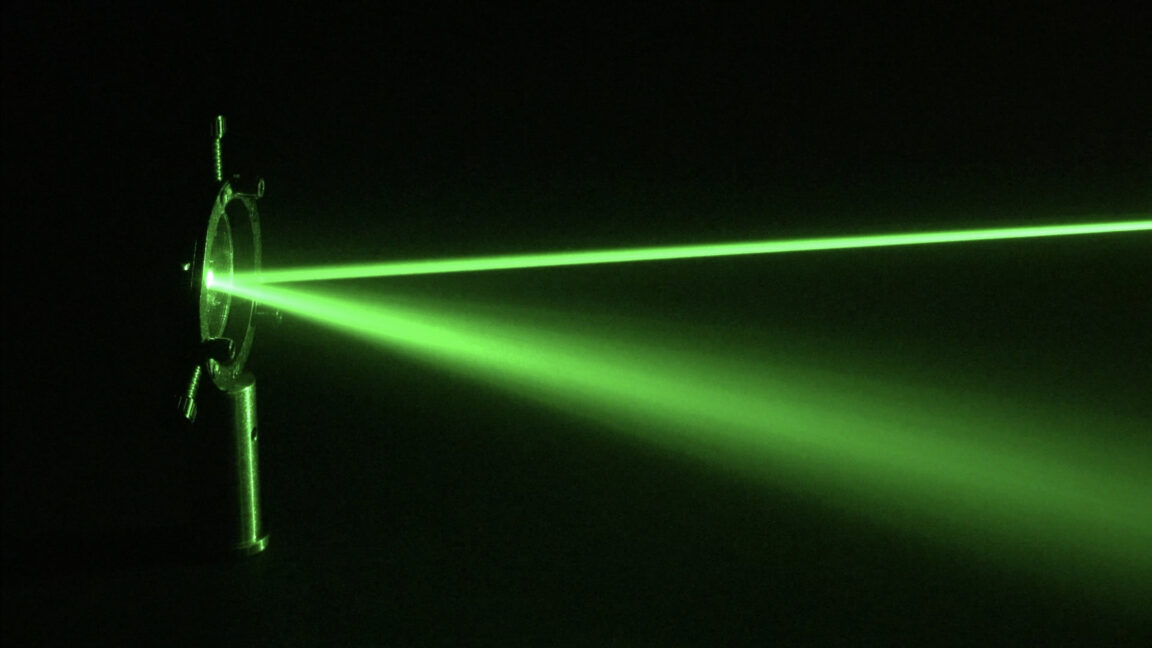
An experimental tour-de-force: Entanglement between glass bead and light
Getting a glass bead to act like a quantum object by entangling it with light.
以下正文同步自 Ars Technica,版权归原站所有,已转换为易读排版。
Writing about quantum entanglement is always a challenge. There are so many clichés to avoid: It’s mysterious, ghostly, spooky, and weird. Entanglement is none of those things, and yet it is also all of those things—a superposition of clichés, you might say. So, having gotten all of my clichés out of the way in the second sentence, let’s take a look at how a group of researchers managed to entangle a light beam with a glass bead, which is, frankly, quite an achievement. Cliché-free entanglement Quantum entanglement is nothing more or less than the idea that if two objects are linked, then their behavior will, in some ways, be correlated. To take a terrible example: My upper and lower arm are very strongly correlated in terms of relative position because they are connected at the elbow. No one is surprised by this because we can see that they are actually a single object called an arm. Two photons can be, in a sense, joined together, meaning that they have correlations, too. In this case, we are (naively) surprised for three reasons. First, we think of photons as separate objects that cannot be joined—this is a mistake of understanding. Second, when we connect two photons, we only connect them in limited ways: The two photons may be wholly uncorrelated in terms of polarization, but strongly correlated in terms of energy. Read full article Comments
正文由 探How 从来源站点 RSS 同步,内容未经改写;遇到排版缺失或需要图片、视频时请以原文为准。