StENSEA
Figure: Discharging: Water flows through the turbine into the empty sphere and generates electricity via a generator; Charging: Water is pumped out of the sphere by the electrically driven pump.
以下正文同步自 Hacker News 最新,版权归原站所有,已转换为易读排版。
Figure: Discharging: Water flows through the turbine into the empty sphere and generates electricity via a generator; Charging: Water is pumped out of the sphere by the electrically driven pump.
Marine pumped storage power plants are a novel approach to transferring the well-established concept of pumped storage systems to deep-sea environments. These offshore pumped storage systems are to be used in water depths between 600 m and 800 m and utilize the pressure in deep water to store energy. In contrast to conventional pumped storage power plants, the surrounding water serves as the upper reservoir, eliminating the need for complex piping. The storage capacity of the system is proportional to the volume and depth of the system.
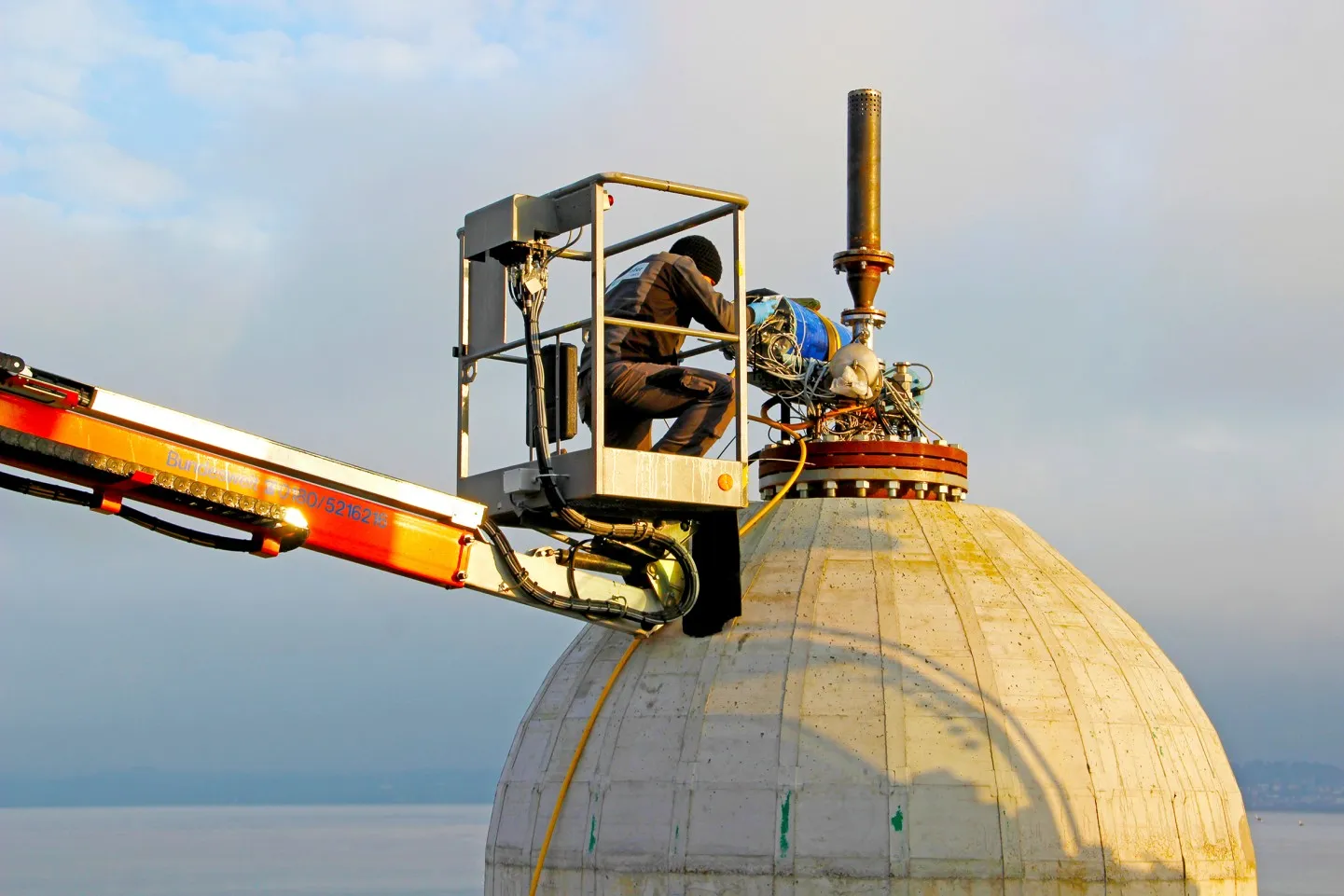
The StEnSea system consists of a hollow concrete sphere that functions as the storage reservoir, and an inserted technical unit containing the pump turbine, a controllable valve, and the components for measurement, control, and regulation (MCR). The technical unit can be removed from the concrete sphere installed on the seabed, maintained or repaired on land, and then reinserted.
An empty sphere corresponds to a fully charged storage unit. To discharge the storage unit, the valve is opened and water can flow into the sphere through the pump turbine. The inflowing water drives the generator via the turbine, which feeds electricity into the grid. Charging is achieved by pumping the water out of the sphere against the surrounding water pressure using surplus energy.
正文由 探How 从来源站点 RSS 同步,内容未经改写;遇到排版缺失或需要图片、视频时请以原文为准。