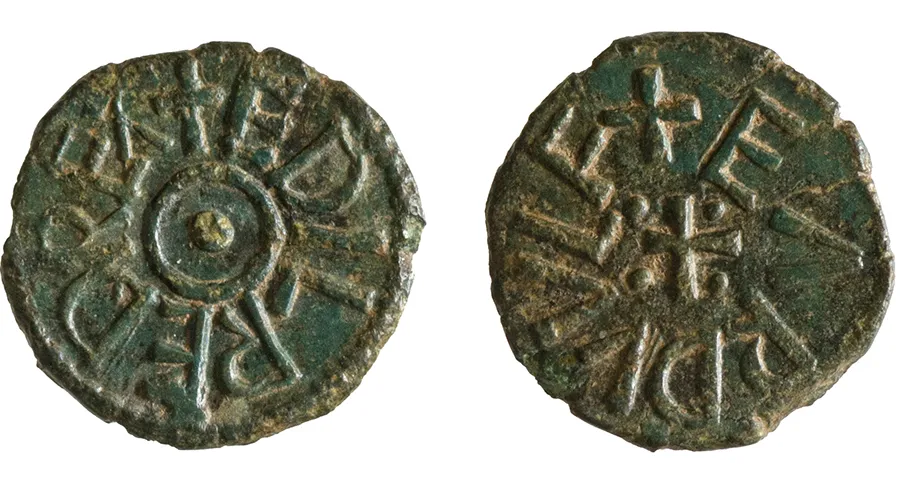
Why did an Anglo-Saxon kingdom mint copper coins when silver was plentiful?
Copper-alloy coin of Aethelred II (second reign) (PAS YORYM-889249): diameter 12.4mm; scale bars removed from original image (© York Museums Trust, CC BY 4.0, https://finds.org.uk/pas/recorded-find/YORYM-889249).
以下正文同步自 Hacker News 最新,版权归原站所有,已转换为易读排版。
Copper-alloy coin of Aethelred II (second reign) (PAS YORYM-889249): diameter 12.4mm; scale bars removed from original image (© York Museums Trust, CC BY 4.0, https://finds.org.uk/pas/recorded-find/YORYM-889249).
Outside of the Byzantine, Islamic and Mediterranean worlds, the production of copper or copper-alloy coins was virtually unknown in medieval western Europe, thirteenth-century Hungary being the only other example prior to the fifteenth century (Spufford Reference Spufford1988: 10). In the Byzantine, Islamic and Mediterranean worlds, base-metal and precious-metal coins circulated together. Contemporaneous Northumbrian precious-metal coins were produced, as evidenced by a silver penny of Eanred from the Trewhiddle hoard (Cornwall) and a gold solidus of Archbishop Wigmund of York (c. 837–854), but these single specimens, the latter of which had been pierced, were likely to have been special issues and not for general circulation.
Ninth-century Northumbria, therefore, represented an exceptional case in early medieval Europe. Unlike other monetary systems based solely or partly on precious metals, Northumbria’s system was based entirely on a fiduciary coin, whose use depended on trust rather than any intrinsic value. Nevertheless, studying debasement in Northumbria can shed light on wider events, such as Viking raids, debasements elsewhere in Europe and the development and use of coins in early medieval Europe. While the increased circulation of debased coins in Northumbria suggests debasement as a means to increase the quantity of coins, without addressing the precious-metals evidence such interpretations are incomplete. Investigating the availability of silver is the key step, allowing us to infer whether debasement was a forced move, and assessing the availability of gold can offer further insights into the economic climate of ninth-century Northumbria.
The circumstances behind debasement in Northumbria have been debated and two broad interpretations have emerged that see the new coinage as indicative of either the kingdom’s decline or, conversely, its vitality.
In the first interpretation, Northumbria was an impoverished kingdom suffering from Viking raids and uniquely violent internal political conflicts (Hodgkin Reference Hodgkin1952: 405–408; Higham Reference Higham1993: 145–46); at times described as backward (Hodgkin Reference Hodgkin1952: 405), bankrupt (Dolley Reference Dolley1958: 16) and degenerate (Smyth Reference Smyth1975: 54); its decline was particularly evident in the transition from silver to copper-alloy coins, which are widely condemned (Dolley Reference Dolley1958: 38; Smyth Reference Smyth1975: 54; Rollason Reference Rollason2003: 224), “a testimony to the weakness of the dying Northumbrian kingdom” (Griffiths Reference Griffiths and Davies2003: 80). The silver pennies of Northumbria’s contemporaries and the later Viking rulers of York, on the other hand, are highly praised (Dolley Reference Dolley1958: 38; Smyth Reference Smyth1975: 47; Rollason Reference Rollason2003: 224) and held as the standard to which Northumbria had been unable to conform (Higham Reference Higham1993: 203). The move from silver to copper-alloy coins is seen as reflecting a severe silver shortage caused by tribute payments to Mercia, the hoarding of silver by tax-exempt churches and Viking raids (the first recorded raid on Northumbria was on Lindisfarne in 793; Dolley Reference Dolley and Wilson1976: 355; Higham Reference Higham1993: 166–67). These raids are suggested to have disrupted international trade so that Northumbria suffered “a drastic economic collapse” (Booth Reference Booth and Metcalf1987: 73), with the sophisticated system of silver coinage largely disintegrating and minting diminishing substantially during the reign of Eardwulf (traditionally dated 796–806 & 808–810; Booth Reference Booth and Metcalf1987: 58, 73–76, Reference Booth, Geake and Kenny2000: 87–88). The base-metal coinage that followed this decline left Northumbria isolated from its contemporaries (Kirby Reference Kirby1991: 196; Booth Reference Booth, Geake and Kenny2000: 88).
Yet, ninth-century Northumbria has also been viewed more positively. In this alternative interpretation, the paucity of contemporaneous texts, coupled with the fall of Northumbria to the Vikings in 867, gives a misleading picture of a kingdom dangerously close to disintegrating (Yorke Reference Yorke2003: 97). Politically, the final decades of Northumbria (805–866) witnessed fewer usurpations and assassinations compared to a similar period of time in the eighth century (736–796) (Kirby Reference Kirby and Metcalf1987: 18). While Northumbria did suffer from political infighting, and powerful non-royal individuals held power, these situations were neither unique to the kingdom nor did they make it perilously unstable (Naismith Reference Naismith2017: 125). Kingship was dominated by a powerful dynastic line (Yorke Reference Yorke2003: 97) and Northumbria maintained a vibrant monastic culture (Kirby Reference Kirby and Metcalf1987: 14–15).
Continued minting into the ninth century evidenced a system under strong royal control, resilient enough to come through threats in a relatively robust state (Pirie Reference Pirie1995: 25). Metallurgical analysis of coins also suggests a stable and controlled minting system (Metcalf & Northover Reference Metcalf and Northover1987: 212–14). Alloys were produced by a workforce adept at manipulating the metals to achieve maximum efficiency (Smith Reference Smith2002: 70–72). Large quantities of tin and brass (a copper-zinc alloy) were increasingly added to the coinage (Naismith Reference Naismith2023: 313). The copper needed for brass was available in Northumbria but zinc was not and neither was tin, indicating an extensive metal trade (Naismith Reference Naismith2023: 313).
The iconography of the coins remained the same. Almost all the base-metal coins bear the name of the issuing authority on the obverse and the moneyer on the reverse. This design pre-dates debasement, being first adopted on silver coins minted in the late 780s (Naismith Reference Naismith2017: 118, 122). As well as design, the debased ninth-century coins used the same small, thick flan as the late eighth-century silver coins, further emphasising continuity in the coinage (Naismith Reference Naismith2017: 115).
The rate of debasement in Northumbria was no greater than that seen in first- to third-century AD Rome (Naismith Reference Naismith and Butcher2020: 198). The greatest period of debasement came during a time of political stability when Eanred handed over the reins of power to his son Aethelred II (Naismith Reference Naismith2017: 125, Reference Naismith2023: 313). It is possible that this metallurgical shift could have been caused by a lack of precious metal to sustain an orthodox currency. To test this, the entire assemblage of ninth-century gold and silver objects found in Northumbria are analysed in this article. Gold, though not directly related to debasement, can provide insights into the state of the economy. Precious-metal artefacts such as strap-ends have been used to highlight that Northumbria was not significantly less able to obtain these resources than other kingdoms (Thomas Reference Thomas and Bork2005: 43). The high-status items in the Poppleton hoard (York), for example, rival those created south of the Humber (Thomas Reference Thomas2006: 159), suggesting that silver was available and that the ongoing debasement reflected an increasingly monetised society (Thomas Reference Thomas and Bork2005: 43). The gold solidus depicting Archbishop Wigmund also indicates the wealth that existed at the time (Pirie Reference Pirie, Cook and Williams2006: 216). By bringing together the analysis of all this evidence, a greater appreciation of the circumstances behind the production of this unique coinage is made possible.
A detailed database of gold and silver finds has been constructed by carrying out a comprehensive search of the relevant literature and sources (see online supplementary material (OSM) 1 & 2 for the database, information on how it was constructed and guidance notes). Different objects from the same site are counted as different finds. Hoards are counted as single finds, though their contents are discussed individually. Over half the finds studied here were recorded by the Portable Antiquities Scheme (PAS), which records archaeological artefacts found by the public in England and Wales and makes them accessible through an online database (https://finds.org.uk/database).
The finds vary in the quantities of precious metals present and in their period of production. As such, the data are filtered and organised to show, as far as possible, the ninth-century precious-metal finds. To facilitate this, the dataset is split into three categories labelled ‘certain’, ‘likely’ and ‘possible’. Certain finds are those made of, or decorated with, precious metals that date to the ninth century. Likely finds are precious-metal or precious-metal decorated objects that may date from more than one century but most likely date from the ninth century (e.g. 800–925). Possible finds are those that are potentially relevant but have issues regarding date (e.g. 50% chance of dating from the ninth century) and/or the presence of precious metals (e.g. possible decoration).
The possible category also contains hoards and burial assemblages, with, or potentially with, Viking associations. These contain Anglo-Saxon precious-metal or precious-metal decorated objects that are certain or likely to date from the ninth century. While the material and date would make these objects relevant, some of the contexts are later. The location of these hoards and burials in Northumbria, as well as stylistic features on some objects, may indicate that they are Northumbrian (for strap-ends, for instance, there is some evidence of production in Northumbria in the form of a mould from Carlisle, Cumbria; Taylor & Webster Reference Taylor and Webster1984), but the Vikings’ propensity to move portable wealth across political borders means that for some objects an origin outside the kingdom is also possible. Viking movement also raises the issue of when and for how long the objects were in Northumbria in the ninth century. As a result, these objects are listed in the possible category. Given the uncertainties surrounding possible finds, conclusions about the availability of gold and silver are largely based on the certain and likely finds, though the impact of the possible finds on these conclusions is noted.
The filtered data had to be quantified for analysis. Two issues prevent quantification by weight. First, some of the objects consist of non-precious metals as well as precious metals; as these cannot be separated into their constituent parts, the amount of gold or silver used cannot be weighed. Second, the composition of the precious metals used is not always known and therefore it is not possible to quantify gold and silver by weight.
Due to these issues, other methods were used to quantify gold and silver. Initially, the availability was quantified by the number of finds. This provides the simplest way of assessing whether gold and silver were available and on what scale. Combining this raw availability with other information about the finds, derived from assessing them individually, can shed further light on the matter. This information includes the type of object, its size, whether the object was made entirely of precious metal or if this was restricted to the decoration, the extent of decoration and, where available, its composition. Together, these measures provide reliable indicators of the extent to which gold and silver were available.
The high number of finds (27 certain & seven likely) show that silver was plentiful in ninth-century Northumbria (Tables 1 & 2) (Figure 3). One of the finds, the Poppleton hoard (York), contai
正文由 探How 从来源站点 RSS 同步,内容未经改写;遇到排版缺失或需要图片、视频时请以原文为准。